
Close Menu
Ikenga Online
    What's Hot

    Mr. President Was in Turkey. So Was I, by Osmund Agbo

    January 29, 2026

    Re: Russian embassy’s fuss over Azu’s article on Putin by Richard Akinnola 

    January 29, 2026

    Yusuf’s red cap on Tinubu’s red carpet by Azu Ishiekwene 

    January 29, 2026
    Facebook X (Twitter) Instagram
    Ikenga Online
    Facebook X (Twitter) Instagram YouTube
    Donate
    • Home
      • Igboezue
      • Hall of Fame
      • Hall of Shame
    • News
      1. Other States
      2. National
      3. International
      4. Interviews
      5. Personalities
      6. View All

      Kole Shettima, others to be turbaned by Machina Emirate

      January 26, 2026

      APC makes it 29 governors as Yusuf defects with 22 Kano lawmakers

      January 26, 2026

      Abduction of 172: Soldiers blocking access to Kaduna community, rights group alleges

      January 20, 2026

      RULAAC petitions Lagos CP over alleged unlawful detention, abuse of police powers

      January 18, 2026

      MRA releases 2025 free expression report, decries ‘reign of impunity’ in Nigeria

      January 29, 2026

      Whistleblower award board endorses Yisa Usman, urges Nigeria to strengthen whistleblower protections

      January 29, 2026

      Igbos play important role in Lagos development, should not be alienated – Nnaemeka Obiaraeri 

      January 27, 2026

      Presidency reacts to Tinubu’s stumble in Turkey, says no cause for alarm

      January 27, 2026

      Nnamdi Kanu conferred honorary citizenship of Georgia, USA

      January 24, 2026

      US delivers military supplies to Nigeria

      January 13, 2026

      Trump vows more strikes in Nigeria if attacks on Christians persist

      January 9, 2026

      Trump signs order withdrawing US from 66 global bodies

      January 8, 2026

      Slash jumbo salaries to pay minimum wage, Bishop tells Tinubu

      June 19, 2024

      Nigeria remains a country in crisis that needs to heal – Chido Onumah

      January 24, 2024

      The Ekweremadus: Obasanjo writes UK court, seeks pardon for them

      April 5, 2023

      I’m coming with loads of experience to re-set Abia – Greg Ibe

      February 1, 2023

      Anambra-born Ugochi Nwizu shines as UNN best graduating doctor with multiple distinctions

      September 29, 2023

      Bulwark for women, girls: Meet Ikengaonline September town-hall guest speaker, Prof Joy Ezeilo

      September 27, 2023

      Rufai Oseni, the most dangerous man on Nigerian TV by Okey Ndibe

      February 13, 2023

      Stanley Macebuh: Unforgettable pathfinder of modern Nigerian journalism by Uzor Maxim Uzoatu

      February 7, 2023

      Police detain officers over alleged killing of motorcycle rider in Ebonyi

      January 29, 2026

      Ebonyi community Protests Alleged Abductions, Killings by suspected Amasiri warlords

      January 29, 2026

      Ebonyi community, mining company sign ₦2bn five-year agreement

      January 29, 2026

      MRA releases 2025 free expression report, decries ‘reign of impunity’ in Nigeria

      January 29, 2026
    • Abia

      Otti urges Abians to bring investments home, tasks Abiriba people on star paper mill revival 

      January 29, 2026

      AIG steps into Abia community transformer theft

      January 29, 2026

      Abia to roll out industrial policy, begins fresh urban renewal drive

      January 27, 2026

      Enyimba FC gets new head coach

      January 27, 2026

      ASEPA distances itself from machete attack, restates ban on cattle roaming in Umuahia

      January 26, 2026
    • Anambra

      Security deployment to Onitsha a recipe for violence — IPOB

      January 27, 2026

      Anambra community rejects Igwe-elect over exclusion of women from voting

      January 26, 2026

      Sit-at-home: Soludo orders closure of Onitsha main market

      January 26, 2026

      Anambra ALGAF fellows urged to intensify advocacy for inclusive local governance

      January 24, 2026

      Obi decries emergency esponse failures as three siblings laid to rest after Lagos fire

      January 15, 2026
    • Ebonyi

      Police detain officers over alleged killing of motorcycle rider in Ebonyi

      January 29, 2026

      Ebonyi community Protests Alleged Abductions, Killings by suspected Amasiri warlords

      January 29, 2026

      Ebonyi community, mining company sign ₦2bn five-year agreement

      January 29, 2026

      Umahi’s son, Osborne secures Ebonyi APC council ticket, salutes Tinubu, Nwifuru

      January 26, 2026

      Political shake-up in Ebonyi as PDP zonal vice chairman defects to ADC with 10,000 supporters

      January 26, 2026
    • Delta
    • Enugu

      Pope honours philanthropist for building Catholic church in Enugu community

      January 26, 2026

      Commissioner reiterates govt’s commitment to peace across Enugu

      January 22, 2026

      Smart schools fraud: EFCC hands over N1.28bn recovered from Sujimoto to Enugu govt

      January 22, 2026

      Ezea’s replacement: Enugu North needs young, vibrant senator – Agbo

      January 20, 2026

      UNN bows to popular demand, reduces sundry fees

      January 20, 2026
    • Imo

      RULAAC petitions Imo attorney-general over alleged torture, sexual abuse of trainee nurse

      January 25, 2026

      Reporters’ diaries: S-East governors earn praise for rural road improvements

      January 6, 2026

      Rights advocates warn of threats over tiger base accountability campaign

      December 22, 2025

      Four cheat death as Port Harcourt-bound plane crashes at Owerri airport

      December 17, 2025

      RULAAC warns of renewed #EndSARS as police abuses persist, cites Imo ‘tiger base’

      December 16, 2025
    • Rivers

      Rivers assembly vows to proceed with Gov Fubara, deputy’s impeachment process 

      January 16, 2026

      Financial disagreements fuel impeachment moves against Fubara — Aide alleges

      January 16, 2026

      The Tinubu I know will not discard Wike for Fubara — Fayose

      January 13, 2026

      APC rejects moves to impeach Gov Fubara

      January 8, 2026

      ‘Do not take our support for President Tinubu for granted’ — Wike warns APC scribe

      January 5, 2026
    • Politics

      ‘Obi or nothing’ a reflection of youth revolt against old politics — Sam Amadi

      January 27, 2026

      Sam Amadi urges Obidients to build new political alliance, calls it unique force in Nigerian politics

      January 26, 2026

      APC makes it 29 governors as Yusuf defects with 22 Kano lawmakers

      January 26, 2026

      Umahi’s son, Osborne secures Ebonyi APC council ticket, salutes Tinubu, Nwifuru

      January 26, 2026

      Political shake-up in Ebonyi as PDP zonal vice chairman defects to ADC with 10,000 supporters

      January 26, 2026
    • Opinion & Editorial
      • Editorial
      • Columnists
        • Osmund Agbo
        • Chido Onumah
        • Uche Ugboajah
        • Hassan Gimba
        • Edwin Madunagu
        • Rudolf Okonkwo
        • Azu Ishiekwene
        • Osita Chidoka
        • Owei Lakemfa
        • Chidi Odinkalu
      • Opinion
    • Special Reports
    • Art & Entertainment
      • Nollywood
      • Music
      • Ikengaonline Literary Series (ILS)
      • Life
      • Travels
    • Sports
    Ikenga Online
    Home » From Biafra’s Wounds to Gaza’s Ruins: The Death of Our Collective Conscience, by Osmund Agbo
    Columnists

    From Biafra’s Wounds to Gaza’s Ruins: The Death of Our Collective Conscience, by Osmund Agbo

    Osmond AgboBy Osmond AgboApril 7, 2025Updated:April 7, 2025No Comments8 Mins Read

    Oppression does not pacify, it inflames. Children who grow up amid rubble and funerals do not forget. They inherit grief, and with it, rage. What future can be built upon such soil? What peace can be negotiated with those whose humanity has been discarded?

    Not long ago, Nigerians awoke to the harrowing news of a brutal massacre in Uromi, Edo State, where sixteen able-bodied men, reportedly hunters of northern Nigerian origin, were violently killed. Preliminary reports suggest that their ethnic identity as Hausa-Fulani may have played a decisive role in their tragic fate. It appears the attackers, driven more by emotion than reason, allowed the victims’ cultural and linguistic affinity with the criminal elements terrorizing the region to distort their moral judgment. In their misguided pursuit of justice, they tragically discarded the foundational principle that every individual is presumed innocent until proven guilty.

    The atrocity was met with widespread condemnation and a genuine outpouring of grief that transcended Nigeria’s ethnic and religious divides. Among those who spoke out was my friend, Professor Farooq Kperogi, who penned a poignant piece on the incident. His post sparked a flurry of responses on social media, and it was within one of those comment threads that I came across a particularly troubling reaction that inspired this reflection.

    A Facebook user operating under the name “Arewa News,” with a following exceeding twenty thousand, decried the killings, rightly so, but then pivoted, bizarrely, to blaming “Igbo settlers in Uromi” for the violence, whatever that may mean. Let’s be clear: this atrocity did not occur in Enugu, Onitsha, or Aba. Yet somehow, the Igbo, convenient and perennial scapegoats in Nigeria’s fraught national discourse, were once again invoked as the root of the problem, supposedly deserving of retribution. As grotesque, dangerous, and bewildering as this deflection is, it nevertheless reflects what has become Nigeria’s recurring “Igbo problem.”

    In his characteristically no-nonsense manner, Prof. Kperogi promptly deleted the comment and issued a stern warning against Igbophobia and all forms of ethnic bigotry. Still, the concern remains: in a climate as volatile as ours, even indirect incitement can have catastrophic consequences. It doesn’t take much for a mob, already steeped in historical grievances and inflamed by ethnic rhetoric, to erupt in violence. One shudders to imagine a scenario where extremists, emboldened by that post, launch reprisal attacks: burning shops, looting property, or even taking innocent Igbo lives in cities like Kano or Kaduna, all in the name of a fabricated grievance.

    In the pre-dawn hours of Tuesday, March 18, as Israeli mediators were engaged in delicate ceasefire negotiations with Hamas, the skies over Gaza once again erupted in violence. In a move that blatantly undermined the spirit of diplomacy, Israel launched a ferocious wave of strikes from warplanes and naval vessels, shattering a fragile truce that had held since January 19. One Israeli official admitted that the deception was intentional and the offensive was designed to catch Hamas leadership off guard. But how can Palestinians be expected to trust that Israel is capable of negotiating in good faith in the future?

    The initial phase of the ceasefire had lasted 42 days, during which Hamas signaled its willingness to proceed with the next step as outlined in the agreement. This second phase would have required Israel’s complete withdrawal from Gaza and a binding commitment to a permanent cessation of hostilities. In return, Hamas would release all remaining living hostages.

    But Israel balked. Instead, it proposed a revision, hostage releases in exchange for Palestinian prisoners, without any obligation to end the war or retreat militarily. This impasse, however, tells only part of the story.

    The true fulcrum of Israel’s shift lies in the machinations of its far-right coalition. Hardline elements have long decried the ceasefire as a betrayal, viewing any negotiation with Hamas not as pragmatism, but as capitulation. Their objective is unambiguous: the total erasure of Palestinian presence in Gaza and the reestablishment of Israeli settlements dismantled in 2005.

    Prime Minister Benjamin Netanyahu’s political survival hinges precariously on this bloc. Minister Itamar Ben Gvir resigned in outrage over the ceasefire, while Bezalel Smotrich threatened to withdraw his party’s support unless hostilities resumed. The collapse of Netanyahu’s governing coalition loomed,making renewed warfare not merely a military decision, but a political imperative.

    There was also the claim that Israel only agreed to a temporary cessation of hostilities due to dwindling military hardware and supplies, as it awaited resupply. Thanks to U.S. President Trump, who didn’t just come to their rescue but effectively handed them a blank check.

    What ensued was catastrophic. Over 400 lives were extinguished in a single day, the deadliest in Gaza in over a year. Since the war’s inception on November 7, 2023, triggered by Hamas-led attacks that killed 1,200 Israelis and captured more than 200 hostages, Israel’s military campaign has taken nearly 49,000 Palestinian lives including rescue workers, the overwhelming majority of them women and children.

    But beyond the harrowing statistics lies a deeper tragedy: these civilians were already captives of Hamas’s oppressive rule. Now, they suffer doubly—crushed by their rulers and bombarded by their occupiers. This is the dark and damning legacy of collective punishment: the morally bankrupt doctrine that punishes the many for the sins of the few.

    This practice is not merely unethical, it is explicitly prohibited under international humanitarian law. The Fourth Geneva Convention is unequivocal: “No protected person may be punished for an offense he or she has not personally committed.” Yet, in pursuit of vengeance or the illusion of security, this principle is routinely abandoned, transforming innocent lives into expendable currency in a geopolitical game.

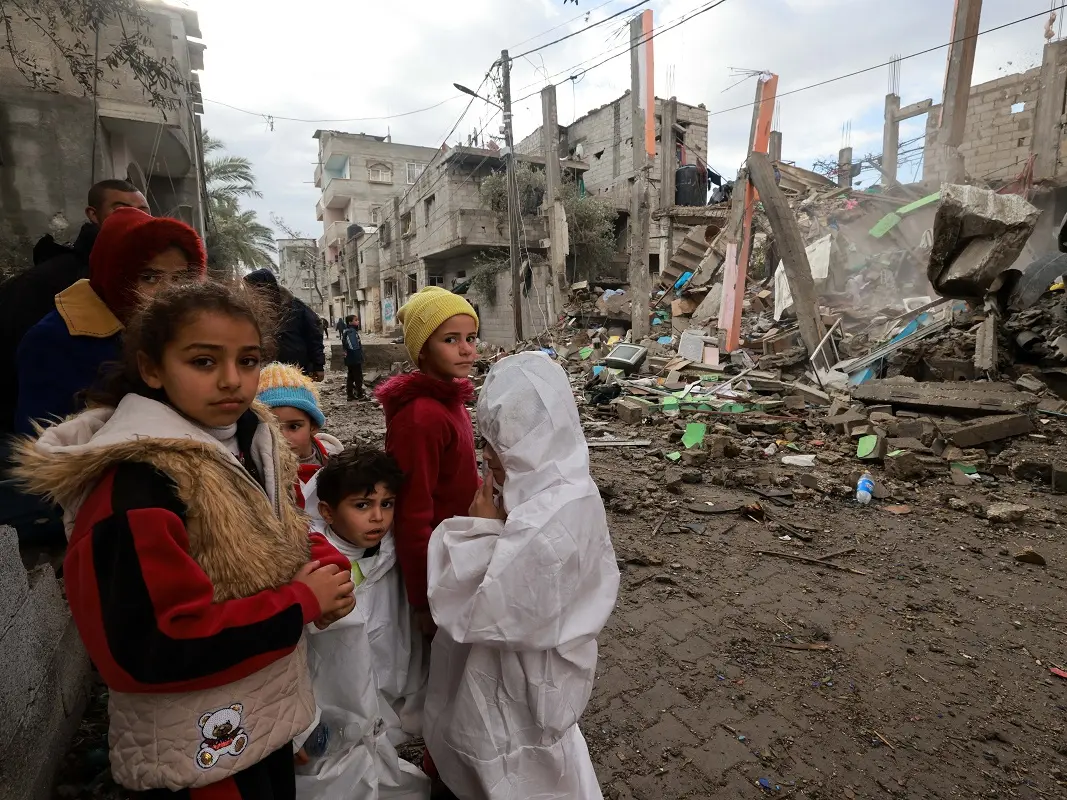
    Israel claims its aim is the dismantling of Hamas. But the devastation it has wrought extends far beyond militant infrastructure. Residential neighborhoods have been flattened. Hospitals, schools, and refugee camps, sanctuaries under the laws of war, have been razed. Basic necessities, clean water, electricity, medical supplies have been deliberately severed. These are not strategic targets. These are the vital organs of human survival.

    History reminds us that collective punishment has never brought peace, only devastation. Between May and October 1966, thousands of Igbos and other Easterners were massacred in Northern Nigeria. These killings were not random eruptions of violence but coordinated pogroms, carried out with military complicity. An estimated 10,000 to 30,000 perished, and over a million fled. The catalyst? A military coup falsely ascribed to an entire ethnic group. When the federal government failed to act, Colonel Odumegwu Ojukwu declared the independence of Biafra, a desperate assertion of dignity against systemic persecution.

    Time and again, whether under emperors, autocrats, or democrats states have reached for collective punishment as a blunt instrument of power. It is a tool of fear, of control. But it is also inherently unjust, for it punishes the blameless, extinguishes hope, and corrodes the moral fabric of society.

    Strategically, it is disastrously short-sighted. Oppression does not pacify, it inflames. Children who grow up amid rubble and funerals do not forget. They inherit grief, and with it, rage. What future can be built upon such soil? What peace can be negotiated with those whose humanity has been discarded?

    Some defenders of this tactic argue that Hamas embeds itself among civilians, leaving Israel no choice but to strike indiscriminately. But this rationale abdicates any moral responsibility. If the inability to distinguish between combatants and non-combatants becomes a license for wholesale slaughter, then the very foundation of humanitarian law collapses.

    And the damage is not confined to bodies. It seeps into the psyche. In Gaza, a generation is coming of age amid trauma, deprivation, and profound disillusionment. They are denied not just physical safety, but the basic recognition of their innocence and humanity. What does this tell the world about the value of Palestinian lives?

    To oppose collective punishment is not to deny a nation’s right to self-defense, it is to demand that defense be bound by ethics, guided by law, and constrained by a reverence for human life. It is a call to conscience to remember that behind every casualty count lies a child, a mother, a future forever lost.

    Peace cannot be born from a graveyard. It must rise from justice, from truth, and from a shared commitment to human dignity. As Gaza smolders under the weight of bombs and broken promises, the world must answer a searing question: Will we continue to tolerate a world where the innocent perish for the crimes of the guilty or will we finally summon the moral courage to say: no more?

    Osmund Agbo is a medical doctor and author. His works include, Black Grit, White Knuckles: The Philosophy of Black Renaissance and a fiction work titled The Velvet Court: Courtesan Chronicles. His latest works, Pray, Let the Shaman Die and Ma’am, I Do Not Come to You for Love, have just been released.

    Osmond Agbo

    Related Posts

    Mr. President Was in Turkey. So Was I, by Osmund Agbo

    January 29, 2026

    Yusuf’s red cap on Tinubu’s red carpet by Azu Ishiekwene 

    January 29, 2026

    Did the New York Times screw the Onitsha screwdriver salesman? By Rudolf Ogoo Okonkwo 

    January 27, 2026
    Editors Picks

    Mr. President Was in Turkey. So Was I, by Osmund Agbo

    January 29, 2026

    Re: Russian embassy’s fuss over Azu’s article on Putin by Richard Akinnola 

    January 29, 2026

    Yusuf’s red cap on Tinubu’s red carpet by Azu Ishiekwene 

    January 29, 2026

    Police detain officers over alleged killing of motorcycle rider in Ebonyi

    January 29, 2026
    Latest Posts
    Columnists

    Mr. President Was in Turkey. So Was I, by Osmund Agbo

    Opinion

    Re: Russian embassy’s fuss over Azu’s article on Putin by Richard Akinnola 

    Azu Ishiekwene

    Yusuf’s red cap on Tinubu’s red carpet by Azu Ishiekwene 

    Subscribe to Updates

    Get the latest news from Ikenga Online.

    Advertisement
    Demo

    IkengaOnline is a publication of the Ikenga Media & Cultural Awareness Initiative (IMCAI), a non-profit organisation with offices in Houston Texas and Abuja.

    We're social. Connect with us:

    Facebook X (Twitter) Instagram YouTube LinkedIn WhatsApp RSS
    • Home
      • Igboezue
      • Hall of Fame
      • Hall of Shame
    • News
      • Other States
      • National
      • International
      • Interviews
      • Personalities
    • Abia
    • Anambra
    • Ebonyi
    • Delta
    • Enugu
    • Imo
    • Rivers
    • Politics
    • Opinion & Editorial
      • Editorial
      • Columnists
        • Osmund Agbo
        • Chido Onumah
        • Uche Ugboajah
        • Hassan Gimba
        • Edwin Madunagu
        • Rudolf Okonkwo
        • Azu Ishiekwene
        • Osita Chidoka
        • Owei Lakemfa
        • Chidi Odinkalu
      • Opinion
    • Special Reports
    • Art & Entertainment
      • Nollywood
      • Music
      • Ikengaonline Literary Series (ILS)
      • Life
      • Travels
    • Sports

    Subscribe to Updates

    Get the latest news from Ikenga Online.

    Facebook X (Twitter) Instagram LinkedIn WhatsApp RSS
    © 2026 Ikenga Online. Ikenga.

    Type above and press Enter to search. Press Esc to cancel.