

Stephen Ukandu, Umuahia
Stakeholders in the education sector have made robust contributions on how the integration of digital skills education into school curriculum would help prevent drug abuse among students.
The stakeholders comprising teachers, civil society organizations (CSOs), the National Drug Law Enforcement Agency (NDLEA), spoke at a workshop in Umuahia, Abia State.
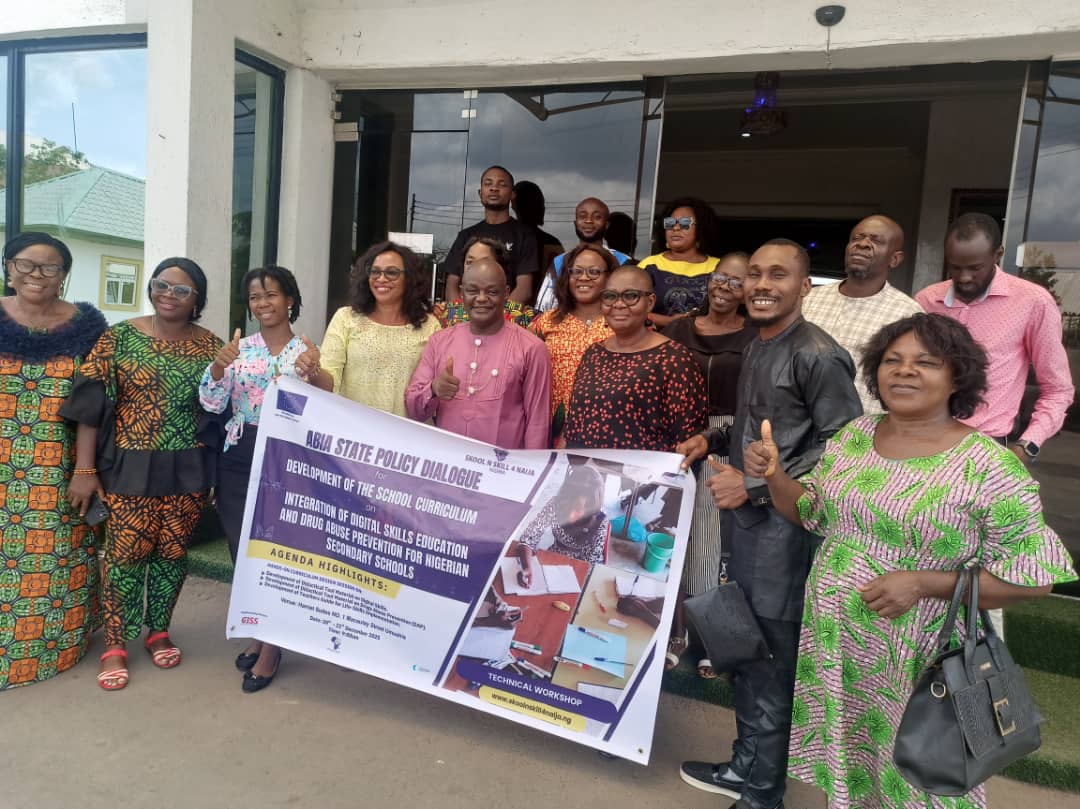
Participants at the workshop organised by Speak Out Africa International in partnership with SKOOL N SKILL 4 NAIJA, and the European Union, decried the menace of drug abuse among secondary school students, and emphasized the urgent need for action.
Delivering a lecture at the workshop, a Superintendent of Narcotics and the Abia State Deputy Commander of NDLEA, Medad Hamzato, exposed various ways drugs and substances could be abused among youths; and how to detect drug addicts.
He blamed production of methamphetamine (METH) otherwise known as ‘nkpurunmiri‘ on greedy pharmacists who have the licence to import the chemical but go behind to sell it to unpatriotic elements who divert it into nkpurunmiri‘ production.
Recall that nkpurunmiri’is one of the latest hard drugs ravaging the Nigerian society.
Namzato also gave tips on how to detect drug addicts.
He also enumerated some of the commonly- abused non-conventional drugs such as deodorants, detergents, gas from pit toilets, lizard excreta, sooth from generating sets, among others; and urged parents and teachers to be on the alert.
Hamzato further advised women to properly dispose of their sanitary pads after menstruation, regretting that of late, some drug addicts, excavate them from wastebins and smoke.
He attributed drug abuse to a number of factors including poor family up-bringing, peer group pressure/influence, as well as availability of some of the non-conventional drugs.
The NLDEA boss cautioned against exposing children to environments where they could come in contact with hard drugs.
He identified poor academic performance, strange and deviant behaviours, as some of the ways to detect students who are into drug abuse.
Hamzato advised parents to keep a close tab on their children and wards, and to occasionally search their school bags for drugs or tools related to drug abuse.
He also encouraged parents not to shy away from bringing any of their children or wards addicted to drugs for rehabilitation instead of hiding them in the house considering the risk they pose to society.
In her opening remark, the Executive Director, Amaclare Connect & Development Initiative, Mrs Loretta Ahuokpeme, who represented Speak Out Africa International, said the main purpose of the state-level dialogue, was to elicit the inputs of relevant stakeholders on how best to implement the project.
She said that the development of a curriculum to integrate digital skills education into school curriculum was already in progress at the national level.
Ahuokpeme said that the outcome of the workshop would be relayed to the centre for a production of a holistic curriculum that would be in the best interest of the public.
One of the participants, Mr Daniel Ezuma, a teacher from Government Technical College Afara Umuahia, thanked the organisers for the opportunity which he noted, opened the eyes of teachers on how to detect students addicted to drugs.
“We are now in a better position to detect drug addicts among our students”, he said, adding that “with the knowledge we gained, we can now help eradicate drug abuse among students.”
Similarly, the Abia State Open Government Partnership co-Chair for non state actors, Mrs Priscilia Ogbonna, thanked the organisers for bringing stakeholders together to brainstorm on ways to combat and prevent drug abuse among students.
