

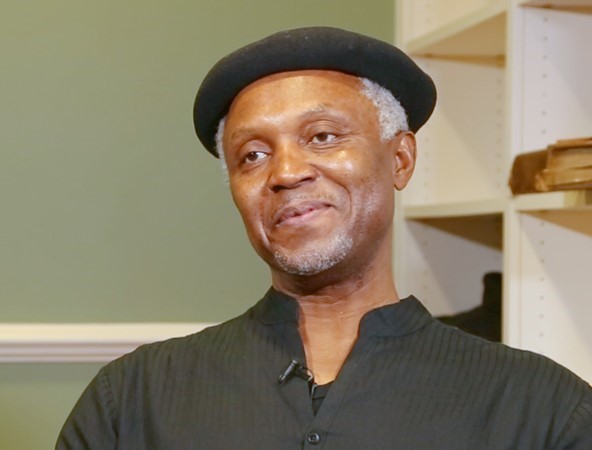
By Okey Ndibe
There’s a charmed, even fated, quality to my relationship with Ngugi wa Thiong’o, the extraordinarily gifted novelist, cerebral intellectual, and intrepid human rights champion who died on May 28, 2025.
Given Ngugi’s stature as a luminary figure in global letters, it’s no surprise that reams and reams have been written about him since the termination of his mortal life. Much of that appreciation has focused on the breadth of his literary corpus, often underscoring the manifold ways in which the late Kenyan writer’s work irrigated not just the field of African literature but, also, global discourse on the literary arts and human rights. There’s no question that, in the coming years, fellow writers and scholars will continue the task of appraising the impact of a man whose common touch, ascetic disposition and unassuming persona often belied the Olympian scope and reach of his oeuvre.
I’ll perchance find occasions, in time, to say a few words on Ngugi’s scholarship, particularly the dimensions of it that most leavened my own creative and intellectual development. For now, however, I wish to bear witness to the drama of my interactions with the man over several decades.
And I might as well start from last things, specifically my fortuitous exchanges with the man I fondly addressed as Mzee or Mwalimu in the last few days of his earthly life.
Ngugi was a man of many passions, but he evinced a particular euphoria for African languages. In our phone conversations, he often requested that I speak a few sentences in my Igbo tongue. He, in turn, addressed me in Gikuyu. While neither of us understood the other’s language, Ngugi was unbothered by our mutual incomprehension. What mattered, for him, was the innate capacity of languages, his and mine, to articulate emotions and convey experiences. The absence of comprehension did not vitiate the exchange; indeed, he was willing to settle for language as a sacramental rite, a profoundly spiritual experience.
When Ngugi rang me the night of May 23, I remarked a familiar ecstatic twinge in his voice. He told me that an ex-student of his at the University of California, Irvine, a Chinese American, had just arrived at the airport in Atlanta (along with two other friends). The three friends, he said, were in a taxi headed to his home to spend the long Memorial Day weekend with him. He disclosed that his former student had lived in Nigeria and spoke Igbo. It was close to midnight, but Ngugi asked that I stay awake. He would call me again once his visitors arrived, because he would be thrilled to hear me speak Igbo with the Chinese American.
The call didn’t come that night, but the next, Saturday, May 24. Ngugi set the phone to video, beamed as he introduced his three young guests, and then asked me to commence a conversation in Igbo with his student. After doing so for a few minutes, much to Ngugi’s delectation, he took over the phone and asked whether I was serious about coming with my wife to visit him in Atlanta. I affirmed the promise.
On Monday, May 26, I had reason to call Ngugi. The reason was a disturbing report I received from a UK-based scholar whom I had introduced to Ngugi because she wished to interview him on his well-known stance that African literature, properly speaking, must be written in African languages. She told me that she had spoken briefly to Ngugi the previous day, remarking that the literary giant came across as too fatigued. Once again, Ngugi switched my call to video. Indeed, his was a shocking portrait of breathless exhaustion. His ex-student sat next to him on a couch, his arm wrapped around the elder writer’s shoulder, as if to steady him.
“How are you doing, Mwalimu?” I asked, smiling to conceal my concern.
Ngugi motioned to his throat, silently gesturing that he was too enervated to speak. Then he waved to his guests, indicating that I should speak with them.
“Professor is very weak,” the lone female among the guests said to me. “But his strength will come back, and he will speak to you.”
As she spoke, Ngugi interjected: “Tell Okey that I’m okay.”
We all guffawed at the familiar joke: Ngugi was fond of making puns out of my given name. I told him I would check up on him again soon.
Two days later came the news—in a barrage of texts and phone calls from friends and relatives—that the literary sage had exited from the mortal realm.
I was stunned, confused, beset by grief. I needed more than a week to regain composure, and to commence contemplation of my uncommon fortune in counting Mwalimu Ngugi as a mentor, inspirer and friend.
He was a prominent member of a cohort of African writers—Achebe, Wole Soyinka, Flora Nwapa, Ferdinand Oyono, Robert Wellesley Cole, and Peter Abrahams among them—who fostered my generation’s thirst for literary works steeped in recognizable African traditions. I was a secondary school pupil when I first read Ngugi’s Weep Not, Child and The River Between. In addition to evoking Kenya’s enchanting pastoral locale, these early novels became exemplars of the powerful ways in which fiction can both carry the imprints of history and refashion our understanding of historical events.
Some writers have this altogether mysterious flair for branding their works with their soul. To read such writers is to undergo a kind of spiritual transport, a feeling of enhanced familiarity with the writer. Ngugi had that bewitching effect on me, so that my experience of reading accrued a powerful sense of nearness and familiarity, as if he were, sitting across from me, telling me a story.
When I finally met him in person at the University of Calabar—where, as a young journalist, I covered an international literary conference that he headlined—I came away with the impression that I had known him, in person, much earlier: since my secondary school days.
A few years later, Ngugi and I would meet several times at different locations in the United States of America. Fate seemed determined to draw us closer, to cement a relationship that began when I read him and burgeoned with personal contact. That relationship has meant the world to me.
In fact, I can’t think of my own fortuitous path to becoming a creative writer without crediting Ngugi’s role as an incubator. In my memoir, Never Look an American in the Eye, I write about telling a lie that ultimately inaugurated my career as a novelist. Here’s an abridged version of that story. I had relocated to the United States at the end of 1988 to serve as founding editor of an international magazine co-founded by the great novelist, Chinua Achebe. After floundering for less than two years, the cash-starved publication ceased production altogether. I was close to despair when, one day, I ran into one of the defunct magazine’s columnists, the African American writer, John Edgar Wideman. After a brief conversation about the ill-fated publication and my next plans—of which there was nothing—Wideman said, “You must be writing a novel, right?” I wasn’t, but I was so swept up by his confident air that I could not help lying. Whereupon Wideman asked me to bring him 15 to 20 pages of my manuscript, indicating that he would explore the possibility of getting me into the graduate program in creative writing at the University of Massachusetts where he was a professor.
I retired to my apartment, and with great trepidation began to scribble a story. Over a long weekend, I produced more than twenty pages which I dropped off in Wideman’s mailbox. Two days later, he called to give me a most heartening response. He described the manuscript as fascinating. I was unbelievably flattered when he said my sample had echoes of Ngugi’s fictive style.
Years later, when I related that anecdote to Ngugi, he roared with his signature laughter. Then he told me that he, too, had started off as a writer by telling a similar lie when he was a student at Makerere. One day, he had chanced upon the editor of the university’s student literary journal. He very much wanted to talk to the said editor, but the man was something of a star on campus. Odds were that the guy would have no time for him. Ngugi came up with a lying strategy. Steeling himself, he walked up to the editor and declared that he’d written a short story which he wanted to submit to the journal. Despite his feigned assurance, he half-expected the man to brush him off. Instead, the editor encouraged him to turn in the piece. Back in his room, Ngugi devoted some feverish hours to composing what became his first short story!
It beggars belief that Ngugi’s storied career as one of the true greats of contemporary literature—a harvest that includes fiction, drama, poetry, memoir, theory—began with such impulsivity and serendipity.
To know Ngugi was to marvel at his unyielding youthfulness of spirit. He often joked that his ideal girlfriend would be somebody aged around 100 years—so that the woman would address him as “my young man.” Some years ago, after his presentation at City College in New York City, he, Cheryl Sterling (then a professor at City College) and I were walking to a restaurant for dinner when we passed a bar from which music blared. Ngugi stopped right outside the bar and showcased a few dance moves.
I have known a few writers and intellectuals to whom the word generous could be applied in justice, but Ngugi was in a class all his own. He was always solicitous of younger writers’ wellbeing and professional advancement. When he held you in conversation, you were in no doubt that he really cared, that he truly listened, that he was interested in hearing about your life, personal and career.
Ngugi was the consummate encourager. He was persistent in entreating me to write in Igbo. Once, he called me while I was in Nigeria. I told him I was in a small gathering with relatives. “Fine, put the phone on speaker,” he directed. Then he told everybody there to join him in convincing me to start using Igbo for my writing. “The Igbo language needs its Shakespeare,” he’d say. “Why don’t you take up the challenge?”
I love to teach Ngugi’s books, especially that favorite of many readers, A Grain of Wheat. Last April, the students in my graduate seminar were wrestling with a question in that finely wrought work of fiction. Right there and then, I rang Ngugi’s number. Imagine my students’ thrill on hearing the author’s voice, warm, largehearted and ebullient, as he joined the conversation over his masterpiece.
Several of my students described the experience as special. Even so, their treat was but a smidgen of the fortune I enjoyed in interacting with Ngugi—teacher extraordinaire, chronicler of sagas, revolutionary spirit, dream weaver, young spirit—over the years. The earth has claimed Mzee Ngugi, but—thanks to the staying power of his work and the imperishable legacy he bequeathed to us—his voice will yet resound.
Professor Okey Ndibe is currently the Shearing Fellow at the Black Mountain Institute at the University of Nevada, Las Vegas.
