

Our Reporter, Abuja
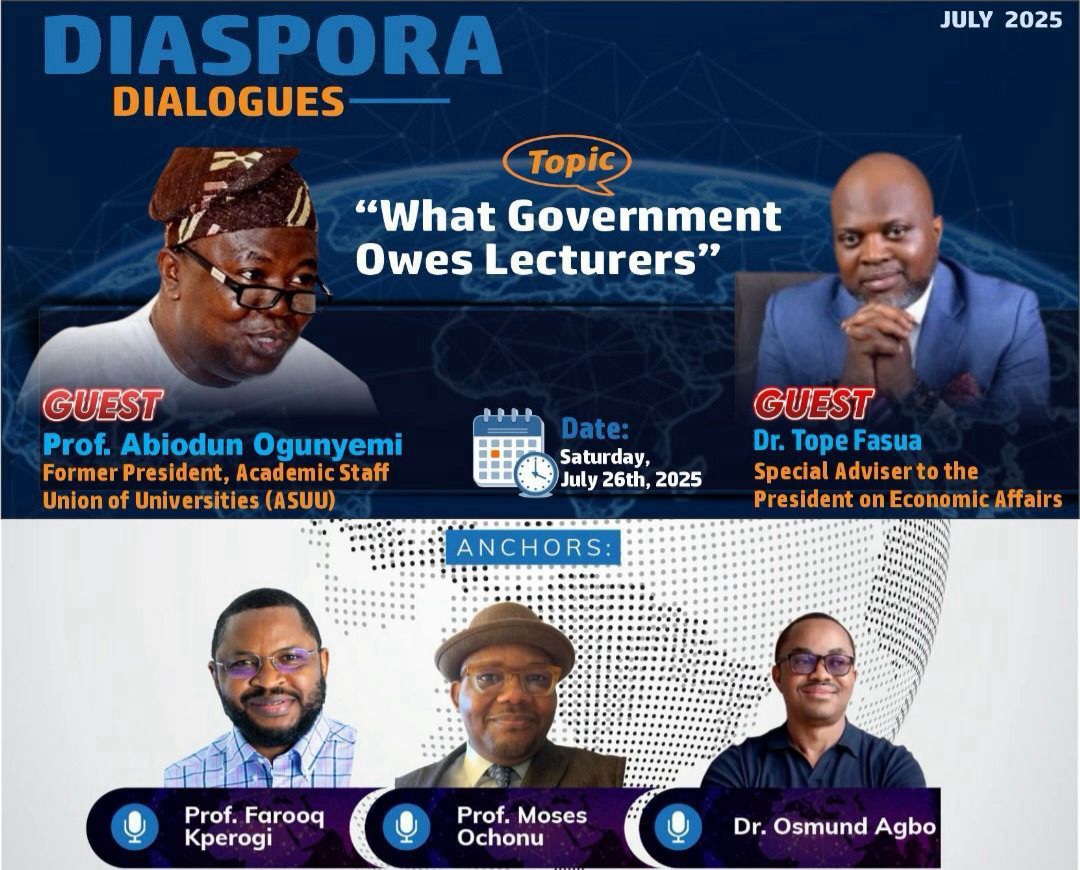
Conversations around the plight of Nigerian university lecturers, the country’s chronic underfunding of higher education, eroded academic standards, and the growing disillusionment among scholars were ignited at the July edition of Diaspora Dialogues, hosted by renowned diaspora intellectuals—Farooq Kperogi, Moses Ochonu, and Osmund Agbo.
Themed, “What Government Owes Lecturers,” the programme featured former Academic Staff Union of Universities (ASUU) President, Professor Abiodun Ogunyemi, and Special Adviser on Economic Affairs to President Bola Tinubu, Dr. Tope Fasua.
The discussion, triggered by Farooq Kperogi’s viral column “Problem of Paying Peanuts to Professors,” dissected the root causes of Nigeria’s deteriorating university system. Central to the debate was the alarmingly low remuneration of lecturers, described as among the poorest in Africa, and the broader governance failures stifling Nigeria’s educational advancement.
Professors as Paupers
Kperogi lamented that Nigerian professors are “treated like paupers,” despite their critical role in shaping national development.
Interestingly, all the panelists agreed that current lecturer salaries are not only uncompetitive but also dehumanizing—pushing some into multiple jobs or small-scale trading just to survive.
But, Dr. Fasua, while acknowledging the financial hardship, stressed the need for academics to maintain professional integrity and avoid moonlighting that could undermine teaching and research standards. He also called for greater involvement of intellectuals in public service, urging critics of government to channel their expertise into policymaking.
The ASUU-Government Deadlock
In his contributions, Professor Ogunyemi recounted ASUU’s long-standing demands, referencing the 1992 and 2009 agreements that successive governments have failed to honour. He argued that strikes remain a necessary evil in the absence of genuine engagement by authorities.
However, ASUU was called to rethink its tactics and improve its public relations strategy.
Moses Ochonu noted that the union’s frequent industrial actions have lost public sympathy and yielded diminishing returns.
“There must be innovative forms of advocacy beyond strikes,” he said, suggesting performance benchmarks and accountability systems for lecturers in return for better pay.
