

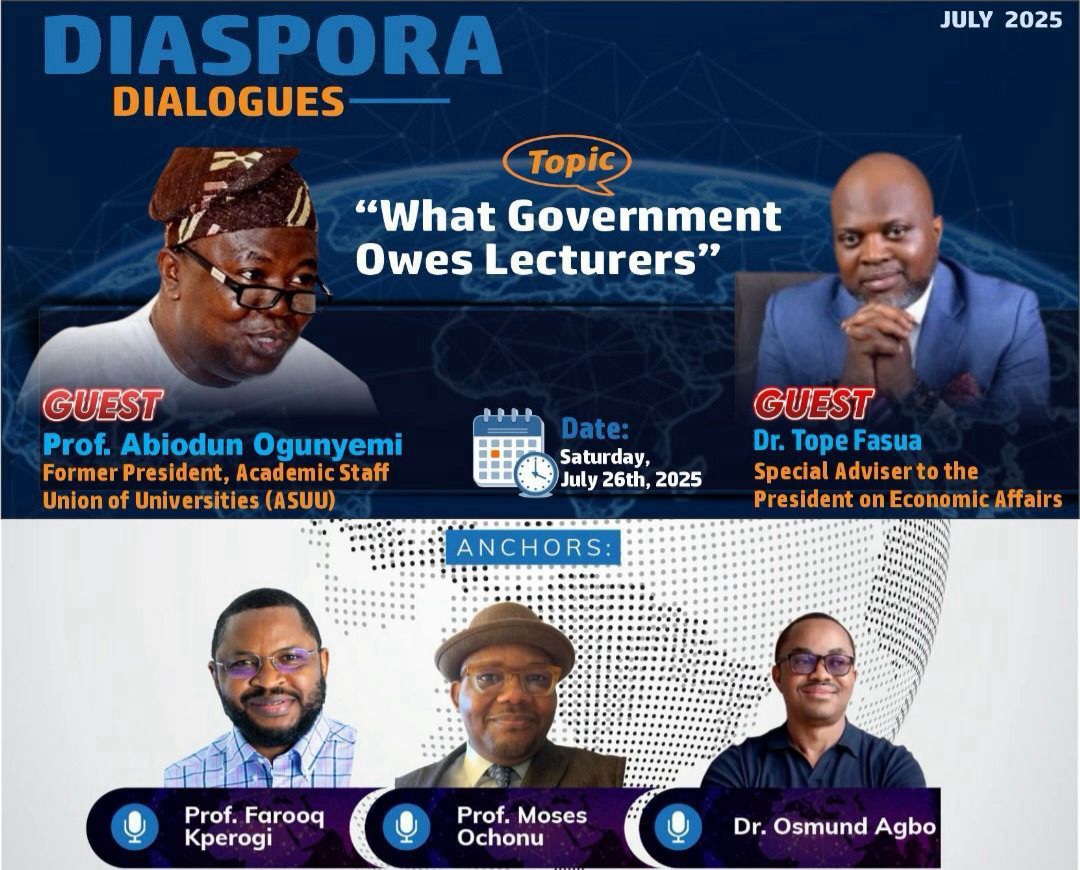
Our Reporter, Abuja
Dr Osmund Agbo has raised critical questions about institutional failure, academic misconduct, and the continuing brain drain of Nigerian talent abroad.
Agbo made these observations during the July edition of the Diaspora Dialogues, which he co-anchored with two other intellectuals, Farooq Kperogi and Moses Ochonu with the theme, “What Government Owes Lecturers.”
Dr. Agbo, who is also co-publisher of Ikengaonline in criticizing Nigeria’s leadership, accused successive governments of systematically weakening institutions and failing to address persistent national issues such as widespread poverty, underfunded education, and lack of accountability.
“Our problem is leadership. It is not just about changing faces in government but about fundamentally changing systems that no longer serve the people. Without that, we will keep recycling failure,” he stated.
Dr. Agbo also called for a comprehensive systemic overhaul, asserting that piecemeal reforms would be insufficient to redirect Nigeria’s current trajectory.
Responding to the criticism, economist and Special Adviser to President Bola Ahmed Tinubu on Economic Affairs, Dr. Tope Fasua, who was one of the guests speakers, while acknowledging governance failures, argued that Nigerian intellectuals bear a shared responsibility in driving change, not just by criticizing from the sidelines but by engaging directly in public service and policymaking.
“We cannot endlessly criticize the government while refusing to participate,” Fasua noted.
“Responsibility lies with all of us—including those who have the means and the knowledge—to offer solutions from within.”
The Dialogues also examined challenges within Nigeria’s university system, especially misconduct among lecturers and the urgent need for cultural and structural reforms.
Participants were unanimous in condemning sexual harassment by professors, with strong calls for the introduction of strict codes of conduct. One proposal that gained wide support was the creation of a student evaluation system for lecturers, modeled after practices in Canada and the United States.
“Accountability in the classroom is non-negotiable,” said Professor Moses Ochonu, a co-anchor.
“Lecturers should be evaluated regularly by students, and those evaluations should influence promotions and tenure decisions,” he said.
There was also a consensus on the need to modernize university curricula, with several contributors suggesting that Nigerian universities must embrace vocational and practical education.
In this regard, Dr. Fasua proposed requiring lecturers to spend time in relevant industries to gain real-world experience, particularly in fields being transformed by artificial intelligence.
While advocating reform, Fasua also was against painting all academics with the same brush. He defended a professor who supplements his income by selling vegetables, arguing that financial hardship should not be conflated with professional misconduct.
Speaking in the same vein, another guest speaker, Professor Abiodun Ogunyemi, warned against narratives that depict lecturers as uniformly corrupt or unprofessional.
“We have systems and procedures to deal with misconduct. Let’s enforce those rather than amplify unverified stories,” Abiodun said.
Brain drain crisis and call for investment
The Diaspora Dialogues also discussed the ongoing exodus of Nigerian-trained academics and healthcare professionals.
In his contribution, a participant, Babatunde, highlighted the existential threat this poses to the sustainability of Nigerian universities.
“We are training people only to lose them to countries with better infrastructure and funding. It’s unsustainable,” he said.
Responding to the problem, Dr. Fasua proposed integrating universities into national development projects, such as rural electrification, to make academic work more impactful and connected to real-world challenges.
But another participant, Adewale, underscored the government’s failure to adequately fund higher education, lamenting the deplorable state of infrastructure and research opportunities compared to international standards.
While, contributing Professor Bashir, a nanotechnology and medical physics expert, emphasized that Nigeria must invest more robustly in its own research ecosystem. He proposed redirecting funds currently used to train academics abroad toward building local research capacity, calling for specific metrics to track research productivity and funding utilization.
