

By Sam Amadi
What is the relationship between changing the name of Charley Boy Bus Stop and falsely accusing Mr. Peter Obi of working for Abacha and therefore being tarnished? The answer is simple: they are Igbo.
Let us make it clear. Last week, a local government in Lagos State changed the name of a famous bus stop in Gbagada, Lagos, from Charley Boy to Olamide Baddo. Charley Boy is the showbiz maestro known for his fierce social criticism and artistic excellence. He was once the “king of the boys” in Lagos before relocating to Abuja. He is an icon who inspired many young people and helped them find direction in art, entertainment, and social activism.
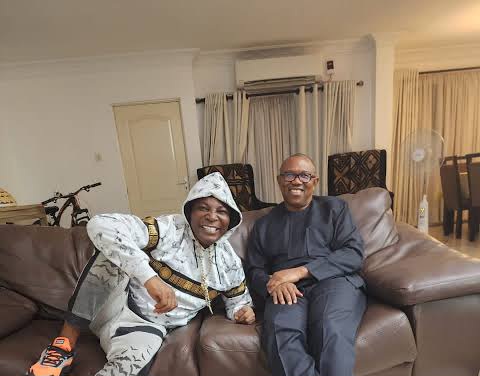
But in 2023, he crossed the Rubicon. He supported Mr. Peter Obi, an Igbo politician who won the hearts of Nigerian youths and became the unofficial president of those seeking radical change in the status quo. Obi did the unexpected—and perhaps, the unwanted. He defeated the Asiwaju of Lagos in Lagos State, his political fiefdom. The audacity of both Igbo and Yoruba supporters—many of them intelligent and accomplished—drew the ire of those who guard Nigeria’s political and social order. Sooner or later, someone was going to pay the price.
It didn’t take long. The casualties of that audacity began to surface after the February 2023 elections. First was a young man who possessed every virtue and competence to become the Governor of Lagos State. Unfortunately, he bore a fatal political flaw—his mother is Igbo. To halt his momentum, he was branded “Chinedu.” Regardless of his qualifications, he was deemed unfit to govern. Then came the governorship election itself: Igbos—and anyone who merely looked “Igbo” (whatever that means)—were barred from voting. Ironically, even some full-blooded Yorubas were stopped from voting simply because they “looked” Igbo.
Nigeria has a remarkable gift: it forgets its horrors and bad history with troubling ease. It also fails to see what it ought to see. The industrial-scale disenfranchisement of Igbos did not merit attention from Nigerian institutions or political leadership. Even leading Igbo intellectuals and political leaders played dead-brain. Of course, if you speak up against the ill-treatment of Igbos, you risk being “cancelled” as an intellectual or political figure in Nigeria. Many prominent Igbos have internalized this psychological warfare—they see all evil, but say nothing (and yes, I run the risk of being cancelled for saying this aloud).
Today, someone is tagging Mr. Peter Obi an Abacha supporter—and therefore, tainted. Are you kidding me? They call him an Abacha supporter because, as a trader, he joined others to plead for the release of their seized goods and was found competent enough to help decongest the ports? Meanwhile, the man who allegedly moved Nigerian money for Abacha and negotiated the return of the loot is now the Minister of Budget and National Planning under Tinubu. Nigeria has washed him clean and embraced him. But the one who went to lodge a complaint about human rights violations and was asked to help address the issue is the one to remain forever stained?
Buhari has just been canonized as a national legend. He was massively voted for and supported by the same leading Southwest intellectuals and politicians who were associates of MKO Abiola—the man whose electoral victory Abacha annulled and who was imprisoned and allegedly killed. Even Abiola’s children and closest friends have now made peace with Abacha’s memory and collected national honours from the same state. But Peter Obi must be the scapegoat? This is an outrageous sense of justice.
As we say in Nigeria: people know what they are doing.
Better still, as critical scholar Max Horkheimer of the Frankfurt School would put it: the Nigerian bourgeoisie uses ideology not out of ignorance, but out of cunning—to protect strategic interests. They know the truth. They just don’t care.
Mr. Charley Boy now joins the growing list of casualties. He has refused to tone down his criticism of the ruling party and his open support for Mr. Peter Obi. The price? The erasure of a well-earned monument. Charley Boy, however, has taken it in his stride. He knows his legacy lives in the hearts of men and women of goodwill—and in the soul of time. Still, we must not forget what this act symbolizes. Beyond intolerance, it serves as a reminder of what Nigerian politics is unofficially all about.
Chinua Achebe once described it as “a national consensus”—a tacit agreement to constrain and contain the Igbos. In my 2011 lecture at the U.S. Holocaust Memorial Museum, I argued that the goal of the Nigerian Civil War was not to exterminate Igbos or drive them out of Nigeria. No—it was to constrain and contain them. That’s why, after Biafra’s defeat, Nigeria pulled back. The deed was done. That’s also why the slogan “no victor, no vanquished” was never earnestly pursued or implemented.
Saying Nigeria has an Igbo problem is one of the painful truths the country must embrace to achieve the greatness it dreams of. Of course, it’s never easy to embrace a painful surgery. But healing cannot begin until the truth is acknowledged. Having an “Igbo problem” does not mean that ordinary Nigerians hate their Igbo neighbors. Not at all. In fact, many Nigerians admire and love their Igbo compatriots, often treating them like family. We are a family in Nigeria—but a troubled one, with a difficult past.
Like every troubled family, healing comes only with sincere and courageous leadership. That’s what Peter Obi’s presidency might have offered. But the hope endures.
The purpose of this reflection is to encourage Nigerians to understand their complex relationship with their brothers and sisters from the Southeast. They love them, no doubt. But there is a national narrative and historical memory that they must overcome to express that love fully.
To the Igbos: you must choose whether to be fully and equally Nigerian, or moderately and unequally Nigerian. I believe you should choose to be fully Nigerian. You must work with fellow citizens to build a better Nigeria that benefits everyone—including yourselves. You must continue to aspire to the full measure of what Nigeria offers. Aspire to be President. Aspire to be Governor. Aspire to be legislator—anywhere in Nigeria. And leave it to the good sense of your compatriots to trust you to lead.
And if they do not trust you yet, do not relent. Continue to aspire.
Because, as our people say: “Onye ajuru-aju, a naghị aju onwe ya.”
He whom others reject must never reject himself.
Dr Sam Amadi is Executive Director, Abuja School of Social and Political Thoughts.
