

Our Reporter, Abuja
The Independent National Electoral Commission (INEC) has announced that more than 1.3 million Nigerians pre-registered for voter cards in just one week of the Continuous Voter Registration (CVR) exercise.
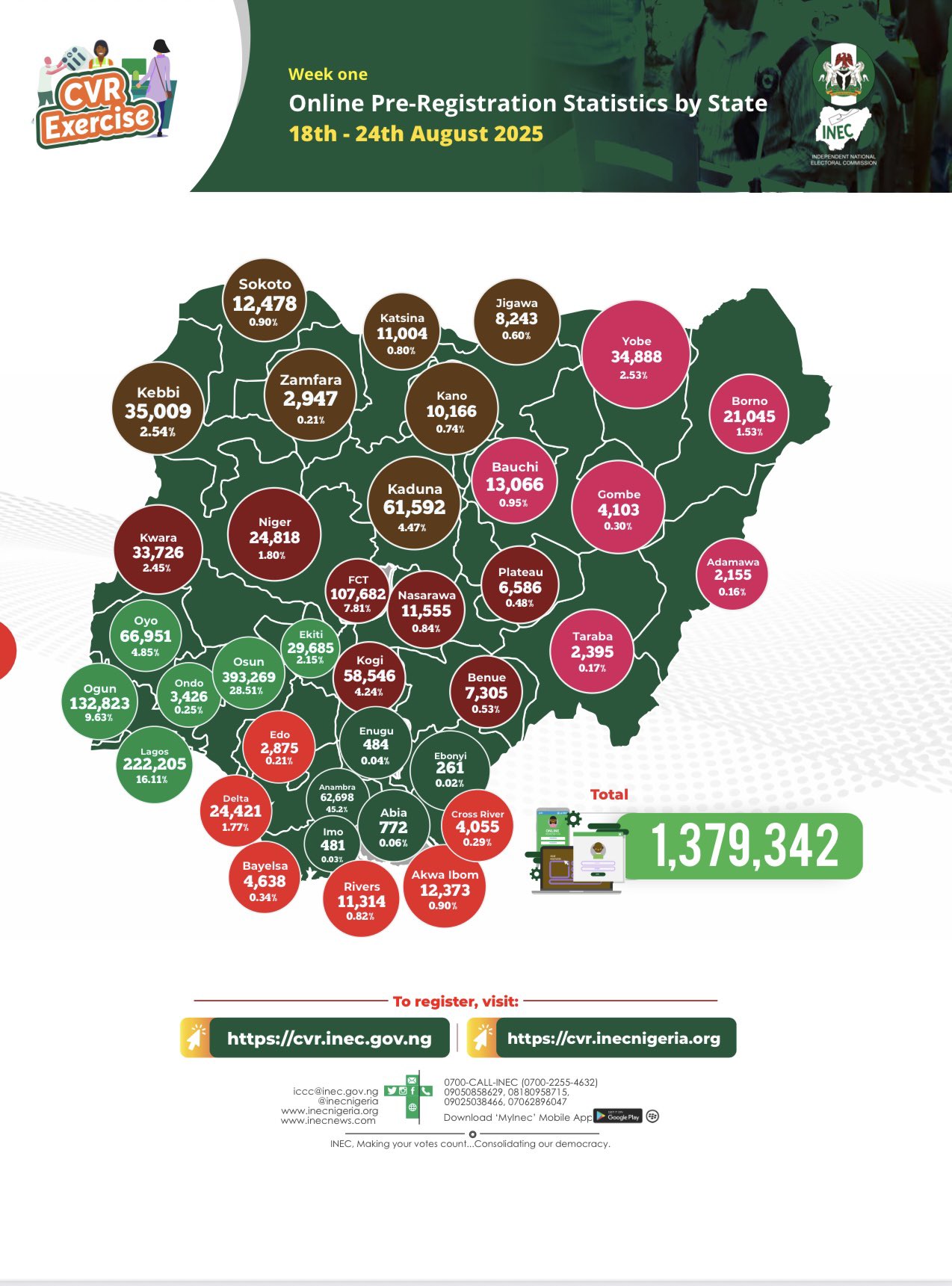
According to INEC’s first weekly update, 1,379,342 citizens signed up online between August 18 and 24, 2025. The online phase preceded the in-person registration, which commenced on Monday, August 25, across 811 state and local government offices nationwide.
While the figures point to a strong national turnout, stark regional disparities—particularly the poor showing in the South-East—have raised fresh concerns about inclusivity and preparedness ahead of the 2027 elections.
Youth Lead the Charge
INEC’s data show that 62.37% of registrants were youths aged 18 to 34, while women slightly outnumbered men at 52.04% to 47.96%. Students accounted for 27.15% of registrations, and 1.96% were persons with disabilities.
National Commissioner Sam Olumekun described the surge as “a clear demonstration of Nigerians’ commitment to democracy,” urging eligible citizens to complete the process before the August 30, 2026 deadline.
South-West Dominates, South-East Trails
The South-West zone topped the charts with 848,359 registrations (61.5%), led by Osun (393,269), Lagos (222,205), and Ogun (132,823). The North-Central followed with 250,218 (18.1%), driven largely by the Federal Capital Territory’s 107,682 registrants.
By contrast, the South-East recorded only 1,998 registrations (0.14%). INEC attributed part of the low turnout to the exclusion of Anambra, which is conducting a separate voter registration exercise ahead of its 2025 governorship election. Other states in the region—such as Ebonyi (261) and Abia (772)—also posted notably low figures.
Elsewhere, the North-West logged 141,439 (10.26%), the North-East 77,652 (5.63%), and the South-South 59,676 (4.33%).
Analysts React
Experts say the disparity may reflect differences in internet penetration, voter awareness, and political mobilization.
“The South-West’s dominance could be linked to its urban infrastructure and strong political mobilization, while the South-East’s numbers expose clear gaps in outreach,” said Dr. Amina Bello, political analyst at the University of Lagos.
Meanwhile, many fear that even with the in-person registration, which started on Monday, the numbers in the South-East may not significantly improve because of fear of insecurity in the region, lack of proper mobilization by politicians and general citizen apathy.
Summary Table
| Geopolitical Zone | Total Pre-Registrations | Percentage of Total |
| North Central | 250,218 | 18.14% |
| North East | 77,652 | 5.63% |
| North West | 141,439 | 10.26% |
| South East | 1,998 | 0.14% |
| South South | 59,676 | 4.33% |
| South West | 848,359 | 61.50% |
| Total | 1,379,342 | 100% |
