

Our Reporter, New York
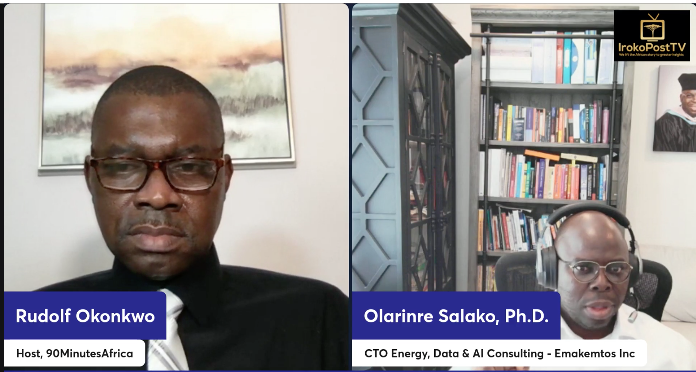
US-based energy expert and consultant Dr. Olarinre Salako has stated that Nigeria’s President Bola Ahmed Tinubu is primarily focused on increasing revenue and does not consider the impact of his policies on the livelihoods of Nigerians.
He made the remarks during an exclusive interview with Rudolf Okonkwo on 90MinutesAfrica.
The doctoral degree holder from Heriot-Watt University narrated how Bola Tinubu led a protest against subsidy removal and petrol tax as an opposition politician because he believed that the policies would inflict more hardship on Nigerians. Dr. Salako therefore argued that the president is not unaware of the dislocating effects these policies, which he is now aggressively pushing, will have on the people.
“Tinubu was well aware of the possible impacts of petrol subsidy removal, but he didn’t care,” the data analyst said.
“He just wanted the money, perhaps to do the Lagos–Calabar coastal highway or any other thing that he wanted to have as his signature project. But poor Nigerians are suffering. More Nigerians are being put into poverty. The income of the middle class has been eroded. So something tangible has to be done to salvage the situation.”
Salako, who holds several patents in the United States, argued that energy subsidies are a vital component of government policies meant to support the livelihood of citizens, even in the most liberal capitalist nations. He pointed out that the tragedy of the Nigerian situation is that people enter government without giving deep thought to the issues confronting the country. He further criticized the hasty removal of petrol subsidy and floating of the naira by President Tinubu – two policies he said threw the nation’s economy into chaos because they were not well thought out.
“Thirty million Nigerians were thrown into poverty within one year of the Tinubu presidency because of his two major policies of floating the naira and subsidy removal. A government should not do things that will make people poorer. They should do things systematically by considering the possible impacts of what they want to do and how to minimize them,” Dr. Salako said.
Speaking on the reported conditional cash transfer of 330 million naira to seventy million households by the Tinubu administration, the social commentator described the move as “another form of government’s misplaced priorities, poor planning, or an outright stealing of public resources.”
He also wondered how the government identified these households in a country that lacks any comprehensive database of citizens.
The Chief Technology Officer at Emakemtos USA Inc. also called on the government to do the right things so they can attract competent Nigerians with technical know-how from all over the world to help in the development of workable systems in the country.
“There are several Nigerians around the world who can help to manage systems in the country, but there has to be political will to really do things appropriately,” Salako said.
He stated that the country does not have a problem of a lack of knowledgeable people, as technically competent Nigerians are all over the world making exploits.
“Technical know-how is not our problem because there are people who have knowledge who can help our country that are out there helping other countries. But if there is no political will to do the right things, the situation will not change.
“Of the four people in charge of our energy-related ministries in Nigeria, one is a biologist, two are accountants, and one is a lawyer. Obviously, none of them has the technical capacity, but if they have the political will, they can hire competent technical people to assist them.
“For instance, I don’t understand why our refineries are not working. There are refineries around the world that are much older than ours, and they are still working. Some are even producing up to 90% of installed capacity. But ours are not producing despite the amount of money that has been sunk into their maintenance. Some people have said that they should sell it, but I don’t think they should be sold. I believe that they should work. If we can’t get refineries to work and help our country, then why do we even have a country?
“All the other OPEC countries have refineries that are working except Nigeria. The worst we can do is to give the refineries to an operator and let the government hold shares in it. If we get the refineries to work, we can utilize them to moderate the market and curb the greed of marketers in the interest of the Nigerian people. Even in the most liberal capitalist nations, the government still regulates the market to protect the interests of the citizens,” the energy expert said.
