

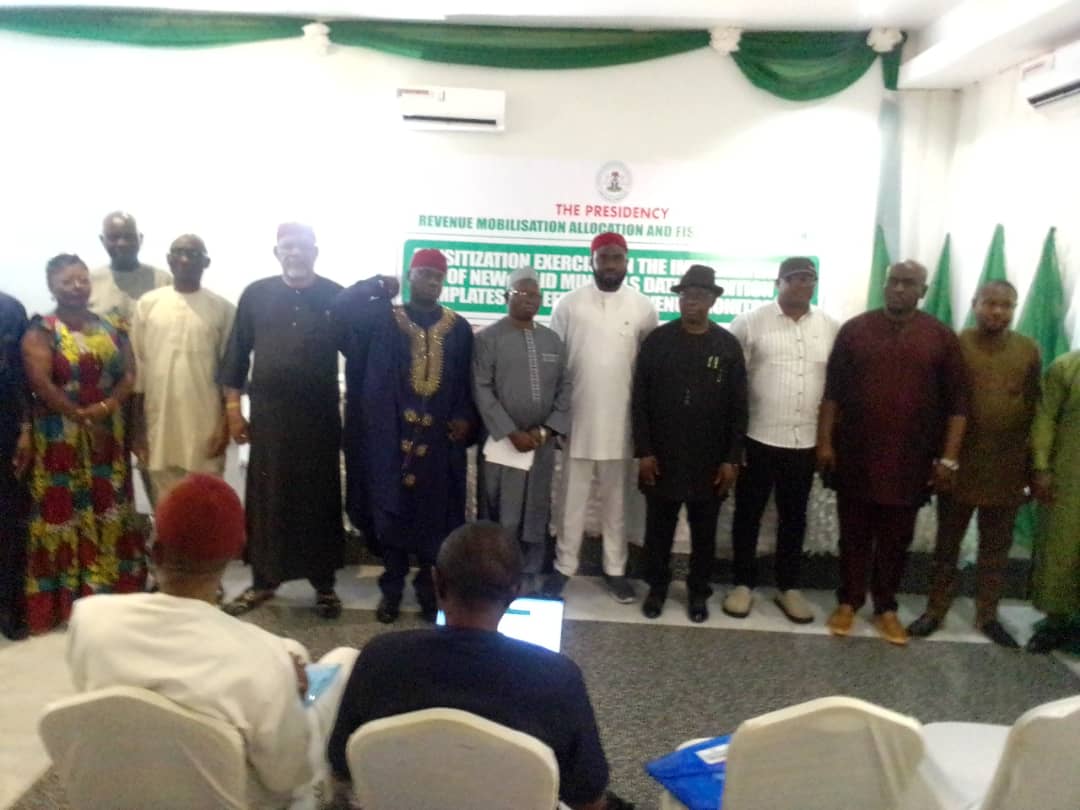
Ben Ezechime, Enugu
The Federal Government, through the Revenue Mobilisation Allocation and Fiscal Commission (RMAFC), says it is developing implementable data rendition templates aimed at ensuring accuracy and plugging revenue leakages in Nigeria’s solid minerals sector.
RMAFC Chairman, Dr. Mohammed Shehu, disclosed this during a Sensitisation Workshop for the South-East Zone on the Implementation of New Solid Minerals Data Rendition Templates for Effective Revenue Monitoring, held in Enugu.
Shehu, represented by the Federal Commissioner for the Federal Capital Territory in the Commission, Amb. Ayuba Ngbako, said the initiative was timely, given the economic challenges currently facing the country.
He noted that the need to diversify Nigeria’s revenue sources had become imperative due to the nation’s over-dependence on hydrocarbons, which are often affected by fluctuations in the international oil market.
According to him, “The present administration of President Bola Tinubu has prioritised harnessing revenue potentials from other key sectors — including solid minerals, agriculture, tourism, manufacturing, and the blue economy — to broaden the country’s revenue base.”
The RMAFC chairman explained that one of the Commission’s core mandates is to monitor accruals into and disbursements from the Federation Account, and that the new data templates are part of efforts to enhance transparency and efficiency in revenue generation.
He recalled that the Commission had in 2016 (Phase I) and 2022 (Phase II) conducted nationwide solid mineral revenue monitoring exercises, which led to significant improvements in revenue from the mining sector.
“I am delighted to state that these efforts have considerably improved revenue generation from the sector,” Shehu added.
In his remarks, Chief Ozo Obumneme, a Federal Commissioner and member of RMAFC’s Solid Minerals Monitoring Committee, said the sensitisation workshop aimed to bridge existing gaps in the rendition of timely and accurate revenue data across states.
He stressed the need for uniform data templates to eliminate discrepancies in figures submitted by state governments and the Ministry of Solid Minerals Development, ensuring credible, comparable, and error-free reporting.
Also speaking, Mr. Chidi Onyia, Commissioner for Solid Minerals in Ebonyi State, called for stronger collaboration between RMAFC, the Federal Ministry of Solid Minerals Development, and state governments to curb illegal mining and associated revenue losses.
Onyia lamented that despite Nigeria’s vast mineral endowments, the sector had yet to receive adequate attention or achieve its full revenue potential.
“I commend the RMAFC for organising this sensitisation and call for inclusive data templates that will ensure the minerals we are blessed with truly work for our collective prosperity,” he said.
Similarly, the President of the Miners Association of Nigeria (MAN), Chief Dele Ayanleke, represented by Mr. Kirian Ananti, commended RMAFC for engaging all stakeholders to ensure uniform understanding and effective implementation of the new templates.
He urged the Commission and state ministries to assist MAN in registering all miners and mapping their operational sites to improve regulation and accountability.
In his address, Chief Enyinna Ogbonna, Enugu State Commissioner for Energy and Mineral Resources, described the sensitisation as a reflection of the collective resolve to enhance data integrity, transparency, and accountability in managing Nigeria’s mineral wealth.
“This initiative aligns perfectly with our drive to reposition the solid minerals sector as a key contributor to Enugu’s internally generated revenue and our broader economic diversification agenda,” Ogbonna said.
He noted that Enugu remains richly endowed with coal and other minerals capable of supporting the state’s development and contributing significantly to national growth.
Ogbonna assured that Enugu State would adopt the new templates once approved by stakeholders to secure revenues and support long-term development.
The highlight of the event was the presentation of the draft New Solid Minerals Data Rendition Templates, followed by an interactive session where stakeholders made contributions and raised questions for further clarification.
