

Stephen Ukandu, Umuahia
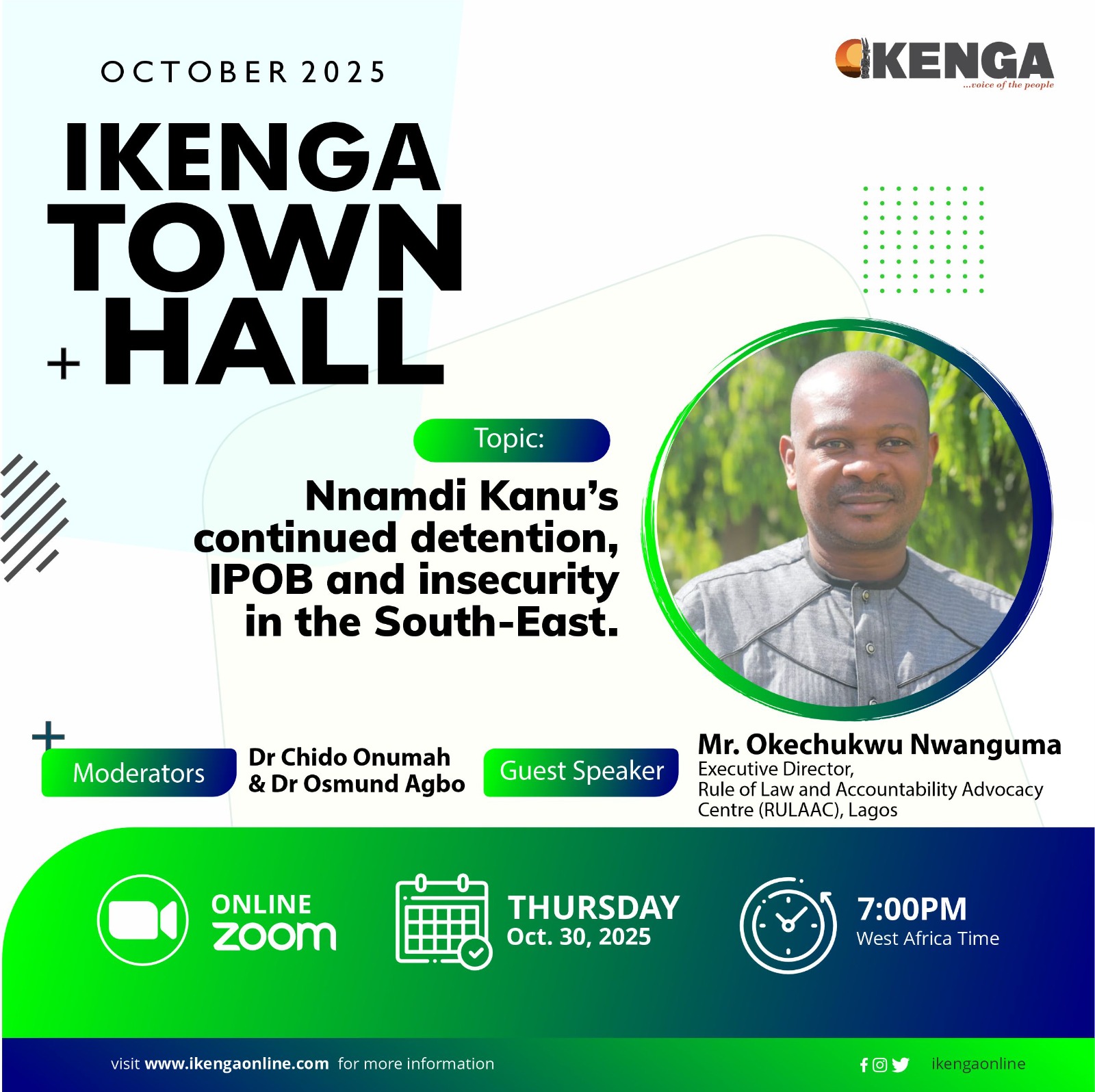
The Executive Director of Rule of Law Accountability and Advocacy Centre (RULAAC), Mr. Okechukwu Nwanguma, has called for the immediate release of the detained leader of the Indigenous People of Biafra (IPOB), Mazi Nnamdi Kanu, describing it as “a necessary step towards national healing.”
Speaking at the Ikengaonline town hall meeting on Thursday, Nwanguma argued that insecurity in the South-East was multifaceted and largely a product of state repression, not IPOB activities as often claimed.
“What I would consider the path towards peace is Kanu’s immediate release. It is not a concession but a necessary step towards national healing,” he said.
According to him, freeing Kanu would remove “a major rallying point exploited by violent elements,” rebuild trust between the government and citizens of the South-East, and reaffirm Nigeria’s commitment to the rule of law.
“Releasing Nnamdi Kanu will not weaken the Nigerian state; it will strengthen it. Peace cannot be achieved through coercion. Justice is the foundation of peace, and injustice divides nations,” he stated.
Nwanguma, who admitted he had previously criticized Kanu’s “extreme and divisive rhetoric,” stressed that his prolonged detention despite multiple court orders undermines Nigeria’s democracy.
“The issue today is whether Nigeria will continue to ignore court orders and deepen alienation, or choose justice, dialogue, and inclusion as the path to peace. The question is not about agreeing with Kanu’s ideology but about upholding the rule of law,” he said.
He described Kanu’s continued incarceration as “unjust, unlawful, and counterproductive,” adding that it fuels insecurity and alienation in the region.
“A government that negotiates with terrorists in the North but detains a political agitator in the South-East indefinitely weakens its moral authority and national unity,” Nwanguma said.
The RULAAC boss accused the Federal Government of using brute force against aggrieved youths in the South-East while “pampering” armed criminals elsewhere.
“By criminalizing dissent and militarizing civilian life, the South-East has become the most militarized zone in Nigeria, with multiple checkpoints manned by different security agencies. Every bullet fired in repression breeds a dozen more angry and alienated youths,” he noted.
He maintained that blaming IPOB alone for the insecurity in the region was simplistic, noting that the violence had “multiple layers—locally driven, politically financed, and historically rooted.”
Citing the 2021 Owerri prison break, Nwanguma argued that “evidence points elsewhere” beyond IPOB and that some security agents and local actors have been complicit in criminal activities.
“Before IPOB, the South-East had witnessed decades of politically motivated violence, gun proliferation, and impunity. The crisis is deeply intertwined with poor governance and corruption,” he added.
Nwanguma concluded by urging the Federal Government to release Kanu and embrace dialogue as a means to restore peace in the region.
“Let the Nigerian government choose justice and let the South-East breathe again,” he said.
