

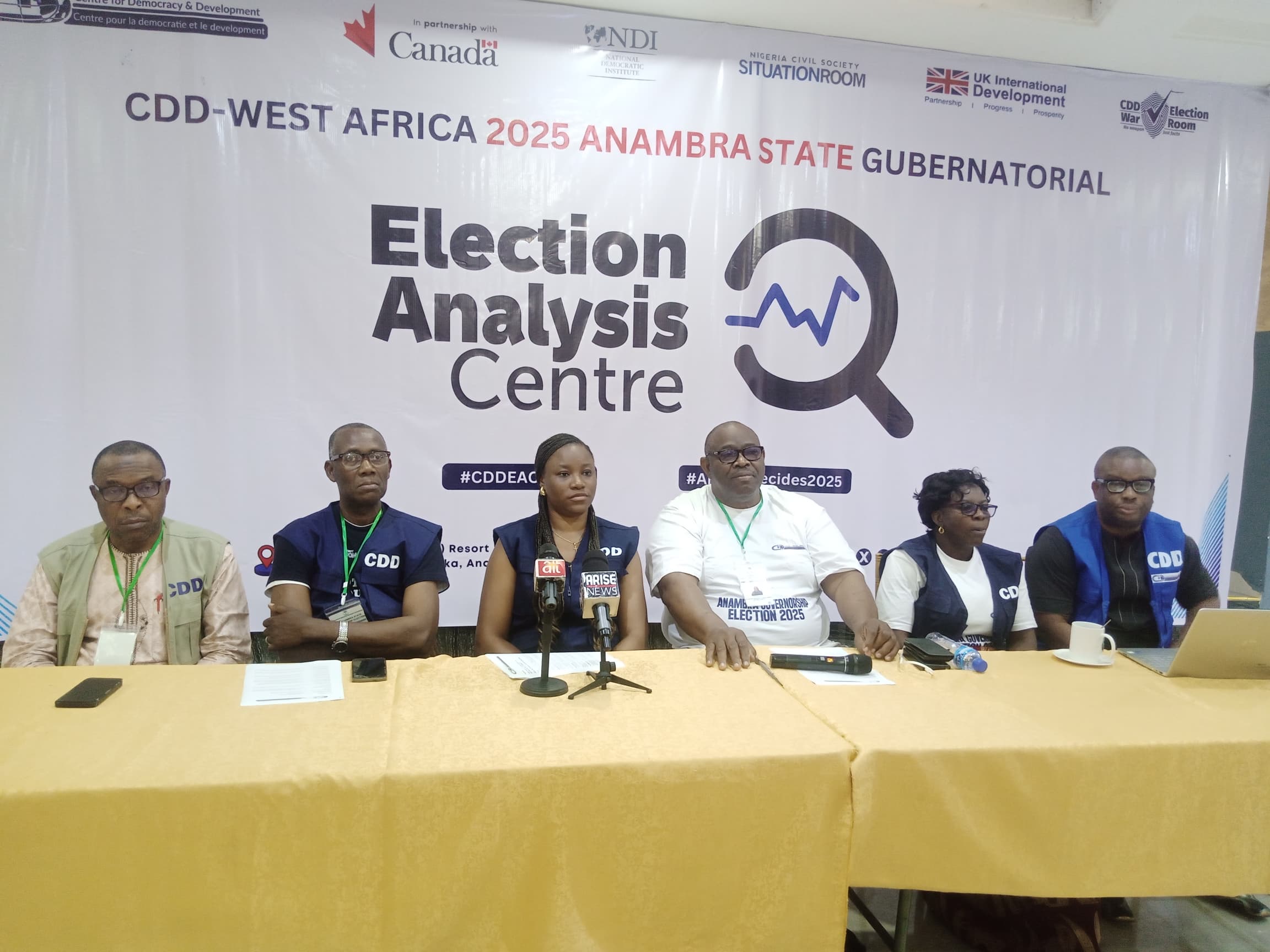
Lawrence Ndubeze, Awka
The Centre for Democracy and Development (CDD–West Africa) has commended the Independent National Electoral Commission (INEC) for its performance in the November 8 Anambra governorship election but urged sweeping reforms ahead of future polls.
In a post-election briefing in Awka on Sunday, the group praised INEC for progress in key areas such as voter card collection, result uploads, and the peaceful conduct of the election.
“With INEC’s claim of 98.8% PVC collection rate, 99.62% result upload on the IReV, and a generally peaceful election environment, INEC made significant progress. These successes are commendable,” CDD stated.
The findings were presented in a statement signed by CDD Director, Dauda Garuba, and Chair, Election Analysis Centre, Prof. Victor Adetula.
However, CDD said the exercise was not without challenges, citing late arrival of officials in about 5.4% of polling units, low voter mobilisation, and absence of issue-based campaigns.
It also reported that while more than 45,000 security personnel were deployed, 12.7% of polling units still had no visible security presence.
“The massive deployment ensured a largely peaceful election, but what happens to flashpoint communities after the withdrawal of security forces?” the group queried.
CDD further condemned widespread vote-buying in several local government areas, noting that party agents offered between ₦2,000 and ₦10,000 per voter — often through digital transfers — in the full glare of security personnel.
Voter turnout, the group said, stood at 21.4%, an improvement from 10.2% recorded in 2021 but still “a troubling indicator of public disengagement,” especially among youths, women, and persons with disabilities.
“Despite high registration numbers, turnout was only 21.4%. This reflects deep voter apathy and underscores the need for renewed efforts in civic education and governance that inspires trust,” the report added.
CDD also raised concerns over the spread of disinformation during the election, revealing that 54% of tracked claims were false and mostly targeted INEC, security agencies, and candidates.
“We tracked over 200 election-related claims; 54% were false, 27% true, and 10% misleading,” it said, warning that misinformation actors used hate speech and artificial intelligence to distort facts.
The group called on stakeholders to prioritise electoral and governance reforms before the 2026 off-cycle and 2027 general elections, including timely funding, decentralised planning, early voting for essential personnel, stronger internal party democracy, and transparent financing.
CDD further urged sustained security presence beyond election periods, measures to curb vote trading, and collaboration between INEC, security agencies, civil society, and the media to counter disinformation and strengthen public confidence in the electoral process.
