

Lawrence Ndubeze, Awka
Owners of Small and Medium Enterprises (SMEs) in the Southeast and other parts of Nigeria have been urged to leverage opportunities in the nation’s capital market to help achieve President Bola Tinubu’s vision of a $1 trillion economy.
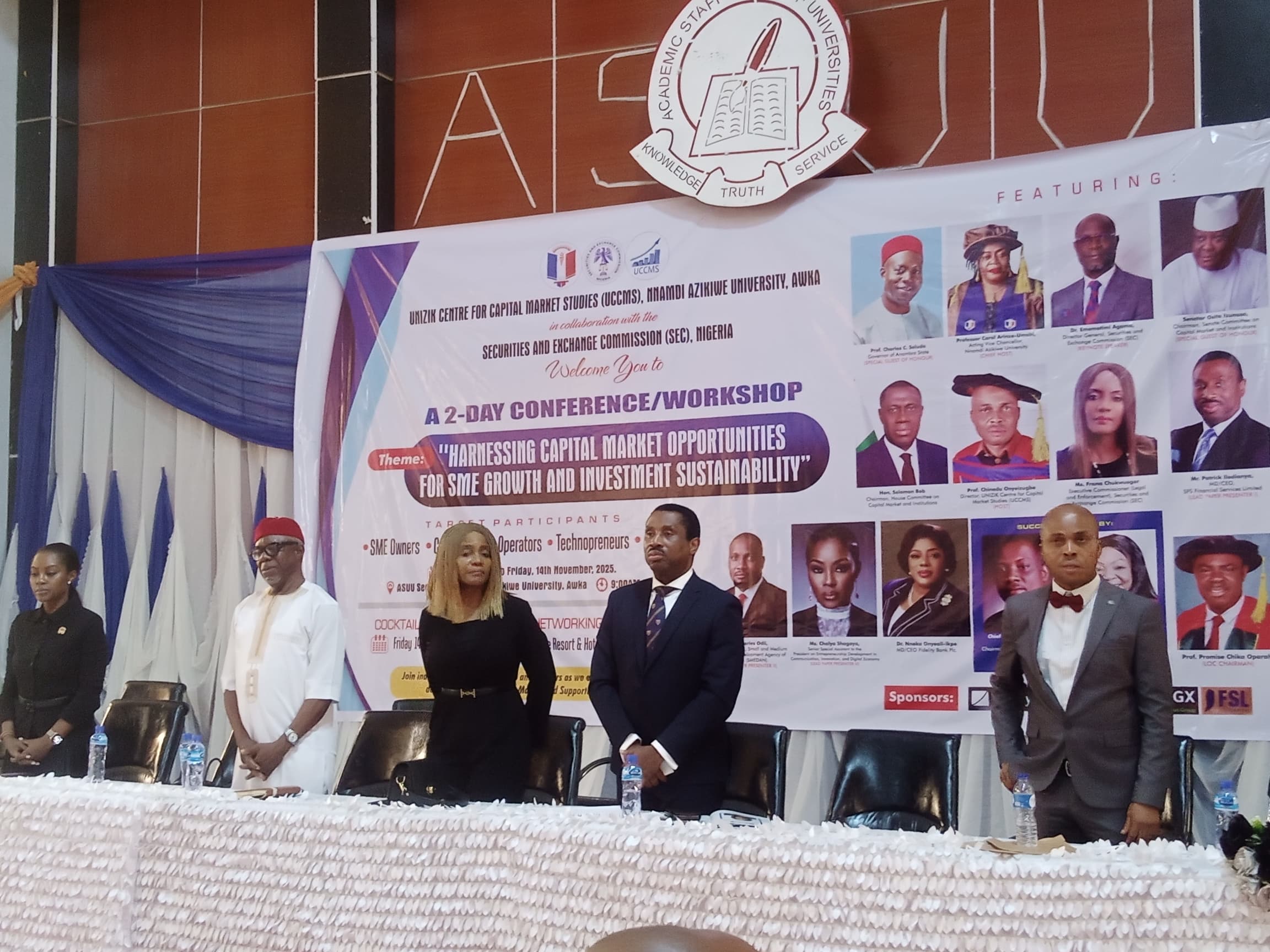
The call was made in Awka during a two-day conference organized by the UNIZIK Centre for Capital Market Studies (UCCMS), Nnamdi Azikiwe University, in collaboration with the Securities and Exchange Commission (SEC).
Speaking at the opening ceremony, the Senior Special Assistant to the President on Entrepreneurship Development, Chalya Shagaya, said the Federal Government had made SMEs a key priority in its economic agenda.
She emphasized that President Tinubu views SMEs as the cornerstone for attaining a $1 trillion economy, anchored on enterprise, productivity, and innovation.
“Under President Bola Ahmed Tinubu’s leadership, we are laying a foundation for a Nigeria where every small business has a fair shot — where good ideas do not die, and where entrepreneurship becomes not just survival, but success,” Shagaya said.
“Capital does not build nations; people do — people with ideas, grit, and the courage to try again after failure. The President understands that when our small businesses thrive, Nigeria thrives. The plan is simple: help entrepreneurs access finance, create enabling environments, and provide the digital and physical infrastructure to scale.”
She further noted that the capital market is not just for billionaires but a platform connecting small business owners with investors and long-term funding opportunities. Shagaya urged Micro, Small, and Medium Enterprises (MSMEs) to explore capital market instruments in addition to facilities available through the Bank of Industry (BOI).
In his keynote address titled “Providing SMEs with Alternative Financing Sources from the Capital Market,” the Director-General of SEC, Dr. Emomotimi Agama, described SMEs as the lifeblood of Nigeria’s economy.
Represented by Ms. Franca Chukwuogor, Executive Commissioner (Legal and Enforcement), SEC, Agama lamented that despite employing over 80 percent of the workforce and contributing nearly half of Nigeria’s GDP, SMEs still suffer a severe financing gap.
He blamed this on high interest rates, stringent collateral requirements, and short repayment tenors, which force many entrepreneurs to rely on personal savings and informal loans, keeping them at a subsistence level.
Agama said the capital market could unlock “patient capital” — long-term investments that can transform small businesses into scalable enterprises.
Declaring the conference open, Acting Vice-Chancellor of UNIZIK, Professor Carol Arinze-Umobi, represented by Professor Harry Obinwosu, expressed concern that many SMEs remain unaware of the capital market’s potential as a funding source.
“SMEs are the backbone of the economy, driving job creation, innovation, and productivity. Yet, inadequate funding continues to limit their full contribution to national development,” she said.
She added that the capital market provides a vital link between investors with surplus funds and businesses in need of long-term financing, stressing that outcomes from the conference would positively impact Nigeria’s socio-economic development.
Director of UCCMS, Professor Chinedu Onyeizugbe, said the theme of the event, “Harnessing Capital Market Opportunities for SME Growth and Investment Sustainability,” was timely and aimed at repositioning Nigeria’s economy through sustainable enterprise and market participation.
He said the Centre — the first of its kind in any Nigerian university — would focus on capital market education, policy research, innovation, and capacity building.
Onyeizugbe revealed that UCCMS plans to partner with SEC, SMEDAN, and other institutions to establish an Innovation Hub for training, incubation, and mentoring of SMEs and startups.
“The Hub will serve as a platform where entrepreneurs can learn business structuring, financial management, and capital formation within the market ecosystem. Beyond training, it will foster collaboration between government, investors, and academia to design practical solutions for SME growth and economic transformation,” he said.
The conference attracted policymakers, academics, regulators, investors, and entrepreneurs from Anambra, the Southeast, and beyond. It also featured paper presentations and award recognitions.
