

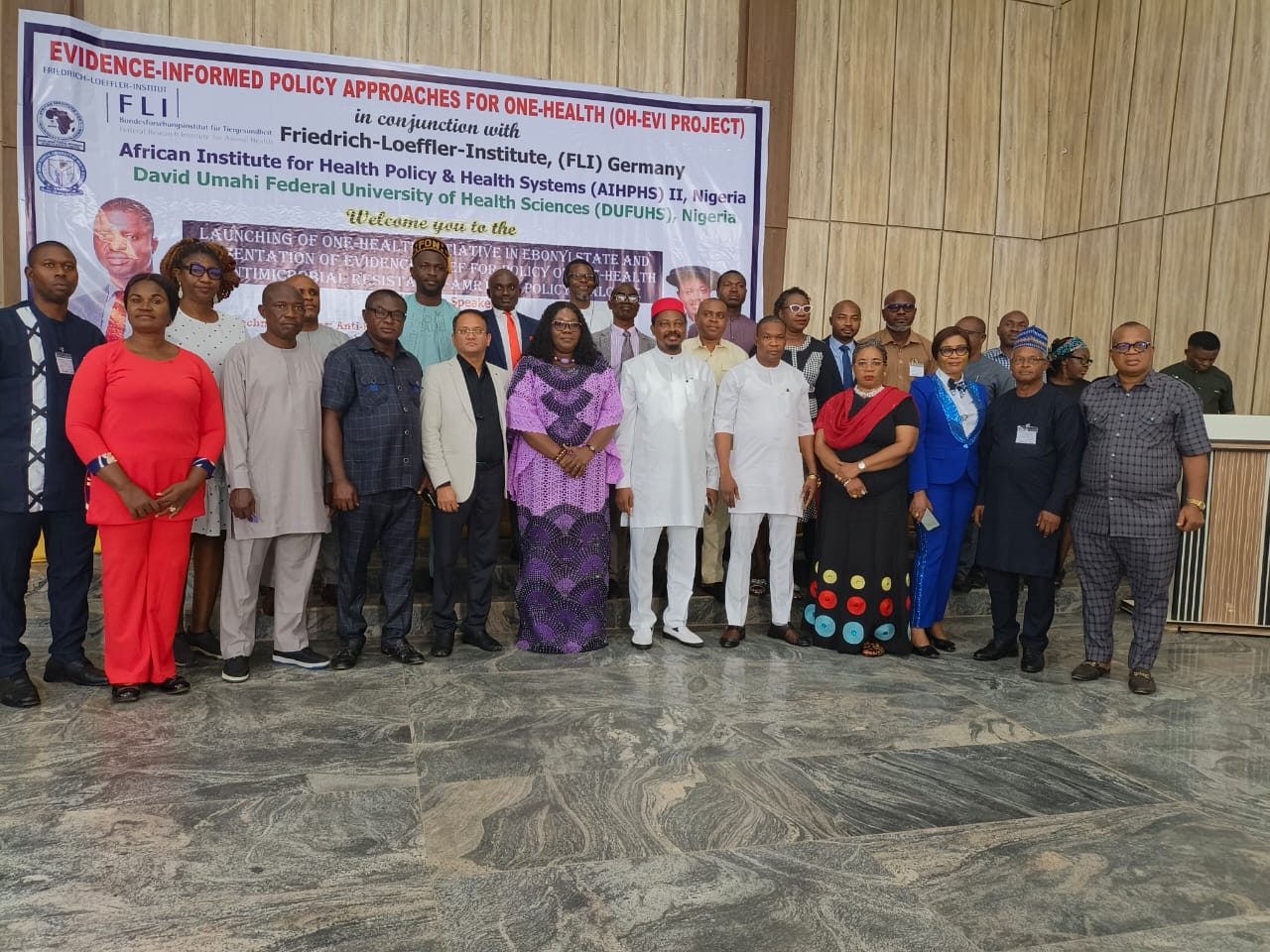
Ike Nnachi, Abakaliki
Ebonyi State has launched the One Health Initiative, a collaborative framework linking the health, agriculture, and environment sectors to enhance disease prevention, detection, and response.
The initiative was unveiled by Governor Francis Nwifuru during a multi-stakeholder engagement held on Thursday in Abakaliki, the state capital.
The programme was organised by the Evidence-Informed Policy Approaches for One Health (OH-EVI Project) in partnership with the Friedrich-Loeffler-Institut (FLI), the African Institute for Health Policy and Health Systems (Nigeria), and the David Umahi Federal University of Health Sciences, Uburu.
The event also featured the presentation of an Evidence Brief for Policy on Antimicrobial Resistance (AMR), followed by a policy dialogue during the technical session.
Governor Nwifuru reaffirmed his administration’s commitment to improving health outcomes, driving economic development, and strengthening the state’s resilience to future epidemics and pandemics. He stressed that protecting the well-being of citizens remains a top priority under his administration’s People’s Charter of Needs.
The Governor observed that global disease outbreaks have increased in recent years, with Africa disproportionately affected by malaria, waterborne infections, childhood diseases, neglected tropical diseases, and zoonotic pathogens. He cited the Ebola epidemic of 2013–2016 and the COVID-19 pandemic as events that exposed deep structural weaknesses in health systems, particularly in resource-limited settings.
“These crises revealed the consequences of inadequate preparedness across the health, agriculture, and environment sectors,” he said. “Unfortunately, insufficient efforts have been made at sub-national levels in Nigeria to build resilient, integrated systems capable of withstanding future epidemics.”
Governor Nwifuru described the One Health Initiative as an essential multisectoral approach that acknowledges the interdependence of human, animal, plant, and environmental health. He identified rapid urbanisation, population growth, deforestation, and increased human–animal interactions in Ebonyi as major drivers of vector-borne and zoonotic diseases.
To tackle these challenges, the Governor announced plans to strengthen collaboration among the state’s ministries of health, agriculture, and environment, as well as their agencies. He also called for closer partnerships between government institutions and academic researchers to ensure that policy decisions are grounded in evidence.
“The evidence generated in our institutions must get into the hands of policymakers so that evidence-based and context-specific policies can be developed for Ebonyi State,” he said.
He pledged sustained government funding and political support for efforts to enhance the health, agriculture, and environmental sectors. The Governor also expressed appreciation to international partners, including the Friedrich-Loeffler-Institut (Germany), which is funding the One Health Project in Nigeria through a grant to the David Umahi Federal University of Health Sciences, with Professor Jesse Uneke as the principal investigator.
He further acknowledged the support of the World Health Organization (WHO), the EVIPNet team, the Federal Ministry of Health and Social Welfare, and other collaborators.
Speaking at the event, the Vice Chancellor of the University, Professor Jesse Uneke, described the launch as “a remarkable day for Ebonyi State,” noting that the state is taking the lead in domesticating the national One Health framework at the sub-national level—something many other states have yet to do.
He said the programme aims to deepen understanding of disease transmission across humans, animals, and the environment, and to strengthen cross-sectoral collaboration in response.
“We hope that our discussions today will lead to actionable working documents that integrate the roles of the key ministries,” he stated, stressing the importance of joint planning to detect, control, and prevent outbreaks, whether pandemic or endemic.
The university also commended Governor Nwifuru for providing the enabling environment and approving the hosting of the programme, describing his support as evidence of his commitment to advancing public health in the state.
Delivering the keynote address, Dr. Laxmikant Chavan, Technical Officer for Antimicrobial Resistance and One Health Coordinator at the WHO Country Office, Abuja, urged all states to implement the One Health policy at the sub-national level.
He said this is critical because states are at the frontline of healthcare delivery, veterinary services, environmental protection, and community engagement.
Dr. Chavan noted that the One Health approach enhances the capacity of states and local governments to detect outbreaks early and respond swiftly, improve food safety, strengthen agribusiness value chains, promote responsible antimicrobial use, curb the spread of resistant pathogens, reduce the economic burden of livestock and human diseases, and protect water sources.
