

Our Reporter, Abuja
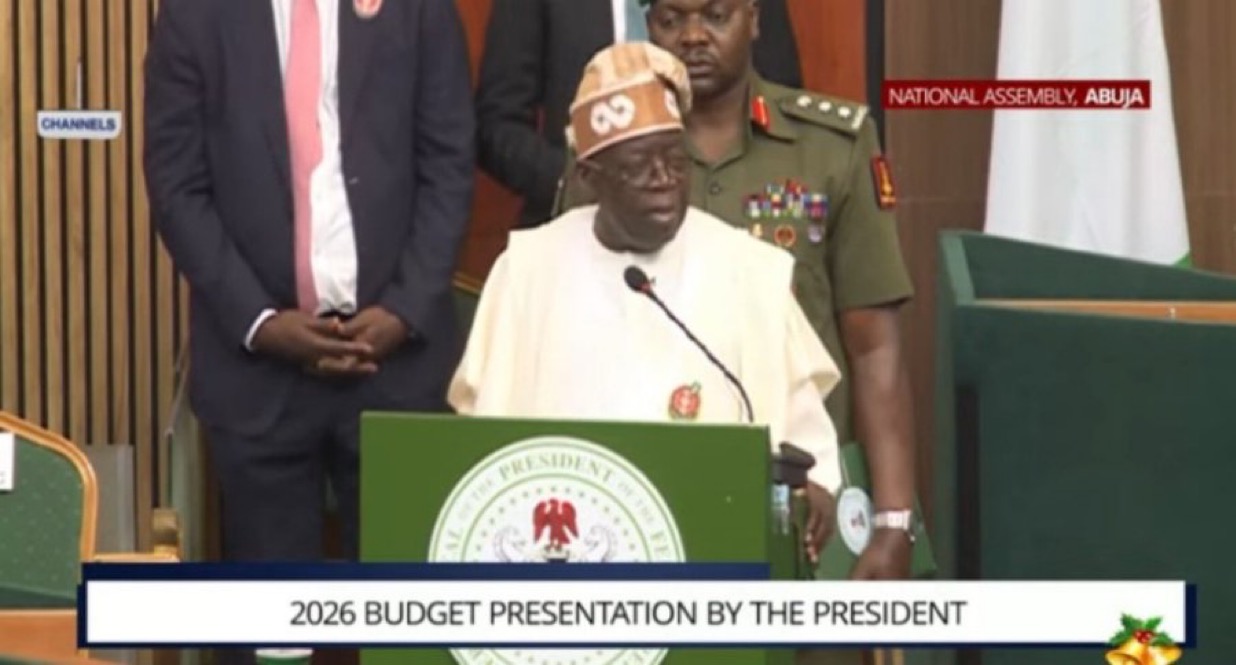
President Bola Tinubu on Friday presented a proposed ₦58.18 trillion 2026 budget to a joint session of the National Assembly, placing security at the top of sectoral allocations and unveiling a tougher national security doctrine.
Tagged the “Budget of Consolidation, Renewed Resilience and Shared Prosperity,” the proposal is aimed at consolidating recent macroeconomic gains, restoring investor confidence and translating recovery into jobs and improved living standards.
In his address, which began at 3:31 p.m., Tinubu declared that all armed groups operating outside state authority would henceforth be treated as terrorists, warning that the government would pursue more decisive security action, stricter budget discipline and deeper economic reforms.
“I appear before this Joint Session of the National Assembly, in fulfilment of my constitutional duty, to present the 2026 Appropriation Bill,” the President said, describing the moment as “defining” in Nigeria’s reform journey. He acknowledged the pains associated with reforms over the past two and a half years but assured Nigerians that their sacrifices were not in vain.
Economy stabilising
Tinubu said the economy was showing clear signs of stabilisation, citing 3.98 per cent GDP growth in the third quarter of 2025 and inflation moderating for eight consecutive months to 14.45 per cent in November 2025.
He also pointed to improved oil production, stronger non-oil revenues and rising investor confidence. According to him, external reserves rose to a seven-year high of about $47 billion by mid-November 2025, providing over 10 months of import cover.
“These outcomes are not accidental. They reflect difficult but deliberate policy choices,” Tinubu said, adding that the focus ahead was to ensure that “stability becomes prosperity, and prosperity becomes shared prosperity.”
2026 fiscal framework
Under the proposal, total revenue is projected at ₦34.33 trillion, while total expenditure stands at ₦58.18 trillion, including ₦15.52 trillion for debt servicing. Recurrent (non-debt) expenditure is estimated at ₦15.25 trillion, while capital expenditure is put at ₦26.08 trillion. The resulting budget deficit of ₦23.85 trillion represents 4.28 per cent of GDP.
The assumptions underpinning the budget include a crude oil benchmark of $64.85 per barrel, production of 1.84 million barrels per day and an exchange rate of ₦1,400 to the dollar.
“These numbers are not just accounting lines. They are a statement of national priorities,” Tinubu said, stressing commitments to fiscal sustainability, debt transparency and value-for-money spending.
Security leads allocations
Security tops sectoral allocations with ₦5.41 trillion, followed by infrastructure (₦3.56 trillion), education (₦3.52 trillion) and health (₦2.48 trillion).
Unveiling a sweeping security doctrine, the President said Nigeria was resetting its national security architecture with a unified counter-terrorism approach. “Henceforth, any armed group or gun-wielding non-state actors operating outside state authority will be regarded as terrorists,” he declared.
He listed bandits, militias, armed gangs, kidnappers, violent cult groups, forest-based armed collectives and foreign-linked mercenaries, warning that their financiers, ransom facilitators, arms suppliers, political protecters and even community or religious leaders who aid violence would also be designated terrorists.
Discipline, revenue reforms
On budget execution, Tinubu admitted that the 2025 budget faced transition challenges. As of the third quarter of 2025, he said ₦18.6 trillion in revenue, representing 61 per cent of the target, and ₦24.66 trillion in expenditure, or 60 per cent of the target, had been recorded. Only ₦3.10 trillion, about 17.7 per cent of the 2025 capital budget, had been released by that time.
He pledged stricter discipline in 2026, directing finance and budget authorities to implement the budget strictly in line with appropriated details and timelines. Heads of Government-Owned Enterprises were ordered to meet revenue targets, supported by end-to-end digitisation to block leakages.
“Nigeria can no longer afford inefficiencies or underperformance in strategic agencies. Every institution must play its part,” he said.
Education, health, agriculture
Tinubu said investments in human capital would be deepened, noting that over 418,000 students had benefitted from the Nigerian Education Loan Fund in partnership with 229 tertiary institutions. Health spending, he added, accounts for six per cent of the total budget, excluding liabilities, with over $500 million in prospective United States grant funding for targeted interventions.
On food security, the President said agriculture would be prioritised through mechanisation, irrigation, climate-resilient farming, improved storage and agro-value chains to reduce post-harvest losses and boost smallholder incomes.
A budget to deliver
“The greatest budget is not the one we announce. It is the one we deliver,” Tinubu said, pledging improved revenue mobilisation, smarter spending and stronger accountability.
Laying the bill before lawmakers, he said the 2026 budget “belongs to all of us,” expressing confidence that cooperation between the executive and legislature would advance the Renewed Hope Agenda.
“It is with great pleasure that I lay before this distinguished Joint Session of the National Assembly the 2026 Appropriation Bill of the Federal Republic of Nigeria,” he concluded.
