

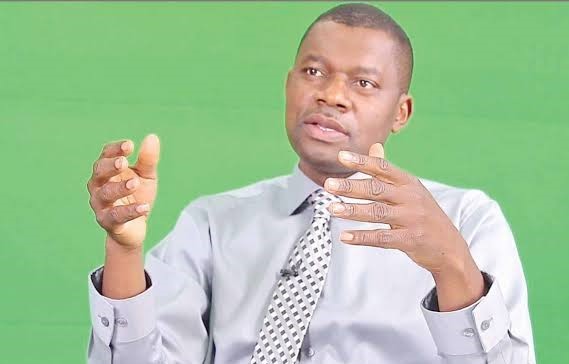
By Rudolf Ogoo Okonkwo
I tried—more than once—to invite Emeka Umeagbalasi of the International Society for Civil Liberties and Rule of Law (Intersociety) onto 90MinutesAfrica. I called. I texted. He never responded.
So when I woke up last Sunday to find him on the front page of The New York Times—reduced to a “screwdriver salesman in Onitsha” blamed for influencing a U.S. airstrike—I knew something had gone terribly wrong, not just for Emeka, but for Nigerian journalism itself.
Over the past two years, I had repeatedly attempted to bring Emeka on the show. His work documenting human rights abuses in Nigeria’s South-East fascinated me. Even more impressive was his success in getting that work published in Nigerian newspapers. Outside Lagos and Abuja, most NGOs in the North-Central, South-East, North-East, and North-West struggle to break into the mainstream press. Emeka had somehow cracked that wall.
Had he appeared on 90MinutesAfrica, we would have interrogated his findings and the obstacles he faced. He would have explained his methodology, his sources, and—critically—the limits of his data. Our global audience of politically engaged Africans across continents and professions might have enriched his work, opened doors to collaboration, and expanded its reach.
But for whatever reason, it never happened.
So imagine my shock when I woke up last Sunday and saw him splashed across the front page of The New York Times under the headline: “The Screwdriver Salesman Behind Trump’s Airstrikes in Nigeria.”
In the story, written by Ruth Maclean, the paper’s West Africa bureau chief, Emeka Umeagbalasi was portrayed in deeply unflattering terms. Beyond reducing him to a screwdriver seller in Onitsha who somehow swayed President Donald Trump’s decision to strike a terror group in Sokoto, the piece cast doubt on his research methods and questioned the credibility of his conclusions.
Some parts were painful to read. It felt like watching a nineteen-year-old Mike Tyson at the height of his ferocity take on Portable in an Oshodi showdown. Emeka never stood a chance.
Even the accompanying photographs betrayed a lack of understanding of how international media encounters operate. A degree in security studies, peace, and conflict resolution from the National Open University of Nigeria does not prepare anyone for that level of combat. During the interview, Emeka reportedly dropped lines that amounted to raw red meat for African bureau chiefs trained to probe, dismantle, and expose.
Asked how he arrived at his figures for the number of churches destroyed by terrorists in Nigeria over sixteen years, he replied: “I googled it.”
No. No. No.
He repeatedly cited media reports and secondary sources as the backbone of his research, apparently unaware that this would fail the evidentiary threshold of international journalism—an ecosystem defined by skepticism and hostile verification, especially toward local narratives.
I was not present during his exchange with Ruth Maclean, but I can imagine how it unfolded. It was never a fair fight. Maclean came prepared for a knockout. Emeka left his flanks wide open.
Responding to the backlash, Emeka later revealed that the interview lasted over three hours, followed by another hour of photography. The published piece must have stunned him. I would wager he has never read Janet Malcolm’s The Journalist and the Murderer. Every African preparing to sit across from an international journalist should read that slim book—or at least its opening paragraph:
“Every journalist who is not too stupid or too full of himself to notice what is going on knows that what he does is morally indefensible.”
Intersociety’s response showed it had learned a lesson many before them learned the hard way: a great journalist is not your friend. No matter how congenial they appear, the god they serve is not the one you serve.
In a press briefing following the story’s publication, Intersociety accused Maclean of false attributions, misrepresentations, and what it called “injurious lies.” The organization insisted its data gathering involved primary fieldwork and that trained volunteer researchers verified secondary sources. It also warned against linking its reports on religious persecution to President Trump’s decision to launch airstrikes in Sokoto on December 25, 2025.
The Nigerian government, it bears noting, claimed it provided the intelligence used in the Christmas Day attack. The New York Times ignored that fact in crafting its headline. Instead, the paper relied on Republican lawmakers quoting Emeka’s report to leap to causation.
In certain Nigerian quarters, readers are now ignoring the documented loopholes in Umeagbalasi’s methodology and jumping to a more conspiratorial conclusion: that Nigeria’s $9 million lobbying contract with Republican-linked firm DCI Group induced the Times story as part of the Tinubu government’s effort to reframe the Christian-genocide narrative.
For ignoring hair to bite Emeka on the head, these readers are ignoring faeces to bite The New York Times in the anus.
Intersociety further denied claims that its leader referred to the Fulani as “animals” or advocated confining them to a single Nigerian state. It rejected assertions that Emeka compared himself to CNN’s Christiane Amanpour, calling the claim “entirely fabricated.”
But here is the hard truth: Emeka likely did not record the interview as insurance against misquotation. And he will not sue The New York Times—because he knows the paper has its own recordings. The quotes attributed to him are not unfamiliar to anyone who follows Nigeria’s media space.
While disputing victim statistics and identities, Intersociety also denied claims that its leader said many of the abducted Kebbi schoolgirls were Christians. It clarified that Emeka merely cited demographic data suggesting that some victims were likely Christian.
Still, despite all protestations, Emeka Umeagbalasi had no chance against Ruth Maclean—just as Portable had no chance against Mike Tyson. Not then. Not now.
Beyond Emeka and The New York Times, this episode exposes a deeper failure: the Nigerian media’s abdication of its watchdog role. Too often, they publish press releases verbatim without interrogation. They splash headlines without scrutiny. They amplify attention-grabbing claims without demanding evidence.
As one of them, I sympathize with Nigerian journalists. I understand the constraints. But constraints do not erase consequences. We all pay a credibility tax.
That deficit explains why international media cite Nigerian sources with subtle contempt, carefully noting that such reports “could not be independently verified.” When local journalism fails to interrogate power, African leaders arrive untrained for the scrutiny of the global stage.
The vacuum invites recklessness. Anyone can say anything. When best practices collapse, we all suffer. And when leaders avoid rigorous local questioning, they deny themselves the rehearsal needed for international interviews. Nigeria’s foreign affairs minister’s recent disastrous media encounters on the same Christian-genocide narrative prove the point. Had local media tested him, Piers Morgan would not have flattened him.
Scholars, too, have failed us. Nigeria’s sociopolitical landscape is riddled with data gaps that universities elsewhere would rush to fill. Peer-reviewed research is the foundation of national self-knowledge. Yet in Nigeria, such work is either absent or inaccessible. Nature abhors a vacuum. Activists like Emeka step in. Who can blame them?
If Emeka’s work had been peer-reviewed and published—say, by the Journal of Social Sciences at the University of Nigeria, Nsukka—it would not matter that he conducted research while selling screwdrivers in Onitsha. And had he entered the New York Times interview fully aware that Nigeria’s “anyhow-anyhow” standards do not survive international scrutiny, the headline would have been very different.
Rudolf Ogoo Okonkwo teaches post-colonial African history at the School of Visual Arts in New York City. His latest book is A Kiss That Never Was.
