

By Nnamdi Elekwachi
In 1997, almost 20 years ago, many Igbo billionaires supported Abacha’s self-succession agenda to my consternation then as a lad who was just beginning to follow happenings in Nigeria. I remember, for instance, the two Arthurs: Arthur Eze and Arthur Nzeribe. There were others, including Igbo political has-beens and opinion leaders, but a young man shocked those of us in Aba with his youth and creativity as one of Abacha’s most flairsome supporters.
He is none other than Dan Kanu (known simply as Dan Omire in Aba), son of an Aba-based millionaire who staged the famous ‘two million man march’ for Abacha, and, just for the optics, went the extra mile sponsoring a pro-Abacha advertisement on CNN!
Dan’s PR stunt for the regime was quite gaudy that many believed something big, maybe a political appointment, was awaiting him in the next phase of Abacha’s rule. Dan, who I guess was in his twenties by then, outdid himself in the Abacha project. Quite confident, he did not even hide his support for the dictator’s agenda and was equally not less vocal about it.
Said he: ‘…the destiny of this nation and the transition to democracy under the present dispensation can only achieve its viable potentials if handled by prudent, purposeful, and transparent leadership of General Abacha.’
Dan Kanu was the national leader of Youth Earnestly Ask for Abacha (YEAA), a youth-themed movement that supported Abacha’s political transition for which all the existing five political parties then selected the diminutive dictator as their ‘sole candidate.’ It was going to be an uncontested election after all because Abacha had only himself as a challenger. Abacha saw the drama unfold and simply followed the narrative. Soon, he was often spotted in agbada more than khaki. The transition, as it were, was in full swing.
In Aba, where he partly grew up, Dan became the topic at barbershops and everywhere as soon as he began to appear on national TV. But Dan was not only appearing on TV, he was on the pages of newspapers, magazines and other publicity materials having become the face of the Abacha youth vanguard.
But then, Gen Abacha died mysteriously and his transition eventually got suspended by Gen. Abdulsalam Abubakar who succeeded him. Following Abacha’s exit, Dan tried to remain relevant but didn’t succeed, albeit there was the ‘Agenda ’99’ which he and other members of YEAA, like Alhaji Jubril Obokhale, staged that didn’t see the light of day. Dan contested the House of Representatives seat on the platform of the PDP and won but was not allowed to represent his people by the party. I learnt he is doing well now and is a philanthropist, but I don’t forget what his townsman (from Arondizuogu) told me when a few years ago I asked him about Dan with whom I have no nodding acquaintance but only known by name.
‘Nnamdo,’ he called me, ‘Dan was in political business then. He’s fine now. Very fine. If the name of the project had been Youth Honestly Ask for Abacha, and not Youth Earnestly Ask for Abacha, I would have worried more.’
I got the joke and laughed quite hysterically. You see, there is something peculiar to political business, just like every other business, I suppose. It is defined by interest. But by inserting the word ‘honestly,’ an adverb of degree, my friend provided what was perhaps lacking in the pro-Abacha agenda, which I believe is largely missing in Nigeria of today. Honesty.
But honestly speaking, politics too is a stage with many actors. So I don’t begrudge actors for the roles they assume. Eras come and go just as transitions are seasonal. Twenty years ago there was Abachas’ YEAA, so ‘this too shall pass,’ as Nigerians say.
(Exeunt Dan, enters Obi Cubana.)
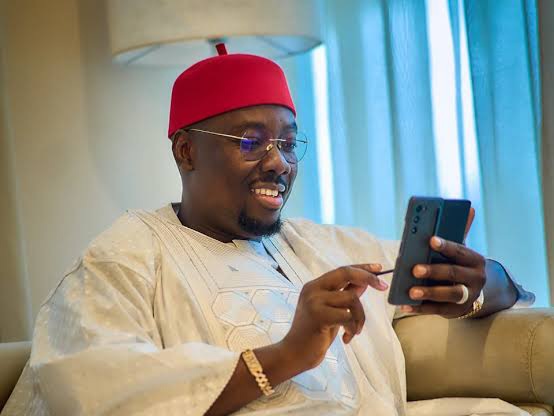
The City Boy Movement publicity material trending online with the picture of Mr. Obinna Iyiegbu (known as Obi Cubana) reminded me of Dan and his CNN advertisement in the nineties. Known as a socialite and showbiz promoter, Iyiegbu had hitherto maintained a posturing of political neutrality, if not passivity, focusing only on his chains of business and philanthropism. Today, it’s a different thing entirely. As a political actor, Mr. Iyiegbu is the current South-East coordinator of the City Boy Movement, a youth-powered organisation interested in the political business of returning Tinubu as president in 2027 just like Dan’s YEAA exactly 20 years ago.
To some, Tinubu’s reelection bid is gradually looking like Abacha’s political transition. The opposition is in turmoil and Tinubu has nearly or about thirty governors on his side, sparking up sentiments and rumours of Nigeria tilting to a one-party state. But in all fairness, Tinubu, unlike Abacha, will face many challengers, but how strong the challengers are, their political capital and currency, and their ability to unseat the City Boy himself is entirely a different ball game.
I do not blame Iyiegbu. Of course man, warns Aristotle, is a political animal. I understand the fact that people have political choices to make just as they have paths to take; and that this is a matter of right. But, like I said earlier, Iyiegbu reminded me of Dan Kanu on whom political event of the time later played Moses.
The Biblical Moses? Yes, wait for it.
Since I am a literature student and enthusiast, I move, in exercise of my poetic licence, that we use the Biblical Moses to contextualise what contemporary Christians call ‘near-success syndrome’ in standard English. And I would add as an ‘eponymous metonymy’. Because, as the saying goes, ‘almost is not enough’. Moses could not enter the Promised Land even when from Mount Nebo he looked over all its beauty and landscape. Though almost there, he didn’t make it. Was Dan too almost there? Yes, but could not make it since the transition did not happen. That miss was like Moses’!
I have respect for Dan for what he achieved then as a young man, even though it was not the right path. But nothing has changed since Abacha died. I always posit that the difference between now and then is that then we had only one Abacha, but now we have more ‘Abachas’ at state government houses, Aso Villa, you name them. Those who succeeded Abacha have even surpassed his records in a supposed democracy.
Iyiegbu may have taken sides, I am not interested in whether or not he backs the wrong horse, what is certain is that his place in the history of 2027 has been written, like the billionaires and youth I mentioned earlier. Nothing is new here. Nigeria is a political theatre on which many have acted or taken the centre stage thereof. How do I end this piece? Well, like they say in theatre: ‘Break a leg!’
Nnamdi Elekwachi, a public affairs analyst writes from Umuahia, Abia State.
