

By Chido Onumah
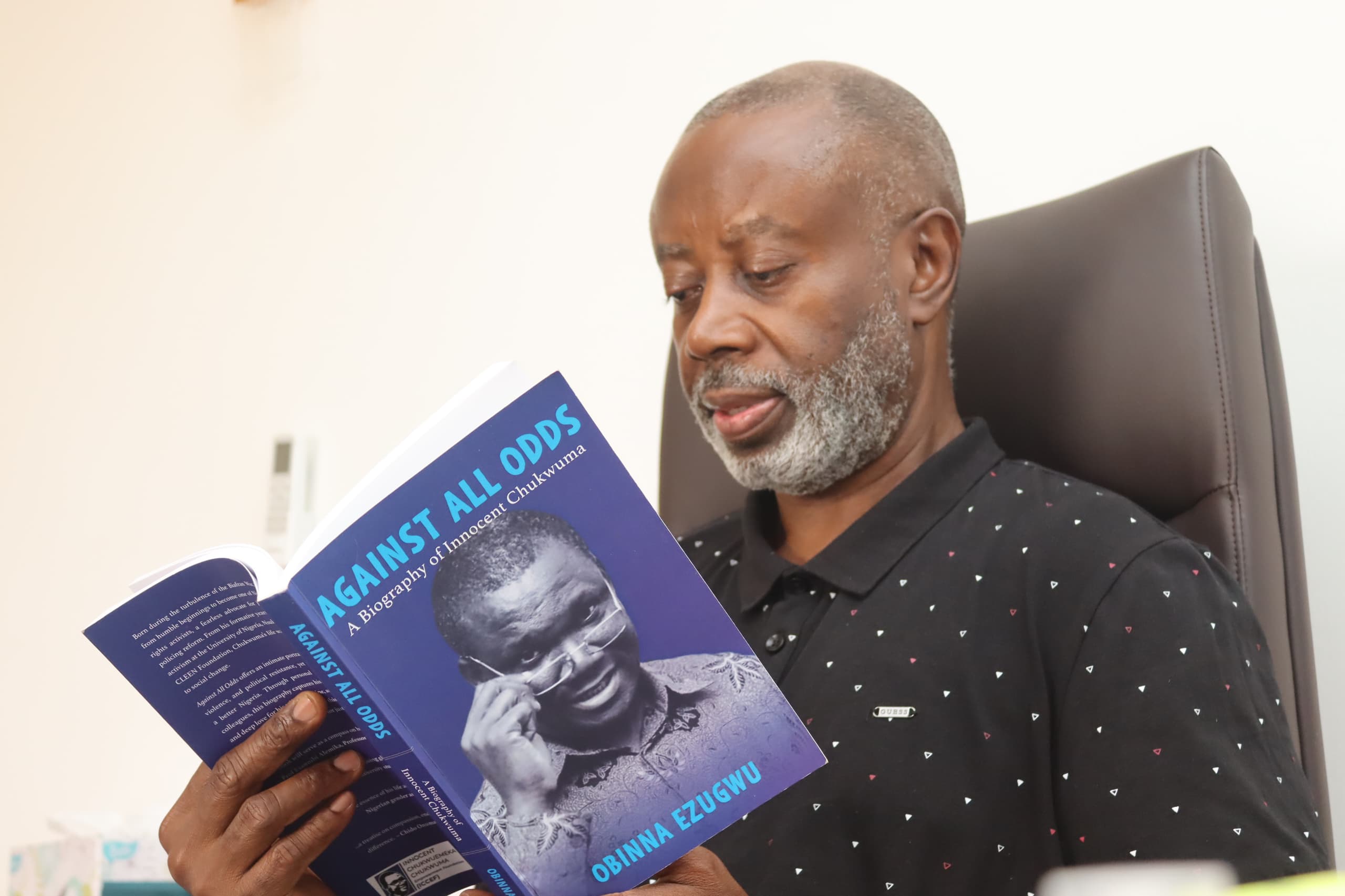
Against All Odds: A Biography of Innocent Chukwuma emerges not simply as a chronicle of one man’s defiance against the vicissitudes of life, but as a profound meditation on a vanishing ethos in Nigerian public life: the ethos of unyielding, principled insistence. Through its meticulous narration, the book endeavours to safeguard the legacy of a human rights defender without elevating him to an untouchable pedestal, while candidly depicting a trajectory of resistance that acknowledges the profound personal and communal tolls exacted by such endeavours. Its success in this delicate balancing act speaks volumes about both the subject’s intrinsic depth and the biographer’s thoughtful craftsmanship, ensuring that Chukwuma’s story resonates as a lived reality rather than a sanitised legend.
Introduction: A Legacy Forged in the Crucible of Conflict
The biography of Innocent Chukwuemeka Chukwuma opens with a moment of profound foreshadowing. It begins not with the renowned civil society leader he would become, but with a vulnerable infant, his cries muffled against his mother’s chest as his family flees through a war-torn Nigerian night. In early 1968, two-year-old Innocent is a fugitive from advancing federal troops during the Biafran War, his survival hinging on silence and chance as the family navigates perilous bush paths (Chapter 1, Humble Beginnings).
This inaugural scene encapsulates the central tension of his life story: an individual destiny irrevocably shaped by national upheaval, who would later dedicate his life to reshaping that nation’s institutions. Against All Odds traces this dramatic arc from a war-scarred childhood in Umuahia, capital of Abia State, to his emergence as a pivotal force for police reform and democratic consolidation. The biography’s significance extends beyond the achievements of one man. It serves as a lens through which to examine the resilience of Nigerian civil society, the unfinished project of institutional reform, and the personal costs of principled advocacy in a hostile political environment.
Obinna Ezugwu crafts a narrative that is both intimate and expansive, seeking a balanced portrait that marries admiration for Chukwuma’s public victories with an unflinching examination of the struggles that defined his journey.
The Foundational Trauma: Biafra and the Potency of Memory
To understand Chukwuma’s later insistence on justice, one must first grasp the formative horror from which it sprang. His infancy unfolded against the backdrop of the Nigerian Civil War (1967–1970), triggered by the secession of the Eastern Region as the Republic of Biafra. The war’s origins were complex, rooted in ethnic tensions, a destabilising military coup in January 1966 that was erroneously labelled an “Igbo coup,” and the anti-Igbo pogroms in Northern Nigeria that followed, killing thousands and displacing over a million people. Chukwuma’s family were among the displaced (Chapter 1).
For children like him, the war was not an abstract political rupture but a daily struggle for survival. The biography recounts how, when the family agreed it was safer to flee Umuahia for their ancestral village, the journey itself was a “risky undertaking,” made “even more perilous by the fact that Innocent … could not be stopped from occasionally crying” (Chapter 1). This visceral detail grounds history in fear. An estimated one to two million civilians died from fighting, hunger, and disease, exacerbated by a government-imposed blockade.
The biography’s strength lies in linking this early experience of vulnerability to Chukwuma’s adult vocation. The war’s memory, often deliberately muted under the mantra of “no victor, no vanquished,” produced a generation alert to state failure and the fragility of citizenship. Chukwuma’s life’s work can be read as a refusal to forget, and as an insistence that institutions must protect citizens rather than prey upon them.
Forging a Rebel: University, Ideology, and Early Sacrifice
Chapter 2, University and Student Unionism, provides the crucial bridge between childhood trauma and adult activism. It shows how conviction was forged not only by memory but by material hardship and ideological encounter.
Chukwuma’s admission to study Religion and Philosophy at the University of Nigeria, Nsukka, in 1986, came after an earlier failure and was only possible because his elder sister’s bride price was used to pay his fees. It was an act of familial sacrifice that weighed heavily on him throughout his life (Chapter 2). As an indigent student, his lived reality aligned naturally with the Marxist Youth Movement, not as abstract doctrine but as an ethical vocabulary for solidarity. As his roommate observed, “Inno was the sharing type … His nature resonated with sharing” (Chapter 2).
Activism quickly moved from debate to danger. In 1989, Chukwuma helped lead protests that resulted in his expulsion and being declared wanted by the authorities. The biography captures the human stakes with restraint and empathy: “On the eve of his becoming the first graduate in his family, he had been expelled from school. Were all her [his mother’s] efforts to be in vain?” (Chapter 2). What followed was a two-year legal battle he concealed from his widowed mother, an early lesson in the private costs of public principle.
One episode stands out as emblematic. When the university planned a celebration for Nelson Mandela’s release, expelled students seized the podium to declare: “Ikoku, you cannot be celebrating the fall of Apartheid in South Africa and be committing injustice in the University” (Chapter 2). It was an early demonstration of a tactic that would later define Chukwuma’s career: exposing hypocrisy by forcing moral consistency, and weaponising global symbols to illuminate local injustice.
Eventually, after winning the legal battle at the Court of Appeal in Enugu through the intervention of legendary lawyer, Gani Fawehinmi, who represented Chukwuma and his colleagues pro bono, the university reinstated them. Chukwuma graduated in 1991 and was posted to Borno State for his National Youth Service Corps (NYSC) programme (Chapter 2).
The Strategic Pivot: From CLO to the Founding of CLEEN
Following Youth Service, Chukwuma’s activism found a professional home in the Civil Liberties Organisation (CLO). Yet, as detailed in Chapter 6, CLEEN Foundation and Serial Social Entrepreneurship, frustration grew alongside his profile. Documenting abuse and filing cases began to feel like a closed loop. He grew “increasingly tired of the vicious circle”, sensing that “no deep impact was being made” (Chapter 6). This dissatisfaction crystallised a strategic evolution: the question was no longer only how to resist injustice, but how to redesign the systems that produced it.
The founding of CLEEN Foundation in January 1998 was the definitive answer. Catalysed by the 1996 Reebok Human Rights Award and its $25,000 grant, which he used as seed capital, CLEEN represented a radical departure from conventional advocacy. Rather than positioning civil society solely as an external antagonist, it would collaborate with the police, offering capacity building to a force he regarded as deeply militarised. Reform, he argued, required engagement and humanisation. Security was a shared social responsibility, not the exclusive preserve of institutions.
The biography also reveals the leadership culture that sustained CLEEN’s credibility. Chukwuma valued intellectual rigour and autonomy, avoiding micromanagement but enforcing accountability. Those who stagnated were not summarily dismissed but professionally isolated, left to “determine your further trajectory all by yourself” (Chapter 6). Over time, CLEEN’s consistent, grounded engagement, described by a partner as “deeply rooted in the history and reality of policing in Nigeria,” earned rare trust within the police hierarchy (Chapter 6).
The Discipline of Departure: Leaving CLEEN and Thinking Beyond Self
One of the biography’s most instructive insights is what it calls Chukwuma’s “every decade restlessness.” After ten years at CLO, he left to found CLEEN. As another decade approached, he began preparing to leave CLEEN itself. By 2008, he felt the organisation could stand without him (Chapter 6, Exit from CLEEN Foundation).
This departure was not painless. Donors and staff were unsettled. Yet the decision reflected his deepest belief: institutions must outlive their founders. Personal indispensability, he believed, was a form of failure.
Scaling the Vision: The Ford Foundation Years
This philosophy found wider expression when Chukwuma was appointed Regional Director of the Ford Foundation for West Africa in December 2012, becoming the first Nigerian to hold the role (Chapter 7). At Ford, the “ideas man” flourished. He helped establish the Association for Research on Civil Society in Africa (AROCSA), bridging activism and scholarship, and played a catalytic role in shaping impact investing in the region, contributing to a portfolio exceeding $4.7 billion (Chapter 7).
What distinguished this phase was continuity, not rupture. The same commitment to building durable ecosystems, rather than personal platforms, defined his grant making and convening.
The Private Man: Family, Fatherhood, and the Burden of Generosity
One of the biography’s quiet achievements is its attention to Chukwuma’s private life. As an Igbo man with three daughters, he resisted cultural pressure for a male heir. He was “proud of his girls,” insisting he would rather raise daughters who made him proud than sons who felt entitled (Chapter 4, An Igbo Man with Three Daughters).
Equally revealing is the portrait of his generosity. Driven by memory of his own deprivation, he supported multiple children through school and carried extensive family obligations. Yet the biography does not romanticise this generosity. It records the painful irony that “the help he so freely gave seemed to never be enough in the sight of those he was helping” (Chapter 4, Generous Innocent), exposing the emotional toll of expectation and ingratitude.
Final Acts: Memory, Illness, and Closure
After leaving Ford Foundation, Chukwuma’s final major project was the Centre for Memories in Enugu, dedicated to preserving Igbo history. Its first documentary focused on the Nigeria–Biafra war, bringing his life full circle by institutionalising remembrance of the trauma that shaped him (Chapter 7, Centre for Memories).
Chapter 8 narrates his final illness with restraint. Diagnosed with Acute Myeloid Leukaemia in April 2021, he declined rapidly. One cruel irony stands out: a young doctor attending to him was someone he had once helped, now unaware of the connection as she fought to save his life. He died on April 3, 2021, the same date he was baptised in 1966, a symmetry the biography notes without sentimentality.
A Critical Lens: Omissions and the Challenge of Balance
Despite its strengths, the biography’s restraint leaves some questions underexplored. Greater attention to internal tensions within CLEEN Foundation during its expansion would have enriched the institutional narrative. Likewise, a more explicit tracing of the evolution from Marxist radical to pragmatic reformer could have sharpened the analytical arc.
The book also stops short of directly challenging contemporary activism. In an age of performative outrage, Chukwuma’s model of patient, institutional labour poses an implicit challenge. The question remains whether today’s advocacy culture possesses the resilience for such “unglamorous” approach.
Conclusion: An Enduring Standard in an Unfinished Project
Against All Odds succeeds as a political biography precisely because it resists myth-making. By following Chukwuma chronologically from war-time child to restless institution-builder, it shows how conviction is shaped, tested, refined, and finally relinquished in service of durability.
It is to Ezugwu’s credit that Chukwuma emerges not as a flawless icon, but as proof that ethical rigidity can coexist with strategic adaptability. His most radical act may have been his willingness to step aside. In a Nigeria still wrestling with reform and memory, his life offers a demanding standard: principled insistence, institutional discipline, and a humanity forged early, exercised patiently, and ultimately surrendered so the work might endure.
In Against All Odds, Innocent Chukwuma, the inveterate activist and social change advocate comes to life. Reading Innocent’s biography, is a masterclass on the history and socio-political evolution of Nigeria as it is a treatise on love, compassion, endurance, the strength of the human spirit, and one man’s creativity, ingenuity and desire to make a difference.
Against All Odds is a welcome addition to the catalogue of socio-political biographies in Nigeria. Readers from all walks of life, particularly civil society, pro-democracy and human rights movements, will benefit greatly from this invaluable chronicling of one man’s service to humanity.
Innocent was a man of many parts. There certainly will be more books written about his life, activism, struggles and successes. For now, we should be content with and grateful for what his widow, Josephine Effah-Chukwuma, feminist and women’s rights activist, and three daughters, Chidinma Ekanem, a lawyer; Amarachi Itu, a market research & strategy consultant; and Nkechi Ama, a computer engineering undergraduate, have served us through the pen of Obinna Ezugwu.
It is hard to believe it has been five years since Innocent’s passing. And on the occasion of his posthumous 60th birthday (February 6, 2026), there is no better way to remember and celebrate him than to put his ideas on the front burner of national conversation.
Onumah, PhD., is a journalist and author of We Are All Biafran, among other books.
