

Ike Nnachi, Abakaliki
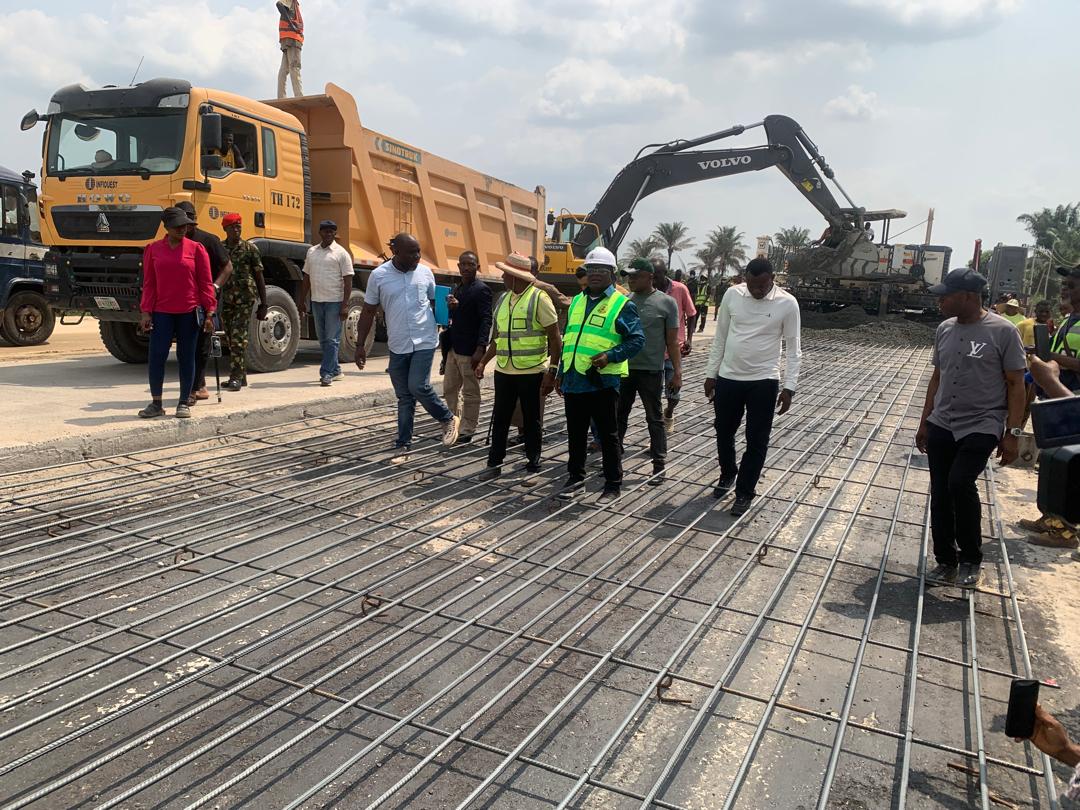
The Minister of Works, David Umahi, has said the federal government is prioritising reinforced concrete pavement for road construction across Nigeria, noting that the shift from traditional asphalt will guarantee long-term quality and durability.
Umahi made the disclosure in Onueke, Ezza South Local Government Area, while inspecting ongoing infrastructure projects being executed under the Renewed Hope Agenda of President Bola Tinubu in Ebonyi State.
According to the minister, the adoption of reinforced concrete pavement marks a significant step toward ensuring sustainable road infrastructure across the country.
“Concrete pavement has come to stay in Nigeria because of its durability. With the quality of materials being used, these roads will last for decades,” he said.
Umahi noted that Nigeria’s infrastructure renewal drive has entered a decisive phase in Ebonyi State as the federal government intensifies work on major highway and bridge projects aimed at transforming transportation across the South-East.
Reaffirming President Tinubu’s commitment to delivering durable infrastructure, he said the projects form part of a strategic national development plan aligned with flagship initiatives such as the Lagos–Calabar Coastal Highway, which is expected to serve as a major economic corridor along Nigeria’s southern coastline.
The minister explained that the ongoing works involve extensive highway construction spanning over 125 kilometres in the first phase, with substantial funding already released to sustain steady progress.
He added that concrete roads are engineered to withstand heavy traffic and harsh weather conditions and can last up to 100 years when properly maintained.
The minister noted that several kilometres of concrete pavement have already been completed, showing visible progress along the corridor.
During the inspection, Umahi also assessed work on a major 1.5-kilometre bridge structure comprising multiple spans designed to improve connectivity across riverine areas.
He explained that the bridge construction involves advanced engineering techniques in which cranes move sequentially across piers, lifting beams into position without disrupting ground traffic.
“Once completed, the bridge will enhance safety, reduce travel time, and open up new commercial opportunities for surrounding communities,” he said.
Umahi commended indigenous contractors handling the projects, describing their performance as evidence of the growing technical capacity of Nigerian engineering firms.
“Many of these local contractors have shown remarkable patriotism. Some have not even been mobilised with funds yet but are already working. At least eight indigenous contractors under the Federal Ministry of Works are currently executing projects without mobilisation,” he said.
He contrasted their approach with that of some expatriate companies, which he said often delay project execution while assessing political and economic conditions before committing resources.
“These indigenous firms see themselves as partners in nation-building. Companies like Hitech Construction Company and others have demonstrated that Nigerian contractors can deliver projects with the same level of professionalism and quality as foreign firms,” he said.
The minister added that the federal government is deliberately strengthening local participation in infrastructure delivery to build national capacity and reduce dependence on foreign contractors.
Umahi said the road project under inspection begins from Calabar and runs through Ndibe Beach, Afikpo, Amasiri and Onueke, linking the South-South and South-East corridors before connecting to Ukwachi (Ndiebor Ishieke) and the old Enugu–Abakaliki Expressway.
According to him, Section One of the project covers about 125.5 kilometres and has a contract value of approximately ₦454 billion.
The federal government has already paid 30 per cent of the contract sum in line with the Engineering, Procurement, Construction and Finance (EPC+F) funding model adopted for the project.
Under the arrangement, the federal government provides 30 per cent of the funding, while contractors are responsible for sourcing the remaining 70 per cent through financing.
Umahi also highlighted ongoing efforts to address community-related issues along the corridor, including property compensation and alignment adjustments where necessary.
He assured that affected property owners would be fairly compensated in accordance with established procedures, stressing that infrastructure development requires cooperation between government and host communities.
The minister noted that the road and bridge projects are not merely transportation upgrades but part of a broader economic transformation agenda aimed at stimulating industry, improving security and strengthening regional integration across Nigeria.
