

Stephen Ukandu, Umuahia
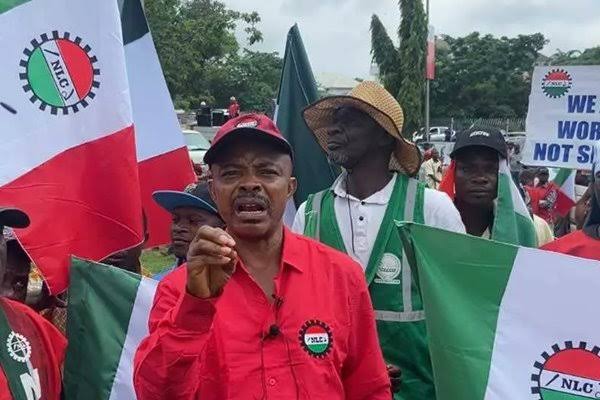
The Nigeria Labour Congress (NLC) has urged the Federal Government to urgently introduce relief measures for Nigerian workers following the recent surge in petrol prices linked to the escalating Middle East crisis.
The labour centre said workers across the country were facing worsening economic hardship as petrol now sells between N1,170 and N1,300 per litre, a development it warned could deepen poverty and heighten social tension if not urgently addressed.
Among the measures demanded by the union are a cost-of-living allowance (COLA), wage awards for workers, tax relief for low-income earners, and the immediate rehabilitation of Nigeria’s public refineries to reduce dependence on global market shocks.
In a statement titled “Save Nigerians From This Shock: An Urgent Relief Has Become Necessary,” signed by its President, Joe Ajaero, the Congress said the current economic situation had placed unbearable pressure on workers and their families.
The statement read in part: “NLC voices the collective anguish of millions of Nigerian workers who are bearing the brutal cost of a global capitalist crisis they did not create. The military escalation involving the United States, Israel and Iran has sent shockwaves through global oil markets. As a result, petrol prices in Nigeria have skyrocketed to between N1,170 and N1,300 per litre.”
The labour body argued that the price spike has exposed structural weaknesses in Nigeria’s petroleum sector.
“This is a direct assault on the Nigerian people. While imperialist rivalries play out abroad with bombs and military escalation, Nigeria’s working class is being bombarded with poverty and hunger because we have failed to ensure that our public refineries are operational.
“This crisis has brutally exposed the fragility of Nigeria’s downstream petroleum sector. It has stripped away the illusion that local refining alone would shield the country from global shocks.”
The Congress also criticised price adjustments by the Dangote Refinery, noting that domestic refining has not insulated Nigerians from global market volatility.
“The Dangote Refinery has adjusted its prices in line with global volatility, passing the burden directly to the masses. This undermines the narrative that domestic production alone guarantees price stability.
“As long as Nigeria remains dependent on a market-driven pricing structure tied to global fluctuations and refuses to revive its public refining capacity, the country will remain hostage to international conflicts and market speculation.”
The union reiterated its earlier warnings about the potential consequences of weakening public refining capacity.
“The NLC had earlier warned about the danger of sabotaging public refineries in ways that could create monopolistic control in the downstream sector. This moment must serve as a wake-up call to the managers of Nigeria’s economy.”
It further stressed that the rising cost of fuel and transportation has worsened food inflation and eroded workers’ purchasing power.
“The soaring cost of petrol (PMS) and diesel (AGO) has made transportation a heavy burden on workers. Food inflation continues to rise, while meagre wages are being swallowed by the rising cost of living. When workers cannot afford transportation to their workplaces, the economy stalls. When families cannot afford three meals a day, society sits on a keg of gunpowder.”
The NLC insisted that the government must act swiftly rather than attributing the crisis solely to global developments.
“The government cannot foreclose any action that would offer relief to the people. It is the duty of the state to act decisively to prevent the suffering of its citizens, rather than helplessly attributing the crisis solely to the Middle East conflict.”
Citing projections by the Nigeria Economic Summit Group (NESG) that Nigeria could earn an estimated N30 trillion oil windfall from the crisis, the labour centre said such resources should be channelled towards alleviating hardship.
“The Nigeria Labour Congress therefore demands the following urgent actions: immediate wage awards and a Cost of Living Allowance (COLA) for all workers to cushion the rising cost of living. Current wages have effectively become starvation stipends.
“We also demand the expansion and overhaul of the cash transfer programme to ensure transparency and guarantee that assistance reaches the most vulnerable citizens. The value of transfers must also be adjusted to reflect inflation.
“There must be immediate tax relief for workers, including suspending regressive taxes on low-income earners. Taxing minimum-wage earners amounts to extortion, and government must also provide a clear timeline for the full operationalisation of all public refineries.”
The Congress further called for accountability over funds previously spent on refinery maintenance.
“The Nigerian state must be held accountable for the billions of naira spent on turnaround maintenance.”
Warning of the social consequences of worsening hardship, the labour body said urgent dialogue with workers was necessary.
“Nigerian workers are being pauperised and subjected to immense suffering. Workers are not statistics — they are the engine of the nation. When the engine overheats, the entire vehicle crashes.
“The estimated N30 trillion oil windfall expected from the Middle East crisis must not disappear like previous windfalls. These resources must be invested in the Nigerian people and used to cushion the economic hardship caused by the current crisis.
“The government must engage in sincere social dialogue with Nigerian workers and the broader citizenry. Using the Middle East crisis as a justification for policies that deepen poverty is unacceptable. The primary duty of government is to ensure the welfare and security of its citizens.
“We demand action. We demand justice. We demand survival.”
If you want, I can also help you with stronger newspaper headline options (the kind editors prefer for front pages or online SEO).
