

Book Reviewer: Osmund Agbo
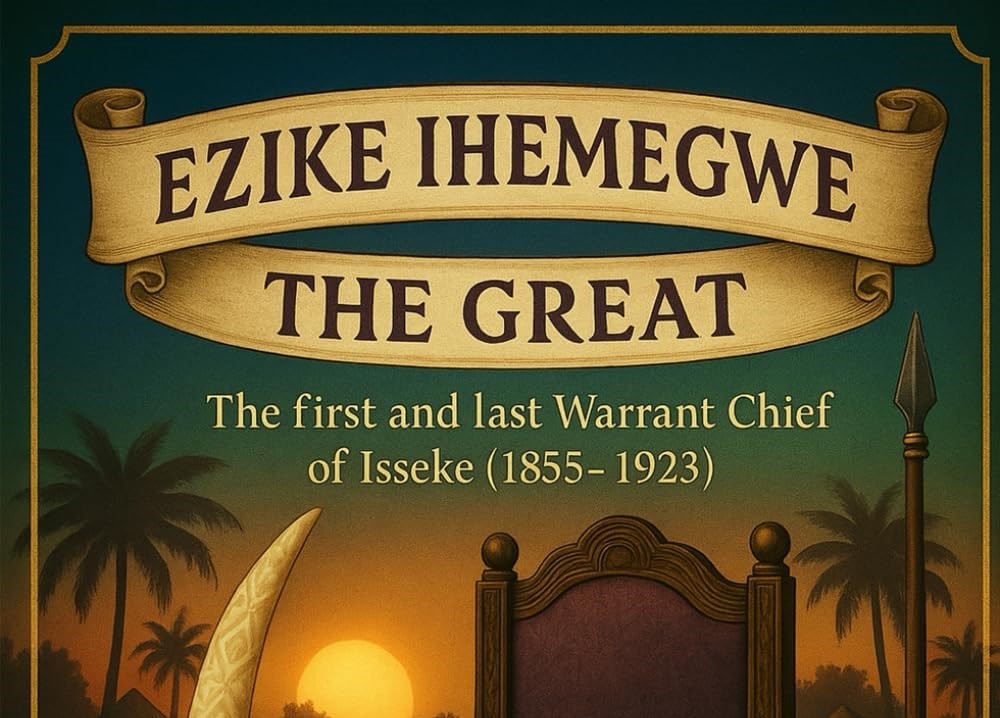
Book Title: Ezike Ihemegwe The Great: The First and Last Warrant Chief of Isseke (1855–1923)
Author: Chinedu Ezike & Uchenna Ezike
Publisher: (Diamond Writing Coach)
Year of Publication: 2025
Sales Outlet: Amazon
His story begins in Isseke, a community nestled east of the River Niger, a region that also gave the world Olaudah Equiano, one of the earliest African voices against the transatlantic slave trade. Yet while Equiano’s legacy has found its way into global academic and moral discourse, Ezike’s has remained hidden, passed down orally in family compounds and community gatherings. This book, therefore, is not just a biography; it is an act of historical justice.
In an era where soundbites and fleeting headlines often dominate the cultural narrative, discovering a book that deeply engages both the intellect and the soul is a rare experience. Ezike Ihemegwe the Great: The First and Last Warrant Chief of Isseke (1855–1923) is such a book. Painstakingly written by Uche and Chinedu Ezike, descendants of the titular character, this work is far more than a familial tribute—it is a monumental reclamation of history.
This work invites readers into the life of a man whose actions speak to the heart of Igbo identity and colonial resistance, and who, until now, remained largely absent from the pages of formal history. Ezike Ihemegwe was not just a chief. He was a warrior, a liberator, a father, a businessman, and a deeply moral leader. His story begins in Isseke, a community nestled east of the River Niger, a region that also gave the world Olaudah Equiano, one of the earliest African voices against the transatlantic slave trade. Yet while Equiano’s legacy has found its way into global academic and moral discourse, Ezike’s has remained hidden, passed down orally in family compounds and community gatherings. This book, therefore, is not just a biography; it is an act of historical justice.
What stands out immediately is Ezike’s multidimensional humanity. Despite the vast wealth he amassed, he was first and foremost a devoted family man. The authors introduce him not as a distant patriarch or power-hungry figure but as a father who, even with many wives and children, held steadfast to moral values and emphasized their transmission across generations. He understood the bedrock of any strong society is a strong family unit, a notion often overlooked in discussions about historical figures, especially those involved in politics and warfare.
Ezike’s economic story is equally compelling. In contrast to many modern wealthy elites whose affluence often emerges from opaque or exploitative sources, Ezike’s wealth was rooted in honest, industrious trade. He exported agricultural produce-yam, plantain, palm oil, and palm kernel, through riverine trade routes in Oguta and Onitsha, establishing commercial relationships with the British. In exchange, he imported valuable goods such as gunpowder, spirits, and the now-famous George cloth that became a cultural mainstay across Igbo land after the coronation of King George of England in 1910. Ezike exemplified a kind of indigenous entrepreneurship that was both adaptive and ethical, blending traditional production with colonial-era commerce without sacrificing communal responsibility.
One of the most defining aspect of Ezike Ihemegwe’s legacy and a central reason why this book is both powerful and timely is his role as a liberator and an abolitionist. While the transatlantic slave trade had been formally abolished in Europe and America by the time of his rise, slavery continued to thrive in the African hinterlands, largely unchallenged and outside the reach of colonial enforcement.
The book recounts in vivid detail two daring rescue missions, at Egbuoma and Akuma, where Ezike personally led military-style operations to free individuals who had been kidnapped and were awaiting sale to slave buyers. In one of these instances, he not only rescued the captives but went further to burn down the slave camp in Akuma, sending a powerful moral message that such atrocities would not be tolerated.
This is where the book makes perhaps its most important intellectual contribution. While Western abolitionists like William Wilberforce, Thomas Clarkson, and even Equiano have rightly been immortalized in global historical memory, African actors who opposed slavery within their own communities remain largely in the shadows. Ezike Ihemegwe was one of those quiet revolutionaries. He fought not with legislative tools but with courage, social capital, and strategic intelligence. His form of abolitionism was grassroots, culturally grounded, and deeply personal. By illuminating this aspect of his life, the authors not only challenge the colonial lens through which African resistance is often viewed but also broaden our understanding of abolitionist movements as global, multi-faceted, and locally rooted.
Ezike’s legacy was also political. After the infamous “fire-ant” incident involving Mr. Green, a British assistant district officer who was mistakenly perceived to be biased against Isseke in a land dispute, the colonial administration imposed a harsh collective punishment. The people of Isseke were unable to meet the British demands. Ezike stepped in, paid the enormous fine in full, and saved his community from further ruin. For this act of magnanimity, he earned the legendary title Okuterennuturuohimiri—“he that saturated the sea with enough salt,” a metaphor for someone whose capacity to give was boundless. His intervention not only showcased his immense personal wealth but also his selflessness and unwavering commitment to communal survival.
His reward came in the form of a political appointment. Ezike was made the first and only warrant chief of Isseke by the colonial authorities. In many parts of Igboland, the British imposed warrant chiefs as a mechanism to control decentralized societies. In many cases, these chiefs were resented and resisted. But Ezike was different. His leadership was legitimate, earned through decades of service, wisdom, and sacrifice. He was not born into royalty, but he embodied the republican spirit of the Igbo people, where leadership is earned through merit and not inherited by bloodline.
Ezike Ihemegwe the Great is not just a biography, it is a foundational text for anyone seeking to interrogate the complexities of colonial Eastern Nigeria. It provides a rich tapestry of cultural, political, and economic life in a period that was transitional and tumultuous. It lays the groundwork for future studies that must continue to examine how indigenous systems of leadership, resistance, and commerce intersected with, adapted to, or resisted the encroachment of British colonialism. The book invites historians, anthropologists, students, and readers across the African diaspora to re-evaluate simplistic narratives of African passivity or collaboration under colonial rule.
This book fills a yawning gap in our collective understanding of Nigeria’s past. It is a much-needed correction to the erasure of African agency in the abolition of slavery and colonial resistance. It celebrates a life that embodied courage, resilience, wisdom, and a deep sense of justice. Through meticulous storytelling and intimate family insights, Uche and Chinedu Ezike have resurrected a towering figure who, though long gone, continues to speak to the challenges and possibilities of leadership in our time.
In a world eager for authentic heroes and grounded narratives, Ezike Ihemegwe the Great delivers both. It is a compelling read, an important academic resource, and a cultural treasure. Every student of African history, every community leader, and every Nigerian seeking to understand the roots of their society should read this book.
Osmund Agbo, MD, is a Medical Doctor, Writer and Public Intellectual.
