

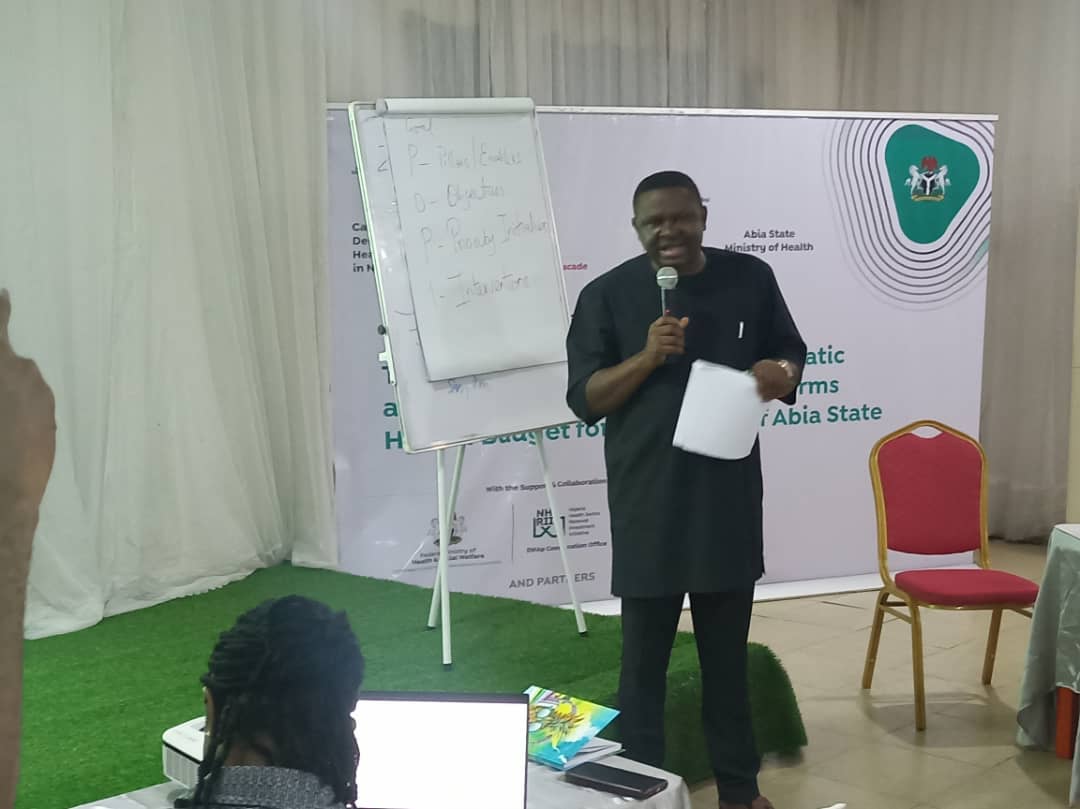
…Identifies causes as strategic workshop holds in Umuahia
Stephen Ukandu, Umuahia
A recent survey conducted by the Federal Ministry of Health has identified Bende, Ugwunagbo, and Ukwa East Local Government areas as the top three LGAs in Abia State with the highest maternal mortality rates.
Dr. Onuka Okorie, the Sector-Wide Approach (SWAP) Desk Officer in the state, made the disclosure during a presentation at a four-day workshop for health leaders and managers in Abia.
The workshop, organised under the Nigeria Health Sector Renewal Investment Initiative (NHSRII), was attended by key stakeholders including representatives of the World Health Organisation (WHO), the Federal Ministry of Health, Primary Health Care Authority Secretaries from all 17 LGAs, and civil society organisations in the health sector.
Citing the findings of the survey, Dr. Okorie attributed the high maternal mortality rates to a combination of factors including delays in seeking, reaching, and receiving care, as well as poor responsibility by some caregivers. He also highlighted the continued patronage of traditional birth attendants and prayer houses—often guided by religious prophecies—over medical facilities as major contributors.
Participants at the workshop raised concerns about the shortage of skilled health workers to manage the renovated primary healthcare centres (PHCs) and hospitals across the state. They urged the Abia State Government to expedite ongoing recruitment efforts to fill the gaps.
In his remarks, Commissioner for Health, Prof. Enoch Ogbonnaya Uche, said the main objective of the workshop was to formulate a comprehensive operational framework for the Ministry’s 2026 activities.
“We want to ensure that every operational activity is adequately planned and budgeted for, in line with the expectations of the current administration. What we are doing is planning to succeed,” he stated.
Prof. Uche reiterated the state government’s commitment to strengthening the health system, emphasizing healthcare as a top priority of the Governor Alex Otti-led administration.
In a separate interview, the Commissioner issued a stern warning to health workers who abandon their duty posts, particularly at PHC facilities, stating that the government will not hesitate to sack erring personnel.
“It is unacceptable for health workers to operate from outside the state or to be frequently absent. This is putting lives at risk, especially after government investment in renovating over 200 PHCs,” he said.
He encouraged health workers to justify the recent upward review of their salaries by showing greater dedication to duty.
“Every health worker must deliver on their mandate. The state has recently approved a new salary structure comparable to the federal scale.”
Prof. Uche disclosed that unscheduled visits to PHCs revealed instances of absenteeism, and some staff are currently facing disciplinary measures.
“I visited several PHCs without prior notice. While many were present, others were absent and have been issued queries directly from my office. Going forward, it will no longer be business as usual. Project Ekwueme is retrofitting 200 PHCs, but the success of this effort depends on the presence and dedication of our workforce,” he warned.
Dr. Jibrin Alkasim, WHO State Coordinator, represented by Dr. Carol Iwuoha, reaffirmed WHO’s commitment to supporting Abia’s health sector. He stressed the need for continuous capacity building to improve healthcare delivery.
WHO expressed concern that some PHCs were not offering 24-hour services to pregnant women and urged health workers to stop making excuses. The organisation also advised expectant mothers to avoid traditional birth homes due to associated risks and to seek skilled care at PHCs or hospitals.
Dr. Chidinma Ejepu of the Federal Ministry of Health described the workshop as part of efforts to assist the state in developing its annual operational health plan.
“This plan, based on the national health sector strategic blueprint, is aimed at saving lives and reducing both physical and financial suffering,” she explained.
She dismissed claims of bias in federal health interventions, insisting that all states are treated equitably based on performance.
“There is one national plan and a unified budget pool. Every state has equal opportunity to access and benefit from it,” she added.
Dr. Ejepu also hinted at upcoming federal measures to tackle the brain drain in the health sector, saying a comprehensive strategy would soon be unveiled.
Dr. Ifeyinwa Umah-Kalu, Permanent Secretary, Abia State Ministry of Health, described the workshop as a capacity-building exercise aimed at improving healthcare delivery.
“We are working together across all levels of the health sector to ensure our budget aligns with our operational goals. Our mission is to eliminate preventable maternal deaths in Abia,” she said.
Dr. Umah-Kalu revealed that the government had begun the recruitment of 771 health workers, with the application phase running through August. An extension may be considered if the turnout is low.
She commended development partners for their support in strengthening the state’s health sector.
Mrs. Patricia Wogu, the Primary Health Secretary for Isuikwuato LGA, attributed some absenteeism to the hiring of workers residing outside the state.
“I confronted one staff member who told me she couldn’t report daily due to distance, adding that her recruiter was aware of her situation,” she said.
Comrade Richard Okoro, a representative of civil society organisations, called on local communities to take ownership of PHC facilities in their areas. He also criticized some religious leaders for discouraging pregnant women from accepting medical advice in favour of misguided prophecies.
