

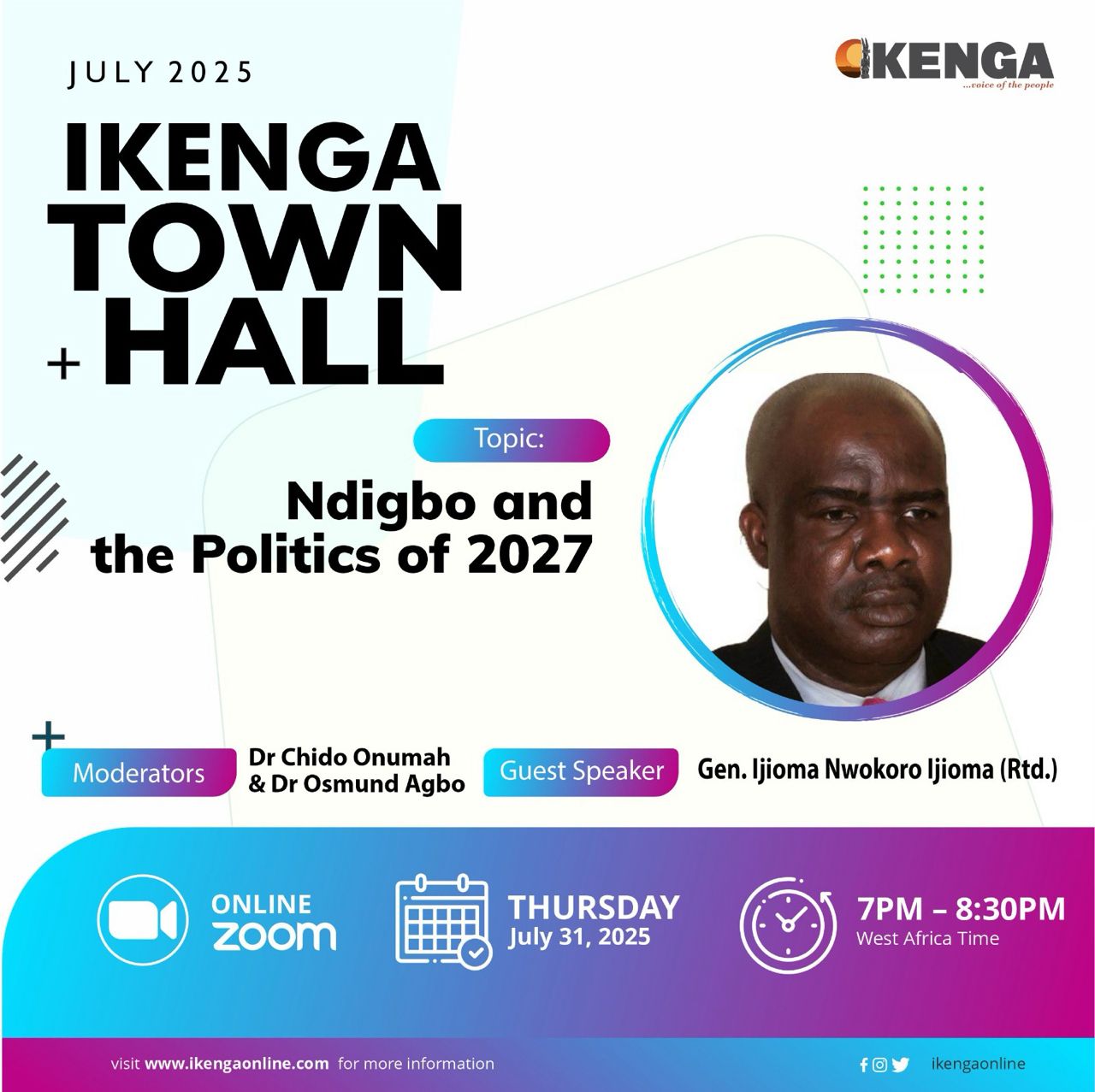
…Slams Igbo political elite for abandoning the people
Stephen Ukandu, Umuahia
Retired Major General Ijioma Nwokoro Ijioma has decried the continued marginalisation of the Igbo in Nigeria, lamenting that 55 years after the end of the Nigeria-Biafra war, the country appears not to have forgiven Ndigbo.
Speaking during the July edition of Ikengaonline town hall meeting on Thursday night, the retired General expressed disappointment over what he described as the deliberate exclusion of the Igbo from national affairs, despite their genuine commitment to reintegration.
“Our people, at the end of the war, wholeheartedly sought reintegration and have done everything possible to show that we are Nigerians,” Gen. Ijioma said.
“But despite these efforts, it seems there is an unspoken agreement among Nigerians that the war never really ended.”
He described the popular post-war slogan, “No victor, no vanquished,” as mere rhetoric, insisting that the treatment meted out to Ndigbo contradicts the message.
“Nigeria is still at war with the Igbo. My 33 and a half years in the Army, rising through the ranks to Major General, convinced me that the rest of Nigeria has not forgiven the Igbo,” he said.
The retired Army officer likened Nigeria to a family where six dwarfs gang up against a giant sibling and take turns to suppress him, drawing from a metaphor he used in his Master’s thesis at the University of Ibadan.
“For Ndigbo to reinvent themselves, they must unite and challenge the status quo,” he declared.
Gen. Ijioma questioned why Nigeria continues to sideline the Igbo from presidential leadership, while other regions have had their turn.
“If President Tinubu completes his second term in 2027, that will be eight years for the Yoruba. Add Obasanjo’s eight years and Jonathan’s six years, and Buhari’s eight — that’s 30 years. By 2031, if power returns to the North for another eight years, we’re looking at 38 years of Igbo exclusion from the presidency,” he lamented.
He noted that aside from the brief tenure of Commodore Ebitu Ukiwe as Number 2 during the military era, no Igbo had come close to the presidency.
“This exclusion cuts across all sectors — business, academia, the military. The end of the war impacted every aspect of Igbo life negatively. But it shouldn’t be so,” he said.
Gen. Ijioma argued that the suspicion and fear of Ndigbo by other ethnic groups are unfounded, asserting that the Igbo are the most committed to Nigeria’s unity.
“We fought a war for a just cause. I don’t know why Nigeria is afraid of the Igbo. We are the true Nigerians — in theory and in practice. The development of this country is largely driven by the Igbo. Show me a Hausa or Yoruba man developing Igboland the way we develop other regions,” he challenged.
“In Lagos and across Nigeria, Igbo own property and contribute significantly to the economy. You won’t find such reciprocal development in the South-East. Yet, it is the Igbo who are excluded. Why?”
He blamed the Igbo political elite for the disunity and political weakness of the South-East, urging them to prioritise collective interests over personal ambition.
“Our exclusion is deliberate. It’s a calculated effort. But our vulnerability lies in our division. We must understand that politics is a game of numbers — and we have the numbers,” he said.
Gen. Ijioma traced the political decline of Ndigbo to the emergence of the All Progressives Congress (APC), which he described as the beginning of their woes.
“Look at the five South-East states. When we were united under the PDP, our voice was louder, and we were respected. Now, with APC in two states, PDP struggling in Enugu, Labour in some places, and APGA in Anambra — our strength is diluted, and our voice weakened,” he said.
He referred to 1956–1966 as the golden era for the Igbo in Nigerian politics, lamenting that since then, especially from 2015–2025, the region has been thrown into a political wilderness.
“This recent era is the worst and most shameful period for Ndigbo in Nigerian politics — excluded from party leadership, from the legislature, and from governance in general,” he said.
Looking ahead to 2027, Gen. Ijioma expressed skepticism, warning that unless the South-East unites and re-evaluates its political strategy, it risks continued irrelevance.
“But there is hope,” he said. “Hope lies in self-reflection and in building a united front. We must learn from our political allies while addressing our internal weaknesses.”
He also called for a redefinition of Igbo value systems and political leadership, expressing concern that individuals lacking integrity were being followed and elevated.
“Why do we follow people who lack the moral integrity to lead? When will we stop following leaders just because of what they can put on our table? Our political followership is another major challenge,” he said.
Gen. Ijioma urged the masses to hold their leaders accountable and to realise that politics is more than material gain.
“We are derided in Nigeria today, despite our numbers. I challenge the Igbo; with about 65 million people out of Nigeria’s 200 million, and with marginal support from other regions, we can produce a president in 2027.”
