

Stephen Ukandu, Umuahia
Abia State Government has re-stated its commitment to good governance and social welfare protection, particularly for vulnerable groups.
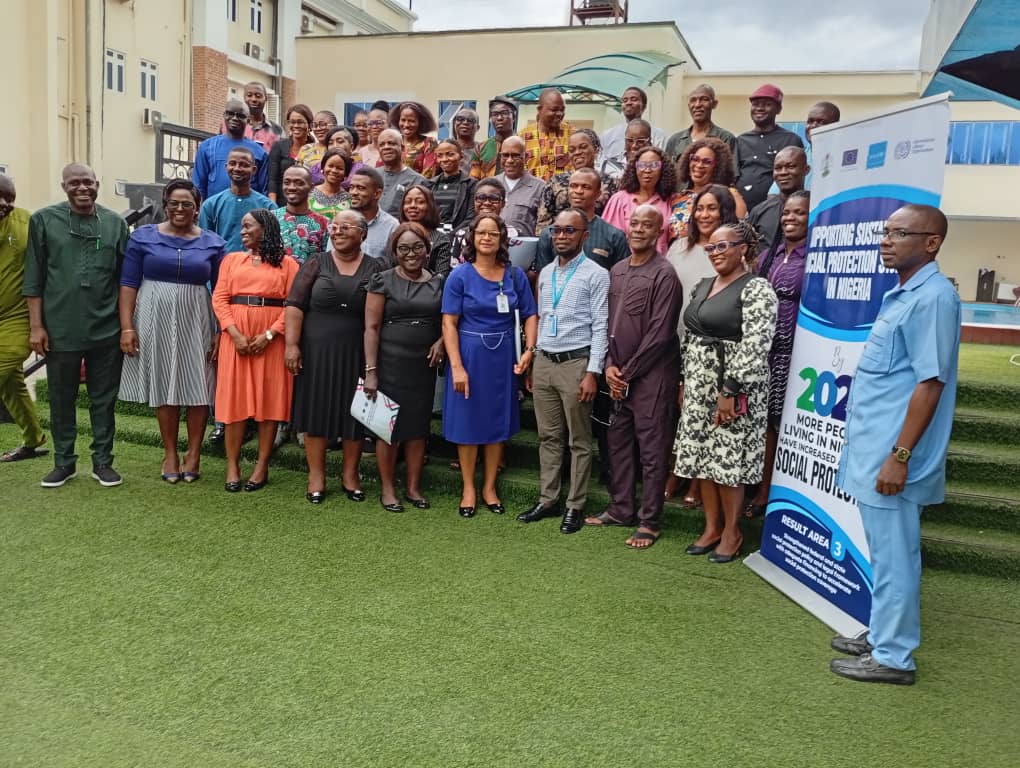
Commissioner for Poverty Alleviation and Social Protection in the state, Mrs. Ngozi Blessings Felix, stated this in Umuahia, the state capital, on Tuesday during a one-day workshop for social protection capacity needs assessment in Nigeria.
The Commissioner, who was represented by Mr. Obinna Uzuegbu, the ministry’s Social Policy Officer and Technical Assistant on Donor-Funded Programmes, said: “Abia is poised to design programmes to advance social protection and effectively implement them.”
She commended the International Labour Organization (ILO), UNICEF, the European Union, and other development stakeholders for their steadfast commitment to strengthening social protection systems across Nigeria.
“Supporting sustainable social protection system in Nigeria (SUSI) is precisely what today’s workshop seeks to address,” the Commissioner said.
Continuing, she said: “I see in this room a rich assembly of policymakers, development partners, civil society actors, and technical experts. Each of you carries a unique role in shaping a social protection system that is inclusive, shock-responsive, and sustainable.”
She urged participants at the workshop, mainly accountants, to engage openly, share knowledge, and commit themselves to the hard but noble task ahead.
“The outcome of this workshop will directly feed into the Supporting Sustainable Social Protection Systems in Nigeria (SUSI) Project, and by extension, into the lives of millions who rely on our decisions for hope and survival.
“May our deliberations today plant the seeds of stronger systems, deeper collaborations, and lasting solutions for our people.”
Speaking also, co-consultant leading the process for the assessment of capacity on social protection in the state for ILO, Dr. Taiwo Benson, said the purpose of the assessment was to understand the capacity gaps in delivering social protection services in Abia State.
He explained that the project is funded by the European Union, while the ILO and UNICEF are facilitating its implementation by identifying the gaps in social protection in the pilot states of Abia, Oyo, Benue, and Sokoto where it is being implemented.
“Before support comes, there is a need to understand the situation of the states in terms of the capacity to provide social protection services. And where there are gaps, the assessment will enable us to develop a capacity development plan that will be used to support the identified gaps.
“We must look at social protection from a life cycle approach in the sense that at one stage in life as an individual, you will need social protection. Because the perception that people have is that social protection is for the poor.
“Everybody, at one stage of their life, needs it. For example, you are retired from the civil service and you are being paid a pension. That is basic income security for your whole life, isn’t it? That is social protection. You get it.
“So, even today you are a permanent secretary and you leave service and you are receiving a pension. That is a form of social protection.
“So, we need to look at social protection from a life cycle approach, from pregnancy to the moment a person dies.”
