

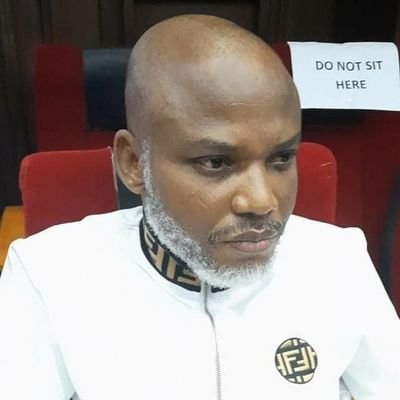
Our Reporter, Abuja
In a ruling that escalates the long-running terrorism trial of Leader of the Indigenous People of Biafra (IPoB), Mazi Nnamdi Kanu, a Federal High Court in Abuja on Friday dismissed his no-case plea, compelling him to mount a defense against charges of treasonable felony and terrorism.
The decision, delivered by Justice James Omotosho, came alongside a directive for the Nigerian Medical Association (NMA) to assemble an independent panel within eight days to evaluate Kanu’s deteriorating health status, addressing mounting concerns over his ability to stand trial.
Kanu, has been held by the Department of State Services (DSS) since his controversial rendition from Kenya in 2021.
The no-case submission, filed by his legal team after the prosecution rested its case in June with testimony from five witnesses, argued that the evidence presented was insufficient to warrant a defense and should lead to an outright dismissal of the seven-count charge sheet. However, Justice Omotosho ruled that the prosecution had established a prima facie case, particularly on allegations of terrorism-related activities, including jumping bail and inciting violence through radio broadcasts.
“The court finds that there is a prima facie case against the defendant,” Omotosho stated, rejecting defense arguments that Kanu’s extraordinary rendition invalidated the court’s jurisdiction. No concrete evidence of such rendition was presented, the judge noted, paving the way for Kanu to open his defense when proceedings resume.
The ruling unfolded against a backdrop of escalating health disputes. Kanu’s lead counsel, Dr. Onyechi Ikpeazu (SAN), had urgently petitioned for his client’s transfer from DSS custody to the National Hospital in Abuja, citing a private consultant’s diagnosis of severe cardiac and neurological issues that had worsened in detention. Professor Martin Aghaji, Kanu’s physician from the University of Nigeria, Nsukka, warned that the conditions required immediate advanced care, potentially abroad, and accused DSS medical facilities of inadequacy.
Prosecutors, led by Chief Adegboyega Awomolo (SAN), countered that Kanu’s ailments were manageable within the DSS hospital, where he had received consistent treatment for four years, and dismissed the transfer request as exaggerated and a potential security risk. Awomolo emphasized the government’s compliance with prior court orders granting Kanu access to external doctors, family, and lawyers.
To resolve the impasse, Justice Omotosho ordered the NMA president to form a panel of 8 to 10 medical experts, including a cardiologist and neurologist, to conduct a thorough assessment. The team is mandated to inspect DSS medical facilities for their capacity to handle Kanu’s needs and may utilize any hospital in Nigeria for tests. The panel’s signed report, due by October 4, will determine Kanu’s fitness to continue the trial, with the next court date set for October 8.
Ikpeazu welcomed the intervention, stating it served “the interest of justice” by ensuring Kanu remained alive to face his charges. However, lawmaker representing Ikwuano/Umuahia North/Umuahia South Federal Constituency in the House of Representatives (Nnamdi Kanu’s constituency), Hon. Obi Aguocha, while speaking to journalists after the court ruling said the Nigerian system seems to have a different standard and laws for Igbos and wondered why Kanu who no evidence has shown he was a terrorist would remain in detention while the government woos known bandits brandishing Ak 47 guns openly in the North.
Supporters of the IPOB leader, who view Mazi Nnamdi Kanu as a political prisoner fighting for Igbo self-determination, have long decried his detention as a human rights violation, with human rights groups like HURIWA previously warning of dire consequences if his health fails.
The case, which has drawn international scrutiny, now enters a critical phase. As Kanu prepares his defense—potentially calling witnesses to challenge the terrorism narrative—the NMA’s findings could either expedite proceedings or trigger further delays.
