

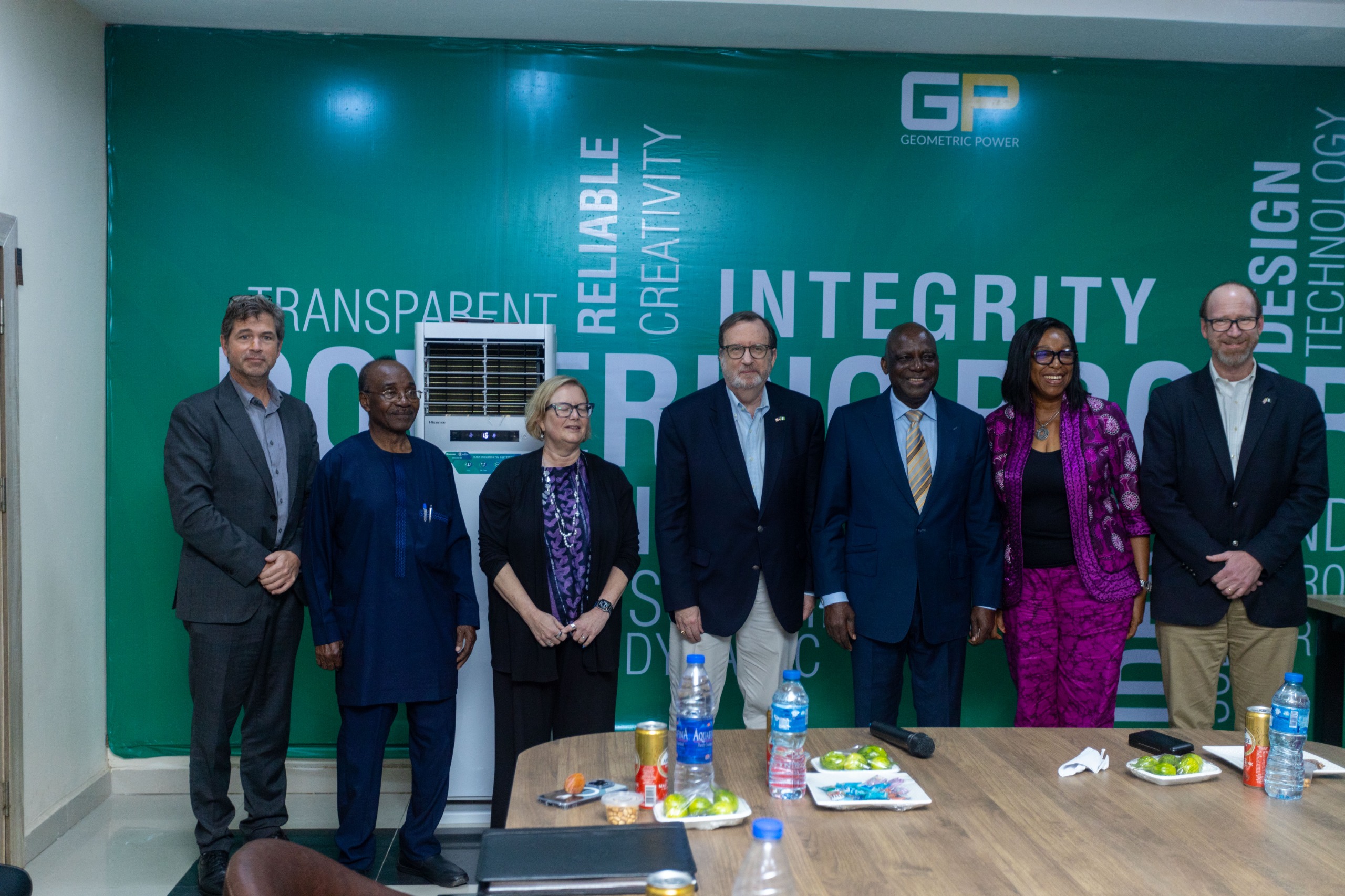
The Aba Independent Power Project, developed by Geometric Power—Nigeria’s only integrated electric power company—has been described as world-class by the United States Ambassador to Nigeria, Richard Mills.
Ambassador Mills gave this assessment on Friday after leading a team of senior American embassy officials on a tour of the company’s facilities in the Osisioma Industrial Layout, Aba, Abia State’s commercial hub.
“This is world-class, reflecting the kind of innovation and commitment needed to address Nigeria’s energy challenges,” Mills said.
The delegation inspected several facilities, including turbines supplied by General Electric, the world’s oldest and largest electricity equipment manufacturer based in the United States.
They also toured Geometric Power’s state-of-the-art digital SCADA facilities, which oversee the distribution and management of electricity across the company’s 30 feeders.
In addition, the visitors were shown the firm’s massive steel tubular poles—similar to those used in San Francisco, California, and Tokyo, Japan, both earthquake-prone cities.
“Although no natural disasters like earthquakes have ever been recorded in the Aba Ring-fenced Area served by Aba Power, which covers nine of Abia’s 17 local government areas, we installed these poles to guarantee uninterrupted power in the event of any unforeseen disaster,” said Professor Bart Nnaji, Geometric Power’s chairman.
Nnaji, a former Minister of Power and globally respected engineering researcher in the United States before returning to Nigeria, further explained that the tubular poles are buried 10 metres deep to withstand extreme conditions. He also disclosed that the company is partnering with international firms to develop new power projects aimed at strengthening Nigeria’s energy security.
Ambassador Mills praised Geometric Power for its end-to-end business model, which makes it the only Nigerian power company that both generates and distributes electricity within a dedicated service area.
“Nigerians are globally known for their creativity and talent,” Mills noted, but regretted that “they often lack the technical training required to maximise opportunities both at home and abroad.”
After listening to a briefing from Geometric Power’s Director of Training and Development, Mills expressed satisfaction with the company’s partnerships with the National Power Training Institute of Nigeria (NAPTIN) and the Industrial Training Fund (ITF) for the training and retraining of its workforce.
“These arrangements make the entire enterprise a sustainable business,” he added.
Members of the ambassador’s delegation included Rick Swart, the U.S. Consul General in Lagos; Mike Ervin, Chief of the Political and Economic Section of the embassy; and Julie McKay, Chief of Public Diplomacy.
