

Our Reporter, New York
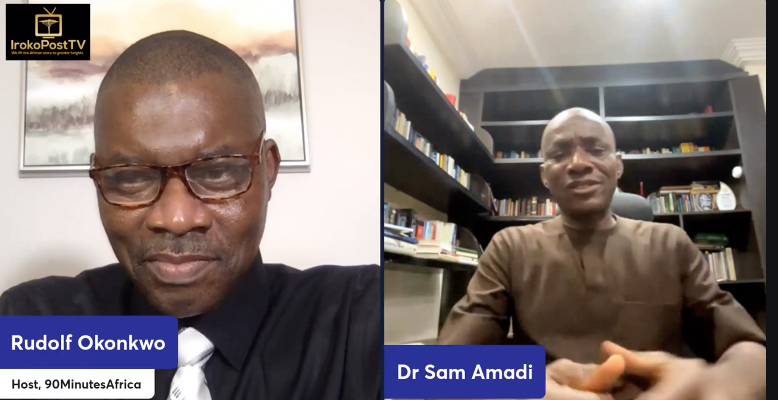
The Director of the Abuja School of Social and Political Thoughts, Dr. Sam Amadi, has said that the ruling All Progressives Congress (APC) is finding it difficult to curtail Peter Obi’s political movement because he does not maintain any political structures that can easily be dismantled.
Dr. Amadi made the remark during an exclusive interview with Rudolf Okonkwo on 90MinutesAfrica.
Speaking on Obi’s impact on Nigeria’s political landscape, the former Chairman of the Nigerian Electricity Regulatory Commission (NERC) described the former Anambra State governor as a politician with a “unique political strength,” which also doubles as his weakness.
“Look at how he runs his campaign. It is difficult for the APC government to stop him because he is everywhere. He has no structure for them to smash. But he also has his own downside,” Amadi said.
According to him, Obi is not the type of politician who can bear the burden of building and sustaining institutions such as political parties, which require enormous time, energy, and resources.
Amadi explained that the Labour Party presidential candidate prefers to operate as a “minimalist,” one who conserves both money and effort. With that disposition, he said, there are certain challenges Obi cannot solve—especially those requiring long-term institutional investments like party formation.
The public commentator also weighed in on the ongoing debate about whether Christians in Nigeria are victims of genocide. He described the situation in northern Nigeria as “state-tolerated and sanctioned mass violence against Christians.”
He traced the origin of this targeted violence to the year 2000, when twelve northern states adopted criminal Sharia law.
“In the year 2000, the twelve northern states became Islamic republics by virtue of enacting criminal Sharia into their laws. So, Nigeria became two republics in one—the Federal Republic, which is secular, and the Islamic Republic. That is why they can kill someone for blasphemy without any consequences,” he said.
Amadi further noted that the Nigerian Constitution guarantees every citizen the freedom to change religion, a right that Sharia law contradicts.
“So, the Nigerian state is toying with inconsistency and contradictions. I see northern Christians becoming more of second-class citizens. Yes, the Nigerian state is guilty and complicit in the sustained violence against northern Christians,” he asserted.
On the economy, Dr. Amadi criticised successive governments for their blind embrace of privatisation, arguing that such policies cannot work in a dysfunctional system.
Using the privatisation of Nigeria’s electricity sector as an example, he recalled advising the administration of former President Goodluck Jonathan to first create a commercially viable power sector before embarking on privatisation.
“I advised the government of President Jonathan to first create a commercially viable electricity sector before gradually moving towards privatisation, but the then Minister of Power insisted on privatisation,” Amadi said.
He noted that countries that successfully developed their power sectors—such as Egypt—did so using public resources before inviting private participation.
“Look at Egypt. They got to 10,000 MW before they began planning to privatise,” he added.
Although the World Bank once rated NERC as the best electricity regulator in Africa, Amadi stressed that regulation alone cannot generate power.
“You don’t build a fanciful regulator without power. We are now regulating a 3,000 MW market with sophisticated regulations,” he said.
