

Ben Ezechime, Enugu
The National Emergency Management Agency (NEMA) has reaffirmed its commitment to reducing delays and addressing identified gaps in emergency preparedness and response across the South-East region.
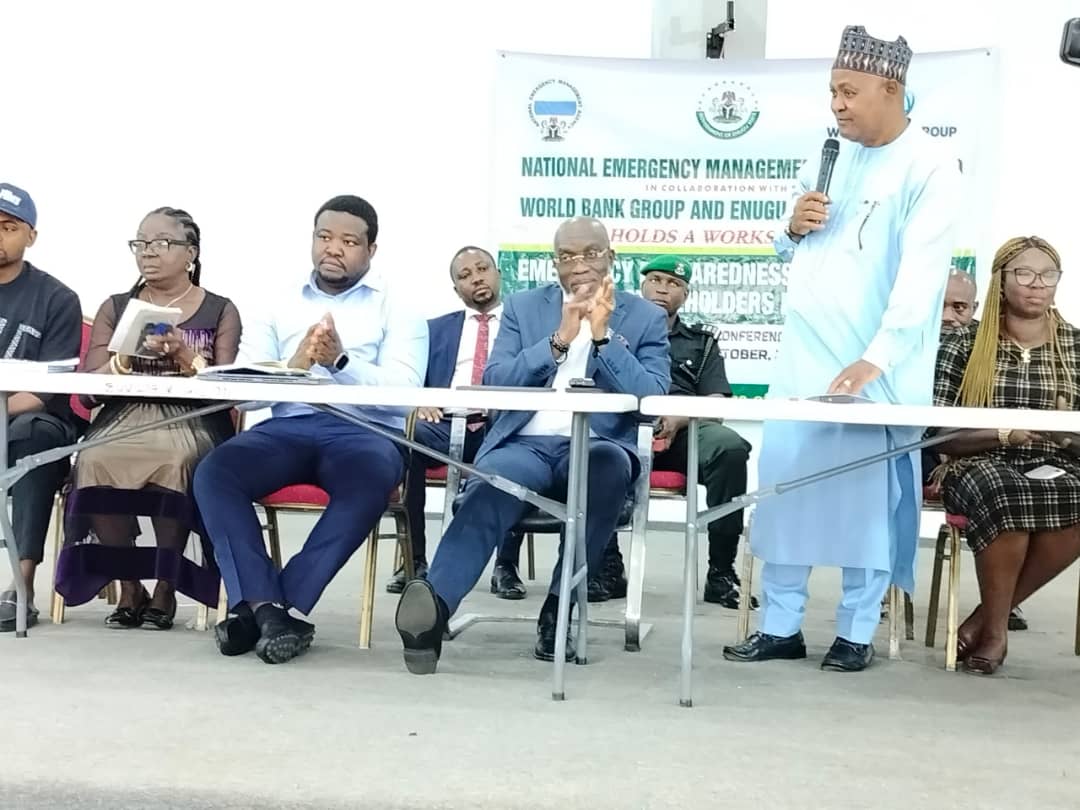
NEMA’s Director-General, Mrs. Zubaida Umar, stated this on Tuesday at the opening of a two-day Emergency Preparedness and Response (EP&R) Stakeholders’ Engagement Workshop held in Enugu. The event was organised by NEMA in collaboration with the World Bank Group and the Enugu State Government.
Represented by the agency’s Director of Planning, Research and Forecasting, Dr. Onimode Bamidele, Umar described the workshop as “the culmination of a far-reaching journey that began months ago,” aimed at strengthening coordination and readiness at sub-national levels.
“Across several locations in the country, we have witnessed the power of collaboration, innovation, and local commitment in strengthening Nigeria’s emergency preparedness and response capacity,” she said.
Umar added that the engagement in Enugu reflected both “reflection and optimism”—reflection on the tangible outcomes achieved through partnerships between NEMA, State Emergency Management Agencies (SEMAs), and the World Bank; and optimism about scaling up the model to other regions.
“Enugu State stands as a strategic and symbolic conclusion to this phase — a state of rich history, civic strength, and a growing commitment to sustainable disaster management systems.
“With the leadership of His Excellency, Dr. Peter Mbah, we are confident the state will consolidate the gains of this project and champion the resilience agenda across the South-East,” she said.
In his remarks, Governor Peter Mbah, represented by the Secretary to the State Government, Prof. Chidiebere Onyia, commended NEMA and its partners for the initiative, describing it as timely and vital to improving disaster management and response mechanisms in Nigeria.
Mbah stressed that disaster response begins at the community level, emphasizing the need to train and retrain first responders at the grassroots.
“The knowledge and resolutions from this workshop will be cascaded down to council areas and communities to ensure they know the right actions to take to safeguard lives and livelihoods,” he said.
“As a government, we are committed to building resilience at every level of disaster management and response for the benefit of all.”
Also speaking, Dr. Oluwaseun Olowoporoku, Urban Specialist at the World Bank, said the institution was committed to supporting the development of a robust EP&R plan through stakeholder inputs.
“These inputs will help close identified gaps in manpower, training, equipment, and legal frameworks — ultimately improving response time and the overall effectiveness of emergency interventions,” he explained.
The workshop brought together officers from the Federal Fire Service, Nigeria Security and Civil Defence Corps (NSCDC), State Emergency Management Agency (SEMA), and Local Emergency Management Committees (LEMCs).
Other participants included focal persons from Water, Sanitation and Hygiene (WASH) units, and representatives from the Ministries of Health, Environment, Gender and Social Protection, as well as members of the media.
