

Emmanuel Michael
In this investigation, Emmanuel Michael uncovers how a routine tenancy dispute spiralled into what whistleblower and architect Joseph Ameh describes as a state-enabled theft. Three years after a controversial court-supervised eviction in Asaba, Ameh is still searching for more than 50 missing household items — including laptops and hard drives containing two decades of architectural work — which disappeared under the watch of court officials. His case, marked by disputed notices, parallel lawsuits, and an inventory riddled with irregularities, exposes alleged collusion and systemic abuse within Delta State’s customary courts, leaving a whistleblower to count losses he says may never be recovered.
A 51-year-old Nigerian architect, Joseph Ameh, who is suffering persecution for his public interest whistleblowing, is still counting the cost of an eviction he says never should have happened.
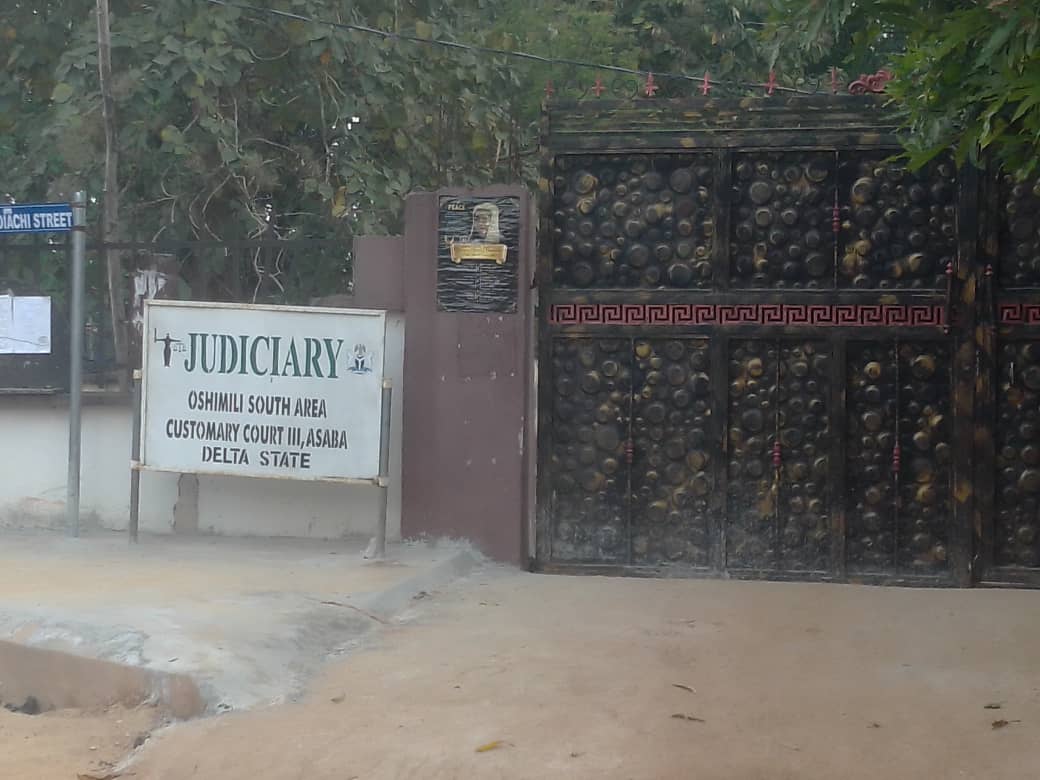
Three years on, Joseph Ameh says the eviction led by bailiff Austin Monye of the Oshimili South Area Customary Court III in Asaba has left him without much of his property.
“I keep hoping for answers, but every day that passes without my laptops, my hard drives, and my appliances feels like a theft under the colour of law,” Mr Ameh told Ikengaonline in November.
On 25 August 2022, while Ameh was in Lagos, he received the fateful call: “You’ve been evicted,” the bailiff said.
When he returned to Asaba the next day, the house was stripped bare. Three of his four laptops were gone. So were six external hard drives containing over 20 years of architectural designs.
His DJ equipment, air conditioners, and generator had also vanished. Dozens of personal belongings were missing too. “It wasn’t an eviction,” he said bitterly. “It was a theft.”

How the tenancy dispute began
The saga began in July 2021, when Mr Ameh moved into No. 5, Professor Egbunike Close, Bonsac, Asaba—a property he had rented in late May 2021. The house, then owned by businessman Friday Okenkwo, needed extensive repairs.
According to Mr Ameh, he reached a verbal agreement with the landlord to refurbish the property before his tenancy officially began, with the understanding that rent would only start after the renovations.
Under this arrangement, he paid in May 2021, but the tenancy was set to run from 1 June 2021 to 31 May 2022, following the completion of renovations.
Mr Lucky Nwali, the property agent who facilitated the rental, confirmed the arrangement.
“I was the agent that helped Mr Ameh secure the house after he contacted me—we were colleagues at the Federal College of Education (Technical) in Asaba,” Mr Nwali told Ikengaonline on Thursday, 4 September.
“We were accompanied by one of my friends to Mr Friday’s house where we paid him in cash but he demanded for his agency fee, which Mr Ameh promised to make a transfer to the following day.”
But barely four months later, Mr Okenkwo sold the house to Uche Okpara Osimiri, whom Mr Ameh describes as “a big-time files dealer.”
According to Mr Ameh, the new owner quickly adopted hostile tactics to force him out—yanking off the entrance gate, cutting power lines, dumping granite stones at the driveway, and using roofing sheets to barricade parts of the property.
Mr Ameh reported the harassment to the state environmental and planning authority, which issued official contravention notices. Ikengaonline confirmed that the notice by the local government was pasted on the property on 19 January 2022.
“Illegal construction of an additional structure attached to the existing building, standing too close to your tenant apartment and thereby completely preventing ventilation and sunlight.
“You are to demolish the said illegal structure, restoring the building to its originally approved state. Relocate all goods (tiles) stored at the side and rear of the premises within fourteen days,” Oshimili South Local Government Environment Department notice declared.
Despite the notice, enforcement never occurred, and the harassment continued unabated, leaving Mr Ameh in a prolonged struggle to secure his legally rented home.
Contested quit notices
Ikengaonline reviewed a quit notice dated 15 December 2021, which Ameh said was not delivered to him until 11 January 2022. Under Nigerian tenancy law, a yearly tenant is entitled to six months’ notice, meaning he could not lawfully be compelled to vacate before 10 July 2022.
Records also show that on 2 June 2022, Mr Osimiri’s lawyer, Dibuike Esuzor, filed a seven-day notice of the owner’s intention to recover possession.
A certified true copy obtained from the Okwe District Customary Court, however, bears irregularities. Mr Ameh alleged that the court chairman, D. O. Oghome, in connivance with Mr Esuzor, altered the filing date to make it appear as though the notice had been filed on 2 July 2022.
He further alleged that the judgement falsely claimed the notice was duly served on him, pointing to the court’s service log where the column for his signature was blank.
“Check the column bearing my name. I did not sign anything because I was not served anything” he asked, showing Ikengaonline pages of the judgement he believes were manipulated.
Mr Ameh also challenged the authenticity of the certified notice, claiming it bore a handwritten annotation suggesting he was served on 8 June 2022—a date he insists is fabricated.
“The seven-day notice certified to me is not clear as to whether it bears June or July; the printed date shows the 2nd. Yet, on top of the notice, someone wrote ‘served 8/6/2022,’ implying I was served on 8 June 2022. I was never actually served. Compare this with the original court copy—it contains no such inscription,” Mr Ameh alleged.
Alleged property looting
In March 2023, Mr Ameh visited Oshimili Area Customary Court III after months of the court’s failure to provide an inventory of his household items seized from his apartment.
Ikengaonline found that on 1 October 2022, Mr Ameh sent a text to then-registrar Christian Ihrieroma, expressing frustration: “Good afternoon Sir. I demanded a copy of the inventory for my household items from the bailiff again today, but he said I have to wait for his OGA. Does he have an OGA I can approach? I am returning to Lagos tomorrow. I have an idea of what is in my house. The last time I demanded the inventory, he said he would type it. Kindly look into this issue, Sir.”

When Mr Ameh finally pressed the court for the inventory, he discovered that more than 50 of his 70 seized items were missing.
This Newspaper reviewed copies of the official inventory that Mr Ameh claimed listed all his properties. Of the three-page document, only two pages bore signatures, while the third page lacked key endorsements and omitted several valuables, including air conditioners.
An audio recording in Igbo reviewed by Ikengaonline, between Mr Ameh and Anyaka Felix Azuka, Assistant Chief Registrar, Area Customary Court III, captured the latter admitting: “We didn’t list everything. That’s why I said write ‘and others.’”
Another recording purportedly captured a court security guard telling Mr Ameh that, “Fear not. Let Oga query us. We will expose the thieves.”
For Mr Ameh, the implication was clear: “A court cannot loot property—it has to be the staff,” he said.

Legal pushback
The dispute was further complicated by overlapping lawsuits. On 20 June 2022, Mr Esuzor filed Suit No. ADCC/216/2022 at the Oshimili District Customary Court.
Court documents show that the landlord claimed ownership of the property and stated that Mr Ameh occupied a three-bedroom flat there. The tenancy had been determined by a notice to quit dated 1st December 2021, and Mr Ameh had paid Three Hundred Thousand Naira (N300,000) for 12 months.
Mr Osimiri said he no longer wanted Mr Ameh on the premises and intended to use the compound as a warehouse.
He also noted that various statutory notices had been served, but Mr Ameh refused to vacate, instead locking up the apartment with his belongings inside.
The landlord sought recovery of possession of the flat by lawful means and claimed mesne profit of Twenty-Five Thousand Naira (N25,000) from 1st January 2022 until Mr Ameh vacated the premises.
Barely a month later, on 18 July 2022, Mr Esuzor filed a second suit—Suit No. OSACC3/10/2022—at the Oshimili South Area Customary Court III, seeking Mr Ameh’s eviction.
Mr Ameh alleged he was never summoned or served any court documents for the second case.
He noted that he had already appeared in court on 10 August 2022, with the matter adjourned to 27 September 2022 for the constitution of hearing and cross-examination.
Despite this, the Oshimili South Area Court III proceeded with the eviction on 25 August 2022, even before the first case was concluded.
On 9 September 2022, Mr Ameh’s lawyer filed a motion to set aside the eviction, arguing that the judgement had been obtained by fraud and that pursuing a parallel case amounted to an abuse of process.
The court delayed nearly a year before ruling on the motion on 31 July 2023, yet it refused to restore Mr Ameh’s property. It took another nine months before the case file was forwarded for appeal.
Frustrated by the drawn-out process and mounting legal costs—over N400,000 in fees and travel—Mr Ameh withdrew his appeal in September 2024, saying the delays appeared deliberately designed to wear him down.
Official responses
When Ikengaonline contacted him on 21 June and 11 August, Mr Azuka said the court premises were “open for investigation” but declined further comments.
Mr Monye ignored repeated calls and messages from 21 June to 4 September.
Mr Ihrieroma, who executed the eviction order before being transferred from the Oshimili Area Customary Court III, denied involvement.
“Before my posting, there was no report of vandalism or missing items,” he told Ikengaonline on 21 June.
Also on 21 June, the Delta State Attorney-General Ekemejero Ohwovoriole, who is a Senior Advocate of Nigeria (SAN) confirmed receiving Mr Ameh’s petition but insisted that only the judiciary could act on the matter, stressing that it remained an independent arm of government.
As of press time, no disciplinary action has been taken.
Not an isolated case
Court-enabled evictions are not new in Nigeria. In 2018, Lagos resident Esther Demola alleged that her landlord forcibly ejected her, carting away goods worth nearly N1 million without valid notice.
Also, the police later confirmed harassment.
Mr Ameh also claims that at least five other tenants in Delta State reported missing property during court-supervised evictions.
Ikengaonline could not independently verify these cases.
Mr Ameh believes his ordeal went beyond a tenancy dispute. He suspects it was an act of revenge.
Years earlier, he had exposed alleged procurement fraud at the Federal College of Education (Technical), Asaba, a case later investigated by the ICPC.
In March 2023, the African Centre for Media and Information Literacy (AFRICMIL) petitioned the President of the Customary Court of Appeal over irregularities in Mr Ameh’s case.
But in a 7 April memo, Bridget Ojeikere, a registrar of the Customary Court of Appeal responded that Mr Ameh had already collected all his belongings, with only nine items unaccounted for.
However, according to Mr Ameh, that is not true.
“First, the Customary Court of Appeal admitted that nine items were stolen but this is not true.
“When I came to collect my property and realised that several items had been stolen, the registrar called me into his office and dictated to me what to write. When he was done, I asked him about the missing items. He asked me to list the items. After listing up to item no. 8, he asked me to just write “AND OTHERS,” adding that we shall continue the listing subsequently.
To be honest with you, I recorded this process.”
Committee of Investigation
Mr Ameh said a committee was set up on October 8 to determine what happened to his missing property in the custody of the court.
“During the committee hearing, the actual inventory of items stolen and not released to me surfaced. I demanded a copy but the deputy registrar of the customary court of appeal asked me to apply for it to be released the same day, since it is an official document. After many months, they released a messed up copy of the inventory to me,” he told Ikengaonline.
According to Mr Ameh, “The inventory submitted to the chief registrar of customary court of appeal when the registrar Mr. Azuka & the bailiff, Austin Monye, were queried upon my official complaint to the president of the customary court of appeal shows that only eight items were released to me out of the 54 items listed in the inventory. This record surfaced during the committee hearing ordered by the president of the customary court. The inventory list was inside the case file but Mr. Anyanka Azuka had gone behind to tick the list in the Area Customary Court III to indicate that the entire items have been collected except nine items.”
He said the inventory is a three-page document. Pages one and two were endorsed by the bailiff, the plaintiff and the police detailed to enforce the execution. But curiously, page three was not endorsed by anybody.
“They kept it open because the list of my property removed from my house did not end there. There are subsequent pages containing items that they did not list, rather, stolen right at my house before they continued the stealing at the court premises,” Mr Ameh alleged.
Mr Ameh also said that on the day of the hearing, the committee members tried to persuade him to forgo the missing items.
“On this day of the hearing, they pleaded that I should forgo most of my property because they are sure the registrar has no money to pay for them. We concluded that they should pay for 20 items that I selected and I was asked to conduct a market survey so they can make payment for those items. I did all of that and gave feedback to the President of the customary court of appeal. But I never got a reply from them.”
ICPC Intervention
ICPC took up the matter, but they refused to allow me to tender further evidence. I have been calling on them to follow up on the matter of retrieval of the inventory from the President and chief registrar of the customary court of appeal but they also refused.
“This case destroyed my career”
Nearly three years on, Mr Ameh says the case wiped out his career, erasing two decades of designs and projects stored on the missing hard drives.
For Mr Ameh, the tragedy was not just personal loss but what he called a betrayal by the judiciary itself—an institution meant to protect rights, now accused of enabling theft.
