

By Promise Adiele
It happened on 18 January 2026, under the humid atmosphere of a North African evening. The venue was the Prince Moulay Abdellah Stadium in Rabat, Morocco. That day, the invigorating winds of West Africa, carried by Senegal, intricately clasped with the scents of the flora and fauna of North Africa, conveyed by Morocco. That day, the global soccer ecosystem converged in Rabat for a reason – to witness the winner of the 2025 African ultimate soccer prize. It was an evening contrived by men but destined by the gods. That day, magic and miracle coalesced in an infinite embrace. While men orchestrated magic, divine authorities engineered a miracle. In the end, miracle triumphed. It defied logic beyond the grasp of sublunary minds. Senegal won. Morocco lost. Thus, the curtain on the 35th edition of the African Cup of Nations was finally drawn. It sparked jubilation. It provoked angst. While the streets of Dakar witnessed uncontrolled frenzy, the streets of Rabat were engulfed in despair. It was a perfect example of the dialectics of contraries. But in its wake were arguments and controversies. Yet, oceans continued to border Africa, unperturbed by the soccer realities of the continent.
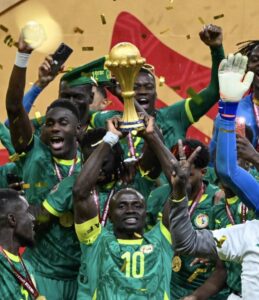 The epigrammatic opening above underscores the multiple emotions that captured the whole of Africa and indeed the world following the final of the 35th African Cup of Nations held in Rabat, Morocco. It was an unforgettable sports festival with mixed emotions. After the final whistle, it seemed the contest had not ended. Consequences were still being expected. New developments were also being expected. Perhaps, only part one had ended. In the immediate, Senegal, the country of Leopold Sedar Senghor, is Africa’s soccer champions. In Nigeria, millions of people supported Senegal against Morocco for obvious reasons. It was Morocco that knocked Nigeria’s Super Eagles out of the competition in the most bizarre way. The officiating was horrendous and unforgivable. It was the same scenario when Morocco played Cameroon. Soccer fans were dismayed. Although Morocco played fantastic soccer, the officiating in all their matches left much to be desired. Lovers of the sport concluded that there was a subtle conspiracy by CAF to award the tournament to Morocco as compensation for hosting the sports fiesta. There is no concrete proof of that conspiracy theory, yet it was obvious that Morocco was favoured. But Senegal won. Esau was favoured, but Jacob was blessed.
Many people watch football matches from different perspectives. While some people watch them for entertainment, many others watch them for emotional satisfaction, supporting one team or another. Also, many watch them for ideological affirmation, to understand the complicated designs of humanity. Some people have argued that football is the most accurate metaphor for human existence. According to such people, if you understand football, you understand life. The emotions, twists, turns, decisions, and unexpected ends – all combine to define football. When football fans say “that is football” at the end of a match, it carries with it underlying meanings. Football is not just sports, it is an ideology, a philosophy that encapsulates life. The unpredictability of football is eternal. In 1989, during the Under-20 World Cup semi-final between Nigeria and the Soviet Union held in Dammam, Saudi Arabia, the Soviets raced to a four-goal lead after 58 minutes. Many Nigerians stopped watching the match. To them, it was over. But like life, a football match is never over until it is over. Eventually, Nigeria equalized the four goals and went on to win 5-3 on penalties in what is popularly known as the Dammam Miracle. Many such examples abound. That is the way of football, that is the way of life, full of miracles and unexpected ends.
Beyond all the tensions generated by the AFCON final in Morocco, I was intrigued by the power of protest from an ideological standpoint. Although many people have criticized the Teranga Lions of Senegal for walking off the pitch when the penalty was awarded to Morocco in the dying seconds of the match, I interpreted the situation differently. Senegal was a victim of bad officiating. They had scored a beautiful goal earlier on, but the referee, in all his mischievous intentions and undisclosed objectives, disallowed the goal because a Senegalese had made the most minimal of contacts with Achraf Hakimi, the Moroccan captain. Having lost the ball, Hakimi shamelessly flung himself to the ground and, as expected, the referee blew his whistle. Curiously, there was no VAR review of the action. Senegal felt cheated. To them, it was an injustice against their team, but it was tailored to favour their opponents. It hurt deeply. The world saw it but could do nothing. The injustice stood, upheld and validated by the match officials. The protest of the Senegalese players was mild and muted. And because it was mild and muted, the match continued. Injustice won. But it was not yet over.
A time comes in the lives of people when protest becomes inevitable. Nobel Laureate Wole Soyinka aptly reminds us that “the man dies in all who keep silent in the face of tyranny”. When the referee’s whistle tyrannically disallowed a clean goal scored by Senegal, they remained quiet. At that moment, the man died in all of them. But the death did not last for too long. They all resurrected in the dying moments of the match. A Senegalese defender had clearly pulled back a Moroccan player after a corner kick, stopping him from attacking the ball. The referee did not spot the incident. But the Moroccan Brahim Diaz protested vehemently. He did not give up. Unlike the Senegalese, who did not protest with conviction, Brahim Diaz protested with conviction. The match had gone on seamlessly, and the referee was not bothered. But Brahim Diaz had other ideas. He refused to continue to play and taught Senegal the meaning of protest. He was convinced of his rights and therefore protested. The Senegalese were timid in their protest. They were denied. Brahim Diaz was adamant in his protest. He was rewarded with a penalty. It marked the turning point in the match, and Senegal felt aggrieved.
The Teranga Lions of Senegal immediately borrowed a leaf from Brahim Diaz’s protest. In one accord, they decided to protest what they thought was a case of blatant robbery. They collectively abandoned the match and walked off the pitch. It was a protest in a different dimension. While Brahim Diaz protested on the pitch and almost harassed the referee, the Teranga Lions adopted a different approach – to walk off the pitch to the embarrassment of the officials and organizers of the tournament. The Senegalese players were not protesting that the penalty was a wrong call. Mortar and pestle saw it. It was a clear foul and a penalty. But they were protesting the neat goal they scored, which the referee disallowed. The whole soccer world was stunned by their nature of protest, yet it was a justified protest. Many people who are used to injustice have condemned the Teranga Lions for walking off the pitch. Such people shamelessly argue that the action of the Senegalese team brought African soccer to disrepute. Such arguments elevate idiocy to a different pedestal. The shambolic officiating of the referee did not bring African soccer to disrepute, but the genuine protest from players diminished African soccer. It is an argument held and sustained by victims of acute enslavement.
The instrumentality of protest has accounted for a genuine reconfiguration of social alignments worldwide. Many African countries achieved independence on the heels of protests. The edifice of apartheid in South Africa was dismantled through sustained protests. Government policies that were inimical to the people worldwide have been overturned after violent protests. Increased school fees have been abolished across the world after students’ protests. In Nigeria, the criminal police department, SAR, was abolished after Nigerian youths took to the streets to protest its continued existence. Indeed, protest is an effective tool for dismantling tyranny within obnoxious power centres. The protest by the Teranga Lions of Senegal achieved something profound. Although the penalty was not overturned, the chaos and confusion resulting from the protest sufficiently distressed Brahim Diaz. He panicked and lost the spot kick. The match went into extra-time and the Teranga Lions of Senegal won through a beautiful, incontrovertible goal that left the referee powerless. The goal excavated all the emotions of the biblical expression “thou preparest a table before me in the presence of my enemies.” Those who refuse to protest against injustice, rigged elections, executive rascality by government officials, high government tax, and against criminal deductions by banks will ultimately wear oppression as a badge of honour.
Congratulations to Senegal. All hail the Champions of Africa.
Dr. Promise Adiele is of the Mountain Top University and can be reached at promee01@yahoo.com; X: drpee4.
