

Lawrence Ndubeze, Awka
Fellows of the Anambra Local Government Accountability Fellowship (ALGAF) have been urged to intensify their advocacy efforts to ensure that local governance becomes more inclusive and responsive to citizens’ needs in Anambra State.
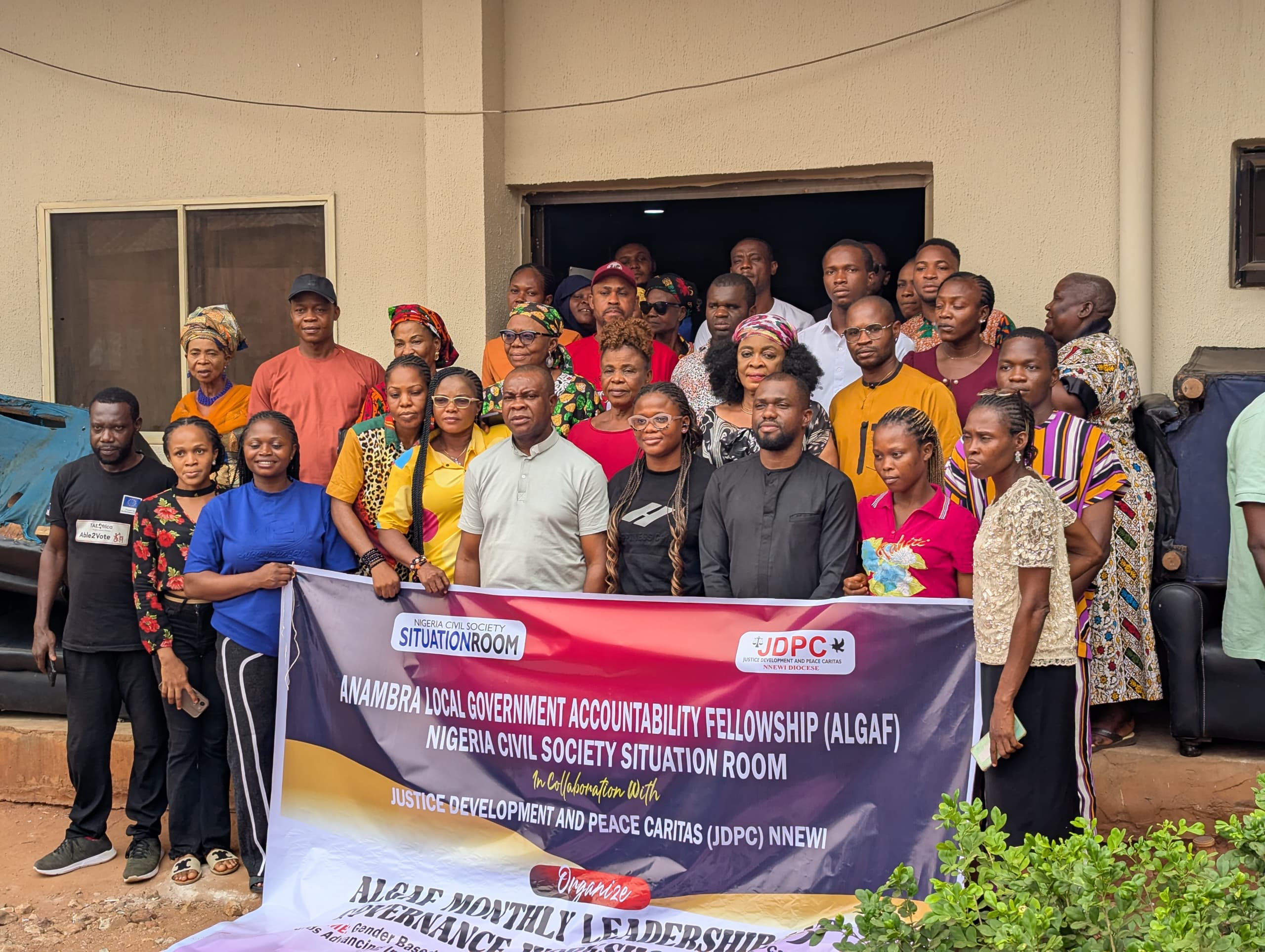
The call was made on Friday during the ALGAF Monthly Leadership and Governance Workshop (MLGW), themed “Gender-Based Violence and Power Mapping for Strategic HDI Advocacy Towards Advancing Inclusive Local Governance at Community Levels in Anambra State.”
ALGAF, a governance fellowship initiative, is implemented in Anambra State by Justice Development and Peace Caritas (JDPC) Nnewi, with technical support from the Nigeria Civil Society Situation Room and funding from the UK Foreign, Commonwealth and Development Office (FCDO).
Declaring the event open, the Director of JDPC Nnewi, Rev. Fr. Benedict Okolo, urged participants to sustain their advocacy for greater inclusivity across political, economic, religious, and other sectors, particularly at the grassroots level.
“Let us continue pushing for more inclusivity in our society—politically, economically, religiously, and otherwise,” he said.
He recalled that JDPC began the project with the careful selection of fellows, followed by strategic training focused on the approaches to be adopted by fellows and coordinators. According to him, the participants also identified key issues in their respective local government areas (LGAs) and undertook courses in research methodology and local government administration.
“We began with the careful selection of fellows, followed by strategic training that addressed the approaches to be adopted by fellows and coordinators. We also strategically identified issues in our LGAs and conducted courses on research methodology and local government administration,” he explained.
He added that other training areas included advocacy strategies, public speaking, persuasive communication, storytelling, policy analysis, social media advocacy, evidence- and rights-based advocacy, disability rights, and legal frameworks, all designed to equip participants with the skills needed to strengthen local governance.
“All these topics have been incorporated into the programme to advance the development of our LGAs. Each Monthly Leadership and Governance Workshop serves as a platform for strategic learning, review of fellows’ approaches and coordination, and increased visibility of issues identified at the local government level. Each session features two resource persons who lead structured and interactive training,” he said.
One of the facilitators, Onyeka Ebenebe, during a session titled “Power Mapping in Advancing Inclusive Local Governance at the Community Level,” reminded participants that addressing local challenges requires a deep understanding of community needs and that meaningful engagement depends on both accessibility and timely action.
In another session titled “Gender, Human Rights and Civic Participation: Advancing Inclusive Local Governance at Community Level in Anambra State,” Eucharia Anekwe urged participants to actively engage local government chairmen and councillors in combating corruption, gender-based violence, and improving governance in their communities.
In his remarks, ALGAF Team Lead, Mr. Onyekachi Ololo, explained that the fellows include local government stakeholders, academics, presidents-general, women leaders, students, persons with disabilities, and members of the Muslim community, among others. He said the objective is to train them to become experts in monitoring local budgets, promoting inclusion, and holding public officials accountable.
“The goal is to make local governments in Anambra more transparent and responsive, ensuring that public funds are prudently managed and communities receive the services they deserve,” he added.
