

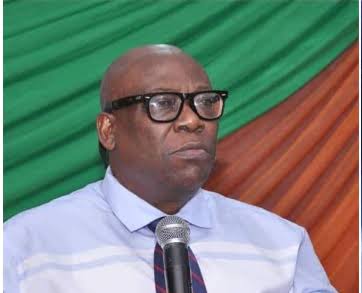
By Richard Akinnola
Reading through the rejoinder of the Russian Embassy to the column of Azu Ishiekwene in the January issue of Ikengaonline, to borrow the phrase of inimitable Patrick Obahiagbon, the “Igodomigodo,” I was “maniacally bewildered.”
The Russian Embassy’s response appears to have missed the point by a wide margin.
Azu, in his usual flowery and didactic prose, had sought to excoriate the modern-day Hitler in the person of Donald Trump, who, in my opinion, exhibits traits of a combination of a sociopath and psychopath.
In his attempt to draw a parallel between Donald Trump and Vladimir Putin, who hitherto had been severally lacerated for his expansionist proclivities in Crimea and Ukraine, Azu had painted Putin in a more saintly light than the tyrant in Washington.
I was therefore at a loss as to what the fuss of a rejoinder by the Russian Embassy was, in an article that seemed to deodorise Putin more than the psychotic occupant of the White House.
The article titled “We Owe Putin an Unreserved Apology” was not, despite its literal reading, a plea on behalf of President Vladimir Putin, nor an exercise in recycling “Western stereotypes” about Russia or its leadership. It was satire, precise, deliberate, and sharply aimed at the US President Donald J. Trump, whose dangerous precedents, words, and actions could normalise bullying in global affairs.
Anyone who reads beyond the headline would see this almost immediately. The column walks readers through an exaggerated, irony-laden comparison in which Trump’s expansionist fantasies, from annexing Canada to seizing Greenland “by any means,” to play-acting regime change in Venezuela, are used to expose the collapse of restraint, logic, and moral consistency in international politics. Putin appears in the piece not as the object of attack, but as a rhetorical mirror, a counterpoint through which Trump’s excesses are laid bare.
Far from excusing Russia’s actions in Ukraine, the article painstakingly restates them: the annexation of Crimea, the full-scale invasion, the staggering human cost of the war, and the absence of any credible justification under international law. These are not glossed over. They are presented plainly, even grimly. The satire lies in the uncomfortable question the article forces the reader to confront: if Trump can openly fantasise about territorial conquest, intimidate allies, ridicule multilateral institutions, and still be indulged, massaged, or excused, on what moral ground does the world stand when it condemns others?
This is not an argument that Putin was “right.” It is an argument that the rules are being shredded selectively, and that Trump’s behaviour accelerates that decay.
Invoking President Putin’s 2007 Munich Security Conference speech does not resolve this contradiction. That speech is well known, widely debated, and frequently cited. But acknowledging its existence does not negate the reality that followed: war, occupation, and immense human suffering. The column does not deny Russia’s grievances; it questions the global system’s growing inability, or unwillingness, to apply its principles consistently, especially when power and ego take centre stage in Washington.
Satire, by its nature, often sounds like praise when it is doing the opposite. Azu’s piece belongs squarely in that tradition. To read it as a straightforward essay is to strip it of context, tone, and intent.
If anything, the article is a warning: when the most powerful leader in the world treats international law as optional and conquest as transactional, he lowers the bar for everyone else. That is neither an attack on Russia nor its defence. It is an indictment of a world drifting back toward a Hobbesian free-for-all, where might increasingly makes right.
Disagreement with this argument is fair. Mischaracterising it is not. A serious conversation about global order, double standards, and the consequences of reckless leadership deserves careful reading, not headline-level reactions.
Akinnola, the Executive Director of the Centre for Free Speech, is a journalist, lawyer and author. He writes from Lagos.
