

Lawrence Ndubeze, Awka
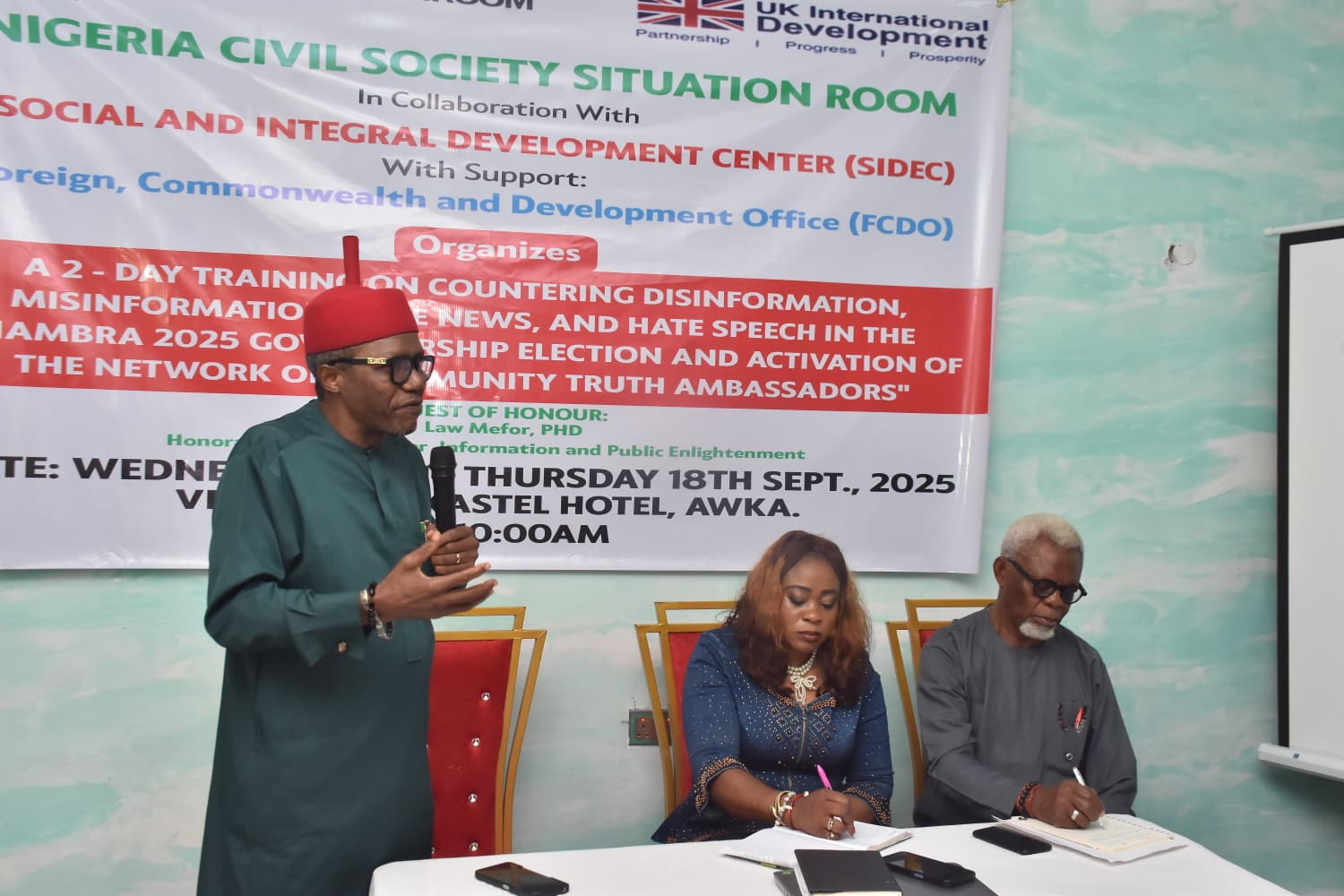
Anambra State Commissioner for Information, Dr. Law Mefor, has called for strong action against purveyors of fake news and hate speech in the state.
Mefor made the call at a 2-day workshop on countering disinformation, misinformation, fake news, and hate speech organized by the Social and Integral Development Centre (SIDEC) in collaboration with the Nigeria Civil Society Situation Room.
Speaking at the workshop, Mefor stressed the importance of verifying information before sharing, stating that spreading false information is a form of criminality that pollutes cyberspace.
He highlighted the potential consequences of fake news, likening lies to a moral sin and a crime that can lead to serious miscalculations and decisions.
“I have never seen where fake news is intended to kill. It is meant to destroy truth, harmony, and everything good. That is what is going on.
“If you go to social media, you will see what we are talking about. You will see the deployment of AI to mimic, satirize, and caricature many people who have gained national and international standing.
“By the time they finish destroying these personalities that are not only iconic but represent Anambra in the center and in the world, how do you want the world to see them when we are done with November 8? There ought to be consequences for such actions.”
The commissioner noted that politics could be played without unleashing hate speech, disinformation, and misinformation, and that clean politics was possible without resorting to such tactics.
He warned that if the trend of spreading fake news and disinformation continued, the November 8 election might not be peaceful, which he added would be unfortunate given its potential to be one of the best elections in the country.
Mefor said timely trials of individuals spreading fake news would serve as a deterrent, ultimately regulating the social media space and promoting a safer online environment.
He urged participants at the workshop to become ambassadors in the quest to clean up the social media space in the state and beyond, adding that the SIDEC workshop was timely due to the existential threats posed by the unruly use of social media.
Earlier, the convener of the workshop and Executive Director of SIDEC, Ugochi Ehiahuruike, described the rampant spread of disinformation, misinformation, fake news, and hate speech as a threat to electoral integrity and governance, stressing that such acts “disproportionately impact vulnerable groups like women, youths, and Persons with Disabilities (PWDs).”
She said the event, supported by the Foreign, Commonwealth and Development Office (FCDO), aimed to nurture community truth ambassadors and grassroots champions poised to fact-check, counter harmful narratives, and foster safer, more inclusive civic spaces, particularly as the state approaches pivotal electoral engagements.
“Through expert-led sessions, hands-on fact-checking practice, role-plays, and collaborative roadmap development, we envision at least 30 participants leaving empowered to detect, report back to the SIDEC secretariat, and combat disinformation.
“We anticipate strengthened digital and media literacy, especially benefiting women and PWDs in markets and communities,” she said.
