

By Nnamdi Elekwachi
What I find increasingly funny these days is how the supporters of today’s government now celebrate state visits. In Nigeria of today, state visits, though part of diplomatic recognition and foreign policy yardstick, are now a measure of performance.
Even Reno Omokri tweeted the recently announced state visit President Bola Tinubu and his wife Oluremi will be embarking on to the Buckingham Palace later in March this year. In the said tweet, and as he is wont to, the influence peddler inset a caricature of Peter Obi, not just for any comical effect but for political baiting and media traffic.
Considering the celebration that greeted the news of Buckingham state visit in the Tinubu camp, one would have thought that what Bayo Onanuga, the president’s aide, said in the state house release was that Nigeria’s debts had been written off or that insecurity had been solved. Conversely, after all is said and done, it will still be the same old scenario where adult governors and ministers leave their states and offices to go and bid farewell to a departing president, a fellow adult, and where the same adults will assemble at the same airport to welcome him back.
Of course, agreements may likely be signed expanding the spheres of cooperation and collaboration. But that’s not where it ends. Always, on the domestic side, there are both political and legal hurdles to scale before agreements become binding – ratification. Even Nigeria has Section 12 in the 1999 constitution, as amended, which prescribed that the National Assembly alone can give treaties or agreements a force of law.
Somehow, Tinubu’s supporters did not know, or deliberately wish not to remember, that Nigeria too has had state visits as the host nation. And I mean hosting dignitaries like serving American presidents, a reigning British monarch and leaders of medium power states on her soil. Even the Pope had visited Nigeria during apostolic and state visits. All these were equally state visits; no less. I am only serving this reminder on those celebrating the news of a state visit, to help them remember that this nation has attracted leaders from virtually all the powerful countries of the world, including those at whose invitation we now issue celebratory press statements one month ahead.
Funnily enough, among the supporters of today’s government, history has equally become a routine, something more serious than a pastime. We are constantly reminded that apart from Tinubu, only three former Nigerian heads of state had been invited to the Buckingham Palace on a state visit in the past, and that Tinubu’s ‘historic visit’ is happening 39 years after Babangida visited in 1989. And you’d nearly bet that the word ‘historic’ itself has acquired a new meaning in the English dictionary.
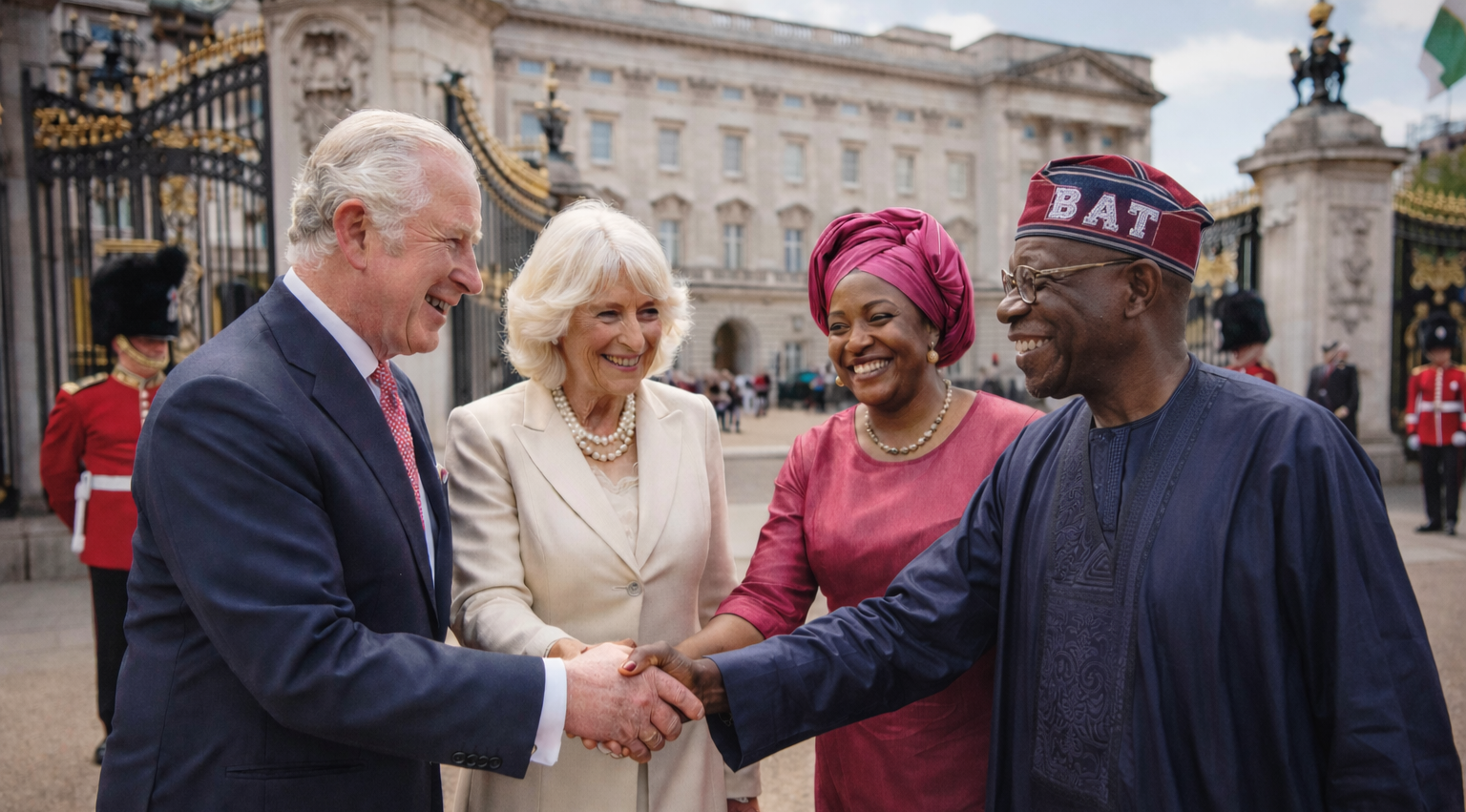
Beyond the optics where leaders are walking on the red carpet, hugging, exchanging warm handshakes, making toast during state banquet in the ballroom, and being shown around the palace and its splendour, a Buckingham state visit should help a nation like Nigeria negotiate or renegotiate bilateral relations on the basis of comparative advantage; a win-win outcome. Some of the state visits to the United Kingdom in the past left a sour taste in the mouths of many Nigerians. The first in 1973 was when Yakubu Gowon committed a crime against the Nigerian state by presenting a 4-00-year-old piece of Benin bronze artwork, to the British monarch. The act itself was described as ‘illegal exportation of a Nigerian artefact’ in one African magazine.
On the other hand, Shagari’s four-day visit to the Buckingham Palace in 1981 was, among other things, Britain’s way of welcoming Nigeria back to democracy after 13 years of military spell. The visit followed a 1980 state visit to the White House by the same Shagari. The visit was about exploring areas and frontiers of cooperation within and outside the Commonwealth, yet it ended with many bilateral agreements being signed.
In 1989, Babangida visited the Buckingham Palace in yet another four-day official visit. Babangida’s visit aimed to normalise relations between the two nations after the Buhari/Idiagbon junta had kidnapped and crated Umar Dikko, Shagari’s ex minister of transport, to be flown back to Nigeria for trials. Perpetrated on British soil by the Nigerian military government with the help of Israeli agents, the aborted illegal deportation ruptured diplomatic relations between the former colonial master and colony, so Babangida’s visit was well understood.
But during his visit, Babangida conferred on the British monarch Nigeria’s highest national honour – the Grand Commander of the Federal Republic, GCFR. One only wonders whether the highest national honour of the land should equally be exported like the piece of artefact lifted from a gallery in Nigeria and presented to the same British monarch sixteen years before. Traditionally, such honours are awarded during national ceremonies and are better received in-person.
Finally, it was when Nigeria returned to civil rule that the Queen visited the country officially for the first time as an independent nation, having missed the 1960 independence celebration during which Princess Alexandra of Kent represented her. Five years or so after the end of her suspension in the organisation, Nigeria was to host the Commonwealth Heads of Government Meeting (CHOGM) in Abuja in 2003 with the Queen in attendance. But before 2003, the Queen had visited the nation, then a British colony, in 1956, in the company of her husband, Prince Philip, during a 20-day visit.
To be honest, a state visit shows that a country is highly regarded by the host nation. In Britain, for example, such visits hardly happen up to four or more times a year. But there are no free riders in international politics. Nations must be strategic in protecting and projecting their core interests. Nigeria and Britain have areas of mutual, strategic, and shared interests. Both are in the British Commonwealth of Nations. Both have people-to-people ties. Both have diverse fronts on which they cooperate, ranging from security, culture, climate and more.
What about climate change? That too may or may not be on the schedule of event or itinerary when Tinubu and his wife Oluremi visit Prince Charles III and Queen Camilla. Part of the release by Bayo Onanuga hinted at talks between Tinubu and Prince Charles III on the sidelines of the COP 28 in Dubai during the UN’s climate conference.
If climate is on the agenda of the Buckingham talks, it shows then that Tinubu is belatedly beginning to commit to climate action or that his awareness of it has increased. I raise this concern because Tinubu is now a regular guest of the Abu Dhabi Sustainability Week, ADSW, a summit where global stakeholders gather to discuss development issues, including climate change problems. This is the same Tinubu who as a presidential candidate of the APC allegorised, using his ‘rat and poisoned chalice’ metaphor to awkwardly answer a question on how he would tackle climate change-induced problems if elected the president!
Beyond treaties, dividends of foreign travels must reflect back home. Recently, data from Govspend.ng, a civic-tech platform created by BudgIT, showed that Tinubu’s foreign trips, including those of his wife and vice president gulped a whooping ₦34 billion of taxpayers’ money in two years during the peak of inflation. The sum, the story continued, represents the actual amount spent converting the naira (NGN) to the dollar (USD) to fund these travels. In addition to putting pressure on the naira, this shows fiscal recklessness. The only difference with the upcoming state visit to the United Kingdom, however, is that the Foreign Commonwealth and Development Office (FCDO) usually covers the cost of expenses like food, accommodations, incidentals and so on during state visits, so the burden isn’t much on Nigerians.
Regardless, Nigerians reserve the right to demand the outcome of these trips because state visits, of course, should have tangible and measurable outcomes. Foreign trips, be they a ‘state visit’, ‘working vacation’, ‘working visit’, whatever name called, should not provide leaders an avenue to escape domestic realities like the incessant security challenge that is not letting up or just to ‘gain global recognition’, apologies to First Lady Oluremi Tinubu.
Global recognition or spotlight is good, but not better than a greater good which caters to the interest and well-being of all Nigerians, which can also be achieved when foreign visits are well explored and harnessed, not when they only exist to offer no meaningful answer to national questions. Like Buhari before him, Tinubu has been touring and travelling the world in search of foreign investors with no visible results yet. If it continues this way, then, Nigerians will be right to conclude that his tours are mere escapist flights.
Lastly, in international relations there is what is known as ‘intermestic factors’. These are issues that have both domestic and international implications, hence the portmanteau ‘intermestic’, a blend of the two English words ‘international’ and ‘domestic’. Climate change, the environment, trade, terrorism and insecurity fall under here. Intermestic approach shows how a nation shapes and projects its foreign policy thrust drawing from domestic issues and how foreign issues are fitted in the domestic environment.
It is somewhat ironic that some of Tinubu’s travels are ‘private’ but last for weeks without him officially transmitting a letter to the National Assembly or handing over to the vice president, as required by the constitution. Tinubu must reduce governance cost by cutting back on his endless tours and embarking only on strategic ones that are more about Nigeria than himself. Else those trips will end up like journeys without purpose.
No government is measured by the mileage covered, but rather by the impacts of policies it initiated.
Nnamdi Elekwachi, Historian and public affairs analyst, wrote from Aba, Abia State.
