

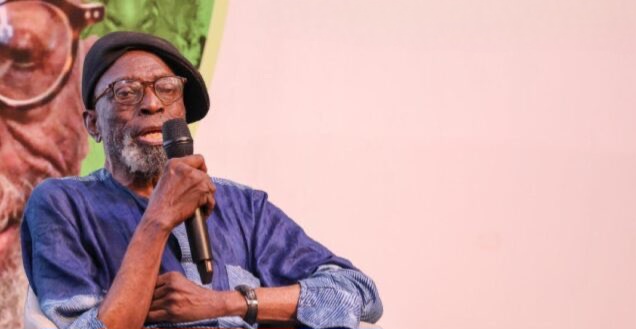
By Sola Adeyemi
Biodun Jeyifo, who has died at the age of 80, was one of the most formidable and beloved figures in African letters: a critic of rare moral clarity, a teacher whose influence spanned continents, a playwright and poet whose creative imagination was inseparable from his political commitments, and a family man whose gentleness at home stood in striking, endearing contrast to the intellectual ferocity he could summon in debate.
His passing marks the end of an era in Nigerian and African literary scholarship, for he belonged to that generation of thinkers who believed that literature mattered not merely as an aesthetic pursuit but as a vital instrument for understanding, challenging and transforming society. In a career that stretched across more than five decades, he helped shape the intellectual architecture of modern African criticism, leaving behind a legacy that will continue to animate classrooms, theatres and scholarly conversations for years to come.
Born on 5 January 1946, in a Nigeria still negotiating the complexities of late colonial rule, Jeyifo came of age at a moment when the country’s cultural and political energies were surging. The ferment of the 1960s and 1970s – independence, civil war, the rise of radical student movements, the flowering of modern African literature – formed the crucible in which his intellectual identity was forged.
He studied at the University of Ibadan, an institution that had already produced some of the continent’s most influential writers and scholars, and where he distinguished himself as the first student in the English Department to earn a first‑class degree; it was also there that he first encountered the ideas that would shape his life’s work: Marxist theory, Yoruba performance traditions, and the conviction that criticism must be accountable to the lived experiences of ordinary people. These commitments would remain constant, even as his thinking evolved and deepened over the decades.
One of the most defining chapters of Jeyifo’s early career was his role in the founding and consolidation of the Academic Staff Union of Universities (ASUU), a union that would become central to the defence of academic freedom and the struggle for better conditions within Nigerian higher education. As one of its pioneering organisers, he helped articulate the union’s intellectual and moral foundations, insisting that the university must serve the public good rather than the whims of military or civilian power.
Those who were there in the early years recall his tireless commitment: travelling the length and breadth of Nigeria in his battered Volkswagen Beetle, visiting campuses large and small, persuading sceptical colleagues, drafting communiqués by candlelight, and building the solidarities that would allow ASUU to withstand decades of political pressure. His leadership was marked by courage, strategic clarity and an unwavering belief that scholars must stand together if they are to defend the integrity of their work. That early labour, which was arduous, often dangerous, and undertaken with characteristic humility, remains one of the cornerstones of his public legacy.
As an essayist and critic, Jeyifo possessed a rare combination of analytical rigour and imaginative sympathy. His writing was marked by a clarity of thought that never descended into dogmatism, and by a generosity of spirit that allowed him to engage seriously with positions he did not share.
He wrote with equal authority about canonical figures such as Wole Soyinka and Ngũgĩ wa Thiong’o, and about lesser‑known playwrights, poets and performers whose work he believed deserved wider attention. His essays were often animated by a sense of urgency, a belief that literature was not a luxury but a necessity in societies grappling with inequality, authoritarianism and the unfinished business of decolonisation. Yet he was never merely polemical; his criticism was grounded in close reading, historical context and a deep respect for the craft of writing.
His contributions to theatre studies were particularly influential. Jeyifo was among the first scholars to articulate a sustained Marxist reading of African drama, arguing that the stage was a site where the contradictions of postcolonial society could be both exposed and imaginatively reconfigured. His work on Yoruba theatre, especially his analyses of the Alarinjo tradition and the popular travelling theatre movement, remains foundational.
He understood that these forms were not simply entertainment but complex cultural systems, rich with political insight and philosophical depth. In his hands, Yoruba performance became a lens through which to examine broader questions of class, power and cultural identity. His scholarship helped legitimise African performance traditions within global academia, ensuring that they were studied with the seriousness they deserved.
Yet Jeyifo was not content to remain an observer. He was also a playwright and poet, and although his creative works were fewer in number than his critical essays, they were marked by the same intellectual ambition and ethical commitment. His plays often grappled with themes of justice, memory and the burdens of history, while his poetry revealed a more intimate, lyrical side, one that those who knew him personally recognised instantly. He wrote with a quiet intensity, attentive to the rhythms of everyday speech and the emotional textures of ordinary life. His creative work was never a retreat from politics; rather, it was another mode through which he explored the complexities of human experience.
As a teacher, Jeyifo was legendary. Generations of students, first, in Nigeria, later in the United States, China and elsewhere, remember him as a mentor who demanded excellence but offered unwavering support. Many of this came out in the tributes celebrating his 80th birthday only a month ago.
He had a gift for making difficult ideas accessible without diluting their complexity, and he encouraged his students to think critically, write boldly and engage the world with intellectual honesty. Many of his former students have gone on to become leading scholars, writers and cultural practitioners in their own right, and they often speak of him with a mixture of reverence and affection. He was, in the best sense, a teacher of teachers.
His relationship with the Nigerian academy of letters was both foundational and transformative. Jeyifo belonged to that small group of scholars who helped define the contours of modern Nigerian literary criticism, and he remained deeply committed to the intellectual life of the country even when his career took him abroad. He was a bridge between generations, connecting the pioneering figures of the post‑independence era with younger scholars seeking to navigate the complexities of the twenty‑first century.
He championed rigorous scholarship, insisted on high standards of evidence and argument, and resisted the temptations of intellectual fashion. Yet he was also open to new ideas, engaging thoughtfully with emerging fields such as postcolonial theory, gender studies and performance studies. His influence on the Nigerian academy was not merely institutional but personal: he nurtured younger scholars, offered guidance with characteristic humility, and modelled a form of intellectual leadership grounded in service rather than self‑promotion.
Jeyifo’s intellectual commitments were inseparable from his political convictions. He was a lifelong advocate for social justice, and he believed that scholars had a responsibility to speak truth to power. His criticism of authoritarian regimes—whether military or civilian—was fearless, and he often paid a personal price for his outspokenness.
Yet he never succumbed to cynicism. He retained a deep faith in the capacity of ordinary people to resist oppression and to imagine more just futures. His Marxism was never doctrinaire; it was rooted in a profound empathy for the struggles of workers, peasants and marginalised communities. He understood that theory must be grounded in lived experience, and he insisted that intellectuals must remain accountable to the people whose lives they sought to analyse.
Despite his formidable public persona, those who knew him well speak of a man of great warmth, humour and tenderness. He was a devoted husband, father and grandfather, and his family was the centre of his life. He approached fatherhood with the same seriousness and joy that he brought to his scholarship, believing that love, like knowledge, required attention, patience and humility. His home was a place of conversation, laughter and books – always books. He delighted in the achievements of his children, both biological and intellectual, and he took pride in their curiosity, their kindness and their independence of mind. Nonetheless, for all his intellectual accomplishments, it was his role as a family man that grounded him, offering a refuge from the demands of public life.
In later years, as he moved between Nigeria and the United States, Jeyifo remained a vital presence in global conversations about African literature and culture. He continued to write, teach and mentor, even as he battled the health challenges that come with age. His mind remained sharp, his curiosity undiminished. He was particularly interested in the new generation of African writers whose work was reshaping the continent’s literary landscape. He read them with enthusiasm, debated them with vigour, and encouraged them with characteristic generosity. He understood that the future of African letters lay in the hands of those willing to challenge old assumptions and imagine new possibilities.
His death on 11 February 2026 at Ibadan, where he was born, has been met with an outpouring of tributes from across the world. Scholars have praised his intellectual courage; writers have celebrated his critical insight; former students have spoken movingly of his mentorship; and theatre practitioners have honoured his contributions to the study of African performance. In Nigeria, his passing has been felt with particular poignancy, for he was not merely a scholar but a custodian of the nation’s cultural memory. His work helped articulate the complexities of Nigerian identity, history and politics, and his voice, clear, principled and humane, was one that many turned to in moments of uncertainty.
What, then, is the legacy of Biodun Jeyifo? It is, first and foremost, a body of scholarship that will continue to shape the study of African literature and theatre for generations. His essays remain models of critical clarity; his analyses of Yoruba performance traditions are indispensable; his writings on Marxism and African drama continue to provoke and inspire. But his legacy is also found in the countless students he taught, the colleagues he supported, the writers he championed, and the institutions he helped strengthen. It is found in the conversations he sparked, the debates he enlivened, and the intellectual communities he nurtured.
Perhaps most importantly, his legacy lies in the example he set: that of a scholar who believed that ideas matter, that criticism must be grounded in ethical commitment, and that intellectual life is inseparable from the pursuit of truth and justice. He showed that it is possible to be rigorous without being rigid, passionate without being dogmatic, and critical without losing sight of the humanity of others. In an age often marked by cynicism and fragmentation, his life stands as a reminder of the power of thought, the importance of integrity, and the enduring value of intellectual generosity.
Biodun Jeyifo is survived by his family and children – Okunola Bamidele, Olalekan (Lek) Babajide, and Ruth Ayoka – who were the source of his deepest joy, and by a global community of scholars, writers and students who will continue to draw inspiration from his work. His passing leaves a void that cannot easily be filled, but his influence endures in the books he wrote, the ideas he championed, the people he mentored, and the cultural traditions he helped illuminate. He lived a life of purpose, conviction and compassion, and the world of African letters is richer for his having been part of it.
In mourning his death, we also celebrate his life: a life dedicated to the pursuit of knowledge, the defence of justice, the nurturing of young minds, and the creation of art that speaks to the deepest truths of human experience. His voice may be silent, but his words remain, resonant and alive, guiding us towards a more thoughtful, more just and more humane future.
Sola Adeyemi sent in this tribute from University of East Anglia, UK.
