

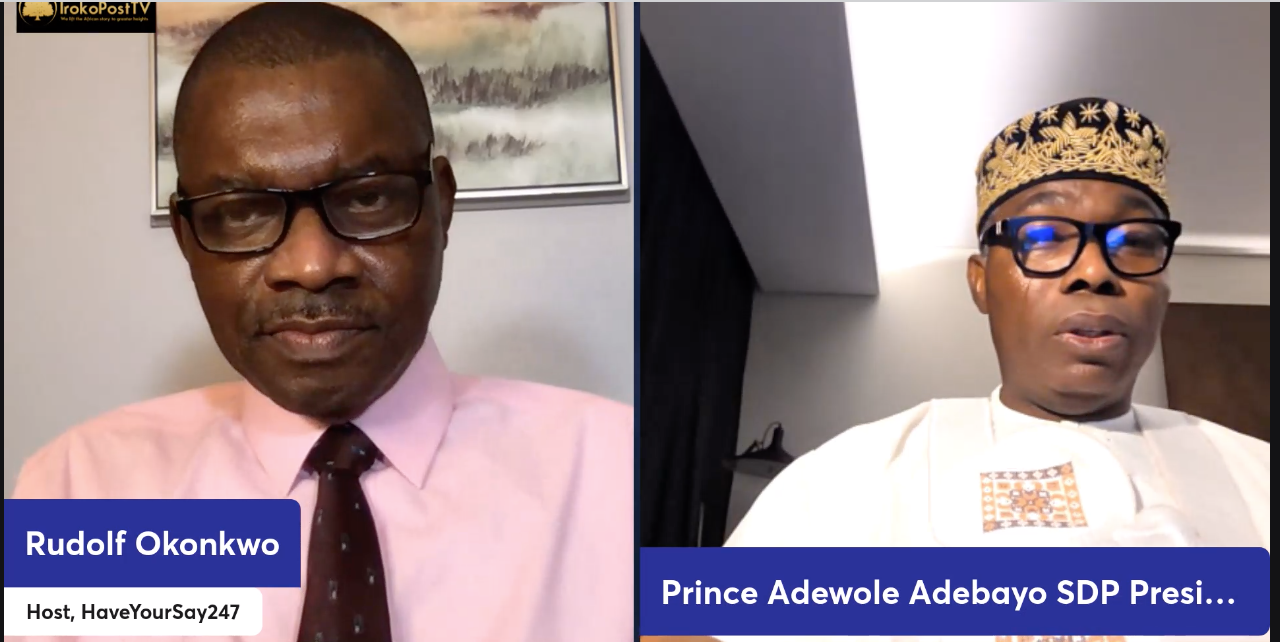
Our Reporter, New York
Prince Adewole Adebayo, the 2023 presidential candidate of the Social Democratic Party (SDP), has dismissed claims that President Bola Ahmed Tinubu’s foreign engagements have attracted $50 billion in investments into Nigeria, describing the assertion as exaggerated and unsupported by evidence.
Adebayo made the remarks during an exclusive interview with Rudolf Okonkwo on 90MinutesAfrica, where he questioned both the credibility of the claim and its supposed impact on the economy.
According to him, an inflow of such magnitude would be impossible to conceal and would have produced visible effects across key economic indicators.
“The statement that President Tinubu’s frequent foreign trips have attracted $50 billion worth of investments into the economy sounds impressive, but the evidence is lacking,” Adebayo said.
The lawyer noted that even major global economies such as the United States, China or Saudi Arabia would regard $50 billion as a substantial inflow. He argued that if such an amount had entered Nigeria, it would have been reflected in the national budget, corporate financing, and the country’s Gross Domestic Product (GDP).
“There is no economy that will receive almost twice its annual budget and the money will not be noticeable,” he said.
“If $50 billion enters the economy, it would double the country’s GDP or, at the very least, add about ten basis points.”
Adebayo said he had reviewed public and private sector budgets, stock exchange listings, bank recapitalisation exercises and public-private partnership (PPP) financing structures, insisting that there was no trace of anything close to the claimed amount.
He suggested that the funds were either yet to materialise or that the government’s claims were grossly inflated. The SDP chieftain accused the administration of lacking credibility, alleging that it relies on what he described as “big lies” in the hope that citizens would be reluctant to challenge them.
“The government should focus on accounting for the monies we are actually generating in the economy,” he said, adding that a significant portion of Nigeria’s wealth remains unaccounted for in official records, a situation he argued is contributing to the country’s shrinking economy.
Beyond the investment claims, Adebayo also criticised what he described as the growing centralisation of power under the Tinubu administration. He alleged that political, administrative, military and economic authority is increasingly being concentrated at the centre.
“This has gone beyond the five leprosy fingers of Abacha that Bola Ige talked about,” he said.
“It is now a black hole where everything has formed into a singularity, and once you enter, there is no escape.”
In a metaphorical remark, Adebayo added that if the President knew “where oxygen is being supplied to Nigeria,” the government would regulate it in a way that restricts access to loyalists, alleging attempts to exert control over institutions including the media, civil society, the clergy and even the electoral process.
